

A sales territory is a specific market segment you assign to a salesperson. Think of it as a dedicated business unit. Your rep is responsible for nurturing the accounts, developing relationships, and driving revenue within those boundaries.
What Is a Sales Territory and Why Should You Care?
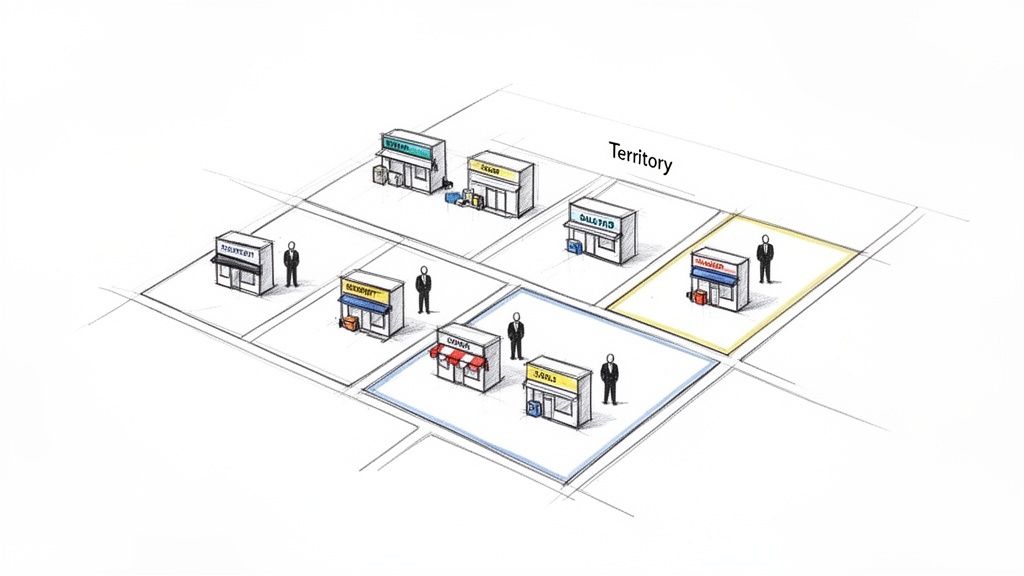
A sales territory is a practical tool for focusing your sales efforts. When you assign a rep to a territory, you give them a defined set of potential customers. They get clear responsibility to generate revenue from that group.
This simple act of setting boundaries creates ownership. When you map territories correctly, you stop reps from fighting over leads. Everyone knows which accounts are theirs. This focus reduces internal conflict and wasted time.
The Real Purpose of Defining Territories
The main goal is to maximize market coverage and make your team more productive. Strategic territory design ensures you don't ignore valuable customer groups.
It also helps each rep develop deep expertise. They build stronger relationships in their patch. They spot opportunities a generalist would miss. A good territory plan is the foundation for hitting your sales targets.
To make this clear, let's break down the components of a well-structured territory.
The Core Components of a Modern Sales Territory
Component | Description | Example |
|---|---|---|
Accounts | The specific companies or customers assigned to a rep. This is the "who." | A list of named enterprise accounts, all healthcare clinics in a region, or all businesses in a specific postal code. |
Geography | The physical area the territory covers. This is the "where." | The Pacific Northwest, the I-95 corridor, or a specific set of city districts. |
Market Potential | An estimate of the total revenue available within the territory. | A territory with 100 potential customers and an average deal size of $5,000 has a potential of $500,000. |
Workload | The effort needed to cover the territory. This includes travel and account management activities. | A dense urban territory might have a low travel workload but a high number of accounts to manage. |
Understanding these parts is the first step toward building territories that are fair and balanced.
A poorly defined territory leads to frustrated reps, unfair quotas, and lost deals. Getting this right is a priority for any sales leader focused on revenue.
Effective territories balance customer density, sales potential, and the real-world effort needed to serve every account. Understanding the role of sales operations is key. This team typically handles the analysis required to build fair and productive territories.
Why You Cannot Afford to Ignore Territory Planning
Poorly designed territories create problems that quietly drain revenue and morale. The most common issue is imbalance. One rep might be swamped with low-value accounts. Another might have a few high-potential prospects.
This imbalance leads to:
Unfair Quotas: Some reps have impossible targets, while others have easy ones. This creates resentment.
Wasted Effort: Salespeople spend too much time on travel or chasing leads that are not a good fit.
Lower Retention: Your best reps get frustrated and leave. Struggling reps can never gain traction.
A thoughtful territory strategy gives every salesperson a fair chance at success. It helps you build a motivated, focused, and productive sales team.
Choosing the Right Sales Territory Model
Deciding how to divide your market is a strategic choice. It dictates your team's focus and their results. The best model fits your product, your customers, and your sales process.
Let's review the four most common models to see which one fits your business.
Geographic Territories
This is the classic field sales model. You draw lines on a map by zip code, city, or country. You assign a rep to each area. This works well if your team needs to meet customers in person.
Consider a company that sells agricultural equipment. A geographic model is a practical fit. A rep in a rural area can efficiently visit farms and attend local trade shows. They become a known person in the community. This workflow cuts down travel time and increases face-to-face selling opportunities.
For B2B sales in a large market like Brazil, this approach is essential. The country's retail landscape is highly concentrated. The Southeast region drives 53.6% of all retail revenues. São Paulo state alone accounts for 27.8% of the national industry's sales. This data, from a USDA report on Brazil's retail sector, shows why you must organize territories to focus on these high-potential zones.
Industry or Vertical Territories
Sometimes, expertise matters more than location. This is where organizing by industry, or "vertical," is useful. Reps are assigned to a specific business sector, regardless of prospect location. This model prioritizes deep industry knowledge.
Imagine you sell a compliance solution for financial firms. A salesperson who understands banking regulations builds trust quickly. They are not just a vendor; they are a credible advisor who speaks the customer's language.
This model turns your salespeople into industry experts. Their credibility leads to shorter sales cycles and higher-value deals.
This approach enables your team to have more relevant conversations from the first call.
Named Account Territories
The named account model focuses on a specific list of companies assigned to each rep. It ignores geography and industry. This is the standard strategy for enterprise sales or any account-based marketing (ABM) plan.
Here, a rep might be responsible for only 5 to 10 large enterprise accounts. Their entire job is to map these organizations and build relationships with key decision-makers. It is a focused, resource-intensive approach designed to win and expand large contracts.
Hybrid Territories
For most companies, a single model does not fit all situations. A hybrid model is often the most practical solution. It blends elements from other structures to match your market's specific needs.
You can be creative with this approach. For example, a company might use a geographic model for its small and medium-sized business (SMB) segment. At the same time, it could deploy a named account strategy for its top 20 enterprise targets.
Another common hybrid approach includes:
Geographic assignments for field reps covering the mid-market.
A dedicated inside sales team organized by industry to handle inbound leads and smaller deals from across all regions.
This flexibility allows you to direct your sales resources where they will have the most impact. Start with your customer and work backward. Design a territory structure that helps your team serve them effectively.
How to Design Fair and Balanced Territories
Designing a sales territory is a strategic exercise. The goal is to balance potential, not just the number of accounts. A fair territory gives every sales rep an equal opportunity to hit their target.
We have all seen imbalanced teams. One rep has too many leads to follow up on. Another waits for the phone to ring. This imbalance hurts team morale and your revenue. Effective sales territory planning solves this. It starts with an honest assessment of your market and your best customers.
This infographic shows the four most common models for structuring sales teams. You can mix and match them to create a balanced plan.
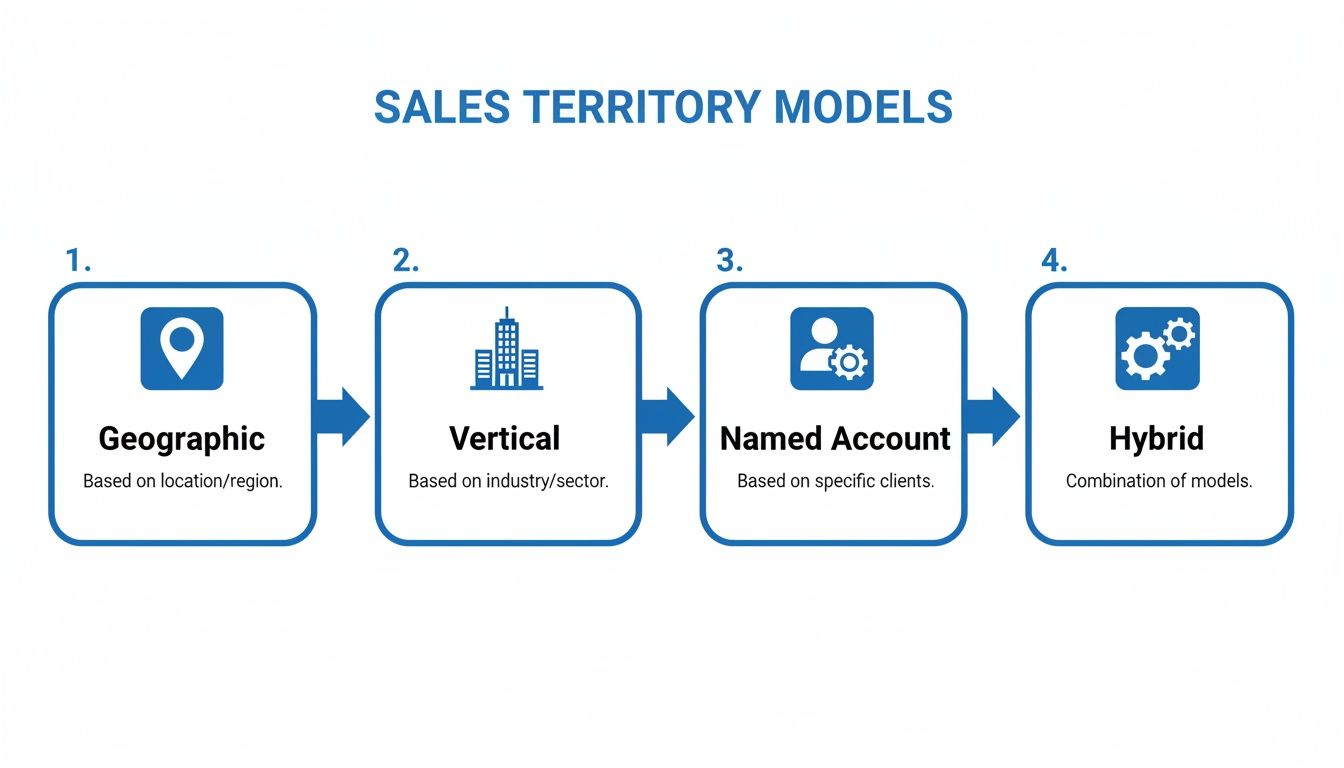
The best territory designs are not rigid. They often blend different models to fit your market and team strengths.
Start with Data, Not Maps
Before you divide territories, you must know who you are selling to. This means defining your Total Addressable Market (TAM) and your Ideal Customer Profile (ICP). A clear ICP guides you to the most promising accounts. If you need help with this, our guide on defining your ICP for B2B sales can assist you.
Once you know what a great customer looks like, use data to estimate workload and opportunity. The goal is to ensure every territory has a similar amount of real opportunity. This is true even if the number of accounts or geography looks different.
The secret to fair territories is not making them identical. It is providing each salesperson with a realistic path to achieve 100% of their quota.
To find that balance, follow this straightforward workflow.
A Three-Step Process for Balanced Territories
Define Your ICP and Score Your Accounts: Analyze your historical sales data. Find the common traits of your best customers. Use this information to create a scoring model for every account in your TAM. This gives you a clear map of where your biggest opportunities are.
Estimate the Total Workload: Workload is more than just account count. Factor in real-world variables like travel time, the number of calls needed to close a deal, and the effort for account management. A territory with 20 high-touch enterprise accounts can be more work than one with 200 low-touch SMBs.
Analyze and Adjust: Overlay your account scores and workload estimates on the market. Historical data shows you what is really happening. For example, recent figures from Brazil showed that retail sales volumes grew 1.8% year-on-year, despite slower growth in some months. This resilience shows that a short-term dip does not always reflect a territory's long-term potential. For teams in a competitive market like São Paulo, tools that automate CRM updates are vital for tracking buyer intent. You can discover more insights about Brazil's economic trends on FitchSolutions.com. Use this type of data to adjust territory boundaries until each one offers a good balance of high potential and manageable work.
Connecting Territory Strategy to Daily Sales Workflows
A well-designed sales territory plan is a good start. But it must connect to the daily work of your sales reps. A strategy's success depends on its execution. That execution relies on reliable, real-time data.
Your CRM should be the center of this operation. It is the record for every account, deal stage, and territory assignment. The problem is that CRMs are hard to keep updated. They often become filled with old information and incomplete notes.
This is where strategy fails. Reps spend hours on manual data entry instead of selling. Managers coach based on guesswork, not facts. So, how do you make your territory plan work in the real world?
From Theory to Reality with Modern Sales Tools
The solution is to automate the flow of information from customer conversations into your CRM. Modern sales tools act as the bridge. They ensure your territory data reflects what is actually happening in the field.
This approach makes your CRM a living map of your sales world. It gives you the information you need to manage performance, find opportunities, and make effective adjustments.
A sales assistant like Samskit automatically joins, records, and transcribes every sales call. It then analyzes the conversation to extract details that are crucial for managing territories.
Accurate Buyer Intent: Is the prospect ready to buy or just looking? The tool identifies real intent. This helps your team focus its energy within a territory.
Key Objections and Risks: What are the common roadblocks in a specific region or vertical? This insight helps you refine your messaging and provide targeted coaching.
Clear Next Steps: Each call summary includes a clear action plan that syncs to the CRM. This ensures promising deals do not get lost.
This screenshot shows how a tool like Samskit captures the key points of a conversation and prepares it for the CRM.
These insights are organized into a clean, structured summary. This eliminates manual data entry and ensures important deal context is never lost.
Giving Reps and Managers Data They Can Actually Use
Automating CRM updates gives your reps back their most valuable asset: time. Instead of spending an hour on data entry after each call, they can focus on the next prospect. Their CRM is updated for them accurately.
For sales managers, this creates a single source of truth for coaching and performance reviews. You can review deal progress based on what the customer actually said, not just a rep's subjective summary.
This data-driven foundation allows you to manage your sales territories proactively. You can see which areas are performing well and which are struggling. This enables you to reallocate resources or provide support where it is needed most. It turns your territory plan from a static document into a dynamic, revenue-driving tool.
The Hidden Costs of Poor Territory Management

Defining territories is one step. Managing what happens within them is the real work. When territory management is poor, the costs are more than just a few lost deals. It can damage your sales culture.
The effects of imbalanced territories build up slowly. You create a team of 'haves' and 'have-nots'. Senior reps may hold on to the best accounts. This leaves new hires with poor prospects and little chance of hitting their targets. This is not just a management issue; it hurts your revenue.
The Human Cost of Imbalance
Consider two reps on the same team. Anna has a territory with many high-potential accounts, but it is also full of demanding, low-value clients. She is swamped and works late to handle service requests. She has no time for new business. Anna is at risk of burnout.
Her teammate, David, has the opposite problem. His territory is quiet. He has a few stable accounts and almost no new leads. He meets his quota but is not challenged. He spends his afternoons updating his resume. One rep is burning out while the other is checking out. Both problems stem from poorly designed territories.
Imbalanced territories create operational and human friction. Team morale suffers, and your best people start to leave.
This inequality destroys trust. It can pit teammates against each other, especially when pay is tied to performance in unbalanced territories.
Market Shifts and Neglected Opportunities
The damage extends to your customers. Poorly managed territories lead to customer churn and revenue gaps. Markets change. A quiet region can become a major opportunity.
Look at Brazil's e-commerce market. It is undergoing a rapid transformation. Projections show the Southeast region will command 56% of all online sales by 2026, while the North will account for just 4%. For any SaaS team selling into this US$346 billion market, failing to align territories with this shift means leaving money on the table. You can find more data on this trend in a detailed analysis from PCMI.
Without a clear, real-time view of what is happening, you are operating without data. You cannot react to market shifts, support struggling reps, or spot growth opportunities. This is why proactive management is so important. It highlights the need for tools that turn raw data into a clear picture of territory performance. This lets you solve small problems before they become big ones.
Got Your Sales Territories Mapped Out? Here's What Comes Next
You have designed your territories and assigned them to your reps. The plan looks good on paper. Now the real work begins. Let's address the questions that come up when the plan meets reality.
How Often Should We Revisit Our Sales Territories?
Your territories are not static. They need regular reviews to remain effective.
As a general rule, plan a comprehensive review at least annually. But don't wait a full year to check for problems. You should review performance metrics quarterly. This helps you spot issues before they become crises.
Certain events require an immediate review. Be ready to act if:
The market shifts, or a new competitor enters your space.
You change your Ideal Customer Profile (ICP).
One territory consistently misses its targets.
Your team size changes.
Real-time data is essential here. It helps you see warning signs early. You can make small adjustments instead of major overhauls later.
What’s the Best Way to Handle a Territory Handoff?
A smooth handoff is about transferring knowledge, not just a list of accounts. A poor transition can lose deals and damage customer relationships. It leaves a new rep feeling unprepared.
When a rep leaves, they must provide a detailed summary for every key account. This summary should include recent conversations, promises made, known risks, and next steps. This is a critical step to protect your revenue.
This process is much easier with a single source of truth. The new rep can have an automated, transcribed history of every customer call in the CRM. They can get up to speed in hours, not weeks. By reviewing past conversations, they can understand a customer's needs and continue the relationship without interruption.
Should I Split a Top Performer’s Territory When They Leave?
When a star performer leaves, the first instinct is often to divide their territory among the team. Avoid this reaction.
A top performer's territory is often successful because of their skill and effort, not just the territory itself. Splitting it up can backfire. You might overwhelm your existing team. This can cause service levels to drop and put valuable accounts at risk.
Instead, use this as a strategic moment. Before you act, ask these questions:
Re-evaluate the Potential: Was the success due to the rep's talent, or is the territory full of untapped opportunity?
Assess the Workload: Can a new hire with the right skills manage this territory as it is?
Think Bigger: Is it better to find a strong replacement for the whole territory? Or should you use this opportunity to realign several territories for better balance across the team?
Rushing to split a high-value territory often creates more problems. Take time to look at the data. Decide what is best for the long-term health of the entire team.
To manage your sales territories effectively, you need a clear view into every customer conversation. Samskit turns these conversations into reliable CRM data and actionable insights. This ensures your territory data is accurate and your handoffs are smooth. See how you can get a true picture of territory performance by visiting Samskit's official website.