When sales teams talk about an Ideal Customer Profile (ICP), they mean a detailed blueprint of the perfect company to buy their product. This is not about individual buyers. It's about the type of organization that gets the most value from your solution, stays a customer longer, and is most profitable for your business.
So, What Exactly Is an Ideal Customer Profile in Sales?
Many sales teams chase any lead that shows a hint of interest. This approach feels productive, but it wastes time and resources on deals that never close. It also leads to signing customers who leave after a few months.
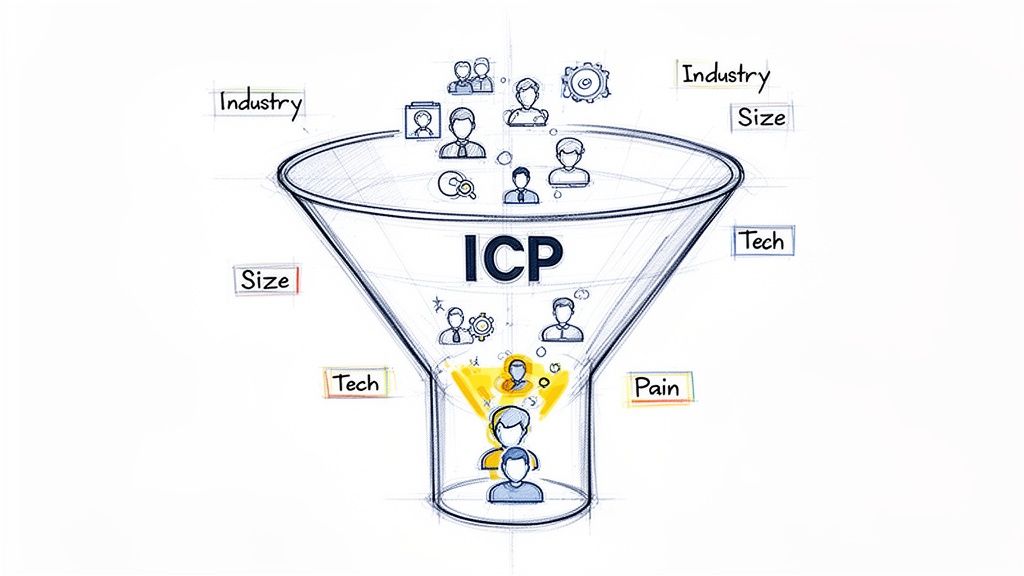
An ICP shifts your focus from quantity to quality. It is a clear, written definition of the company that is a perfect match for what you sell. Think of it as a filter for your entire sales and marketing effort.
It’s More Than Just the Basics
A simple ICP starts with firmographics—basic facts about a company. But a powerful ICP goes deeper. It connects these details to the real-world problems that make a company need your help.
A strong ICP combines:
Firmographics: These are the fundamentals. Include industry, company size (employees and revenue), and location. For example, "B2B SaaS companies in North America with 50-500 employees."
Technographics: This covers the technology they use. Knowing they use a specific CRM like Salesforce or a marketing platform like HubSpot can be a strong signal.
Operational Triggers: These are the internal pains that create a need for your product. Do they struggle with manual data entry? Is their current system failing? Are they trying to scale but hitting a wall?
The goal is to stop guessing who you want to sell to. Instead, use data to define who your best customers actually are. Let facts, not intuition, guide your targeting.
The Real-World Impact of a Sharp ICP
Once you have this blueprint, the guesswork disappears. Your marketing team knows which accounts to target, making their budget more effective. Your Sales Development Representatives (SDRs) can build focused outreach lists and write messages that resonate.
Your Account Executives can qualify opportunities faster. They can focus their energy on deals that have the highest chance of closing and becoming successful, long-term customers.
Defining an ICP has a direct impact on your business. It helps you acquire customers with a higher lifetime value (LTV), lower your customer acquisition costs (CAC), and reduce churn. It is the first step to building a predictable and efficient revenue machine.
Why Your Revenue Team Needs a Data-Backed ICP
Growing a business without a clear Ideal Customer Profile is like navigating a city without a map. You might reach your destination, but you will waste time and energy on wrong turns. For a revenue team, this waste means lost budget, dead-end deals, and customers who leave because they were never a good fit.
A solid, data-backed ICP acts as your company's GPS. It aligns your marketing, sales, and customer success teams. Everyone works toward the same high-value goal. This alignment is the foundation of efficient growth.
A Force Multiplier for Your Entire Go-to-Market Team
When you build an ICP on real data, not gut feelings, your entire revenue engine improves. You replace guesswork with focused actions that produce better results.
Consider how this changes daily work:
Sales Leaders can build forecasts they trust. When the pipeline is full of prospects who match a proven profile, hitting targets becomes about execution, not luck.
Account Executives stop wasting time on leads that go nowhere. They work on pre-qualified opportunities, which frees them to focus on closing deals.
Customer Success Managers find onboarding easier and see more expansion opportunities. Customers who are a great fit from the start understand your product's value faster.
A precise ICP turns sales from a guessing game into a targeted operation. The focus shifts from tracking activity to achieving results that improve the business.
The Tangible Impact on Your Bottom Line
Defining your ICP is not a theoretical exercise. It directly affects your most important metrics. For example, some B2B SaaS companies have seen up to a 68% increase in sales efficiency after honing their ICP. One fintech SaaS provider refined its ICP to focus on specific transaction volumes. This change cut their customer acquisition costs (CAC) by 40% in the first year.
A sharp ICP also shortens your sales cycles. By filtering out poor-fit leads early, your sales team can guide the right deals to a close much faster. This speed is crucial for improving your CAC to Lifetime Value (LTV) ratio. When you land the right customers more efficiently and they stay longer, your profitability increases.
This clarity creates a positive feedback loop across the company, improving your overall marketing and sales strategy.
A Practical Workflow for Building Your ICP
Creating your Ideal Customer Profile does not require data scientists or expensive software. You can start by looking at your current customer base. The goal is to use what has already worked to build a profile for future success.
The process begins by analyzing your existing wins.
Step 1: Identify Your Best Customers
First, make a list of your 10-15 best customers. "Best" does not just mean the ones with the biggest initial contract.
You need a richer definition that points to a strong partnership. Look for customers that have:
High Lifetime Value (LTV): They stay with you, and their contract value may even grow over time.
High Product Adoption: They actively use your solution's core features and get real value from it.
High Satisfaction: They are your champions. They provide positive feedback and would recommend you to others.
These are the customers you want to clone. Once you have this list, you can start digging into what makes them great.
Step 2: Analyse Their Quantitative Data
With your list of top customers, it is time to collect their firmographic and technographic data. Look for common threads that connect them.
You are searching for patterns. Document attributes like their industry, company size (employees and revenue), and the technology they use. Do 70% of them use Salesforce? Are most in the logistics sector with 100-500 employees? These patterns are the building blocks of your ICP.
You can use a simple template to spot these patterns.
ICP Definition Template for Firmographic and Technographic Data
Use this template to gather data from your best customers and find common patterns for your first ICP draft.
Attribute | Customer A | Customer B | Customer C | Common Pattern |
|---|---|---|---|---|
Industry/Vertical | SaaS | FinTech | SaaS | B2B SaaS |
Company Size (Employees) | 250 | 400 | 310 | 200-500 |
Annual Revenue | £20M | £50M | £35M | £20M-£50M |
Geography | UK | UK/EU | UK | UK-based |
Key Technology 1 | HubSpot | HubSpot | HubSpot | HubSpot |
Key Technology 2 | Slack | Slack | Teams | Internal Chat Tool |
Laying out the data like this makes the overlaps clear. These common attributes are the first ingredients of your data-driven ICP.
An ICP starts as a guess but should become an analysis of what actually works. Let your best customers show you who to look for next.
Step 3: Dig Into Qualitative Signals
Finally, go beyond the numbers. The most powerful insights often come from sales and customer success conversations. You need to understand the why behind their decision to buy from you.
Analyze their journey. What specific pain points did they mention in discovery calls? What event triggered their search for a solution? What business outcomes were they trying to achieve? This is where the ICP meaning sales strategy becomes real.
As the image below shows, moving from guesswork to a data-backed ICP directly impacts your business metrics.
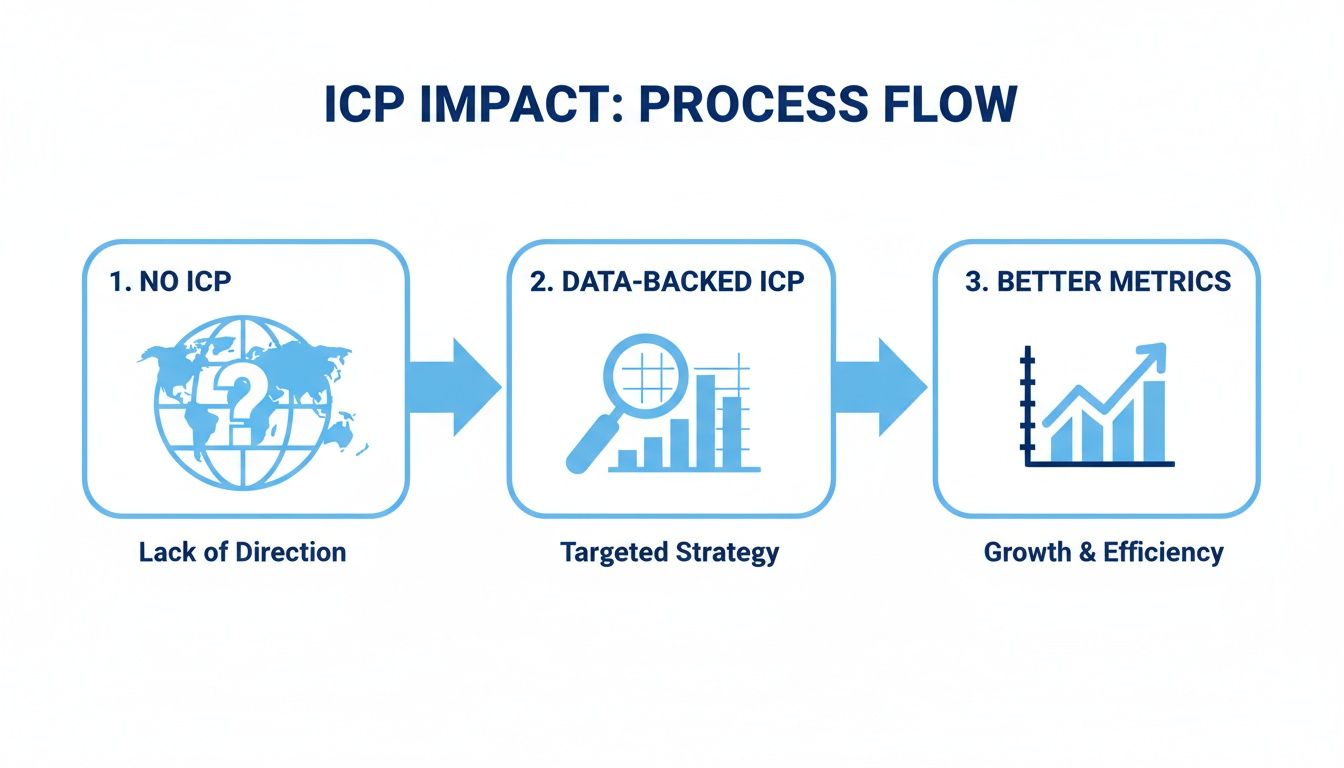
This flow shows the path from a lack of direction to measurable growth, all powered by a clear ICP. When you combine quantitative data (the "what") with qualitative signals (the "why"), you create a solid first draft of your Ideal Customer Profile.
How to Validate Your ICP with Real-World Data
Your first ICP draft is a hypothesis. It is an educated guess based on your best customers. To make it reliable, you must test it against real-world sales conversations.
This process turns your ICP from an idea into a data-driven strategy. The goal is to compare the signals from your best wins with the patterns from your worst losses. The differences will reveal the true qualifying criteria for a perfect-fit customer.
Analyse Your Sales Conversations
Your sales calls contain a wealth of validation data. Every conversation, whether it leads to a signed contract or a "no," is full of clues. Conversation intelligence tools like Samskit can automatically surface these insights, saving you hours of review.
The workflow is straightforward. Review the recordings and transcripts from two different sets of deals over the last six months:
Your Best Wins: Deals that closed smoothly with customers who now use your product successfully.
Your Obvious Losses: Deals you lost, especially where the prospect seemed like a good fit but ultimately did not buy.
Comparing these two groups is where you will find the most valuable insights. You are not just looking at who buys; you are digging into why they buy and why others do not.
Tag and Compare Critical Signals
As you review these calls, tag recurring themes. You are looking for concrete evidence that either supports or challenges your draft ICP.
An ICP starts as a guess but should become an analysis of what actually works. Let your best customers show you who to look for next.
Focus on tagging mentions of business challenges, goals, and blockers. This turns vague feelings into hard data.
Here’s what to look for:
Pain Points: Do your best customers all mention the same problem? For example, if "inaccurate CRM data" appears in 80% of your won deals but only 20% of your lost ones, you have found a powerful qualifying signal.
Budget Discussions: Listen to how they talk about budget. Your best customers might call it an "investment," while lost prospects may have called it a "cost." The language is important.
Competitor Names: Which competitors appear most often in your lost deals? This helps you understand your market position and refine your niche.
Integration Needs: Do your best customers all use a specific CRM like Salesforce or HubSpot? If integration with a certain platform is a theme in your wins, it is a critical part of your technographic profile.
By comparing how often these tags appear in won versus lost deals, you create an objective picture of what matters. This data-backed approach allows you to refine your profile. It ensures your sales team focuses only on opportunities with the highest chance of success. This is also a great foundation for a stronger lead qualification framework.
Activating Your ICP Across the Revenue Funnel
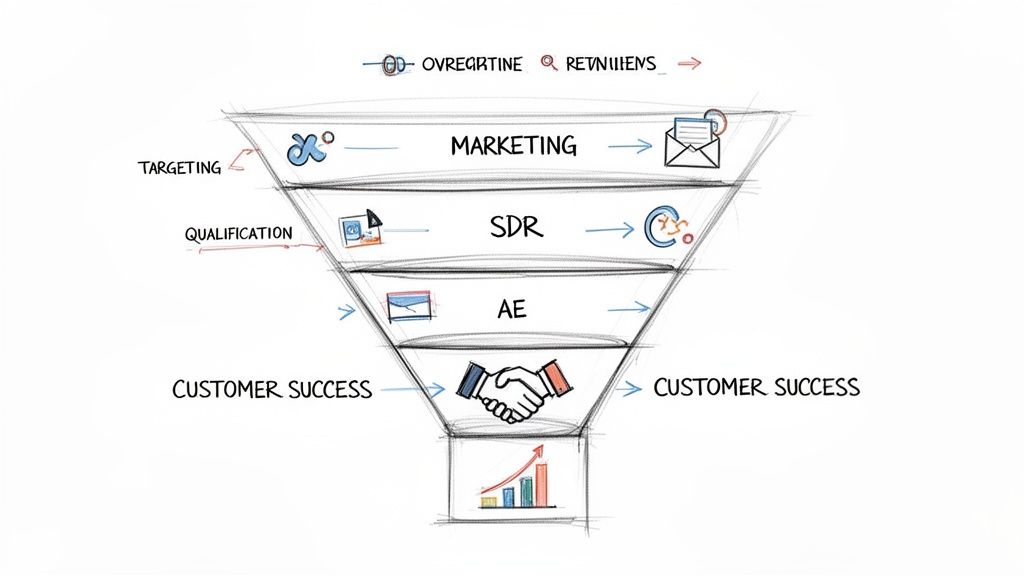
You have built your Ideal Customer Profile. But an ICP on a slide deck does not improve your pipeline. The real value comes when your ICP guides the daily actions of marketing, sales, and customer success.
Think of the ICP as a destination in your GPS. Now, every team must use that destination to plot their course. This approach coordinates your activities and helps generate predictable revenue.
How Marketing Uses the ICP
For the marketing team, a sharp ICP is a filter. It ensures every dollar is spent targeting high-potential accounts. This allows you to move from broad targeting to precision strikes.
Smarter Ad Targeting: Instead of broad campaigns, your team can target companies by size, location, or even the technology they use.
Purpose-Driven Content: Your blog posts and whitepapers can now solve the exact pain points you identified in your ICP research.
High-Intent Keyword Strategy: SEO and SEM efforts become more focused. Marketing can target long-tail keywords that your ideal customers use when they are ready to buy.
How Sales Uses the ICP
Once marketing delivers qualified leads, the sales team takes over. The ICP guides their qualification calls and conversations. This is where an ICP truly empowers a sales team.
An ICP is the ultimate disqualification tool. It gives reps the confidence to say "no" to poor-fit leads early, freeing them to focus on deals they can win.
For Sales Development Representatives (SDRs), the ICP is their guide for prospecting. They can build targeted outreach lists and write personalized messages that address a prospect's specific pains.
For Account Executives (AEs), the ICP should be part of their qualification process. They can quickly check if a prospect matches the attributes of a successful customer. This speeds up sales cycles and increases win rates.
How Customer Success Uses the ICP
The ICP’s role continues after a contract is signed. It gives Customer Success (CS) teams context for onboarding, retention, and expansion. A clear ICP helps CS predict which customers will need more support and which are ready for growth.
Data shows that SaaS firms with operational ICPs see 35% faster sales cycles and 40% reductions in customer acquisition costs. For example, one logistics company targeted e-commerce operators with specific fleet sizes. This led to an 85% retention rate, well above the industry average. You can learn more about how a targeted approach guides product marketing strategies and improves key metrics.
Common Questions About Building Your Sales ICP
Once you understand the theory, practical questions arise. How does an ICP work in a busy sales environment? Let's address some common challenges.
What Is the Difference Between an ICP and a Buyer Persona?
Think of it this way: your Ideal Customer Profile (ICP) identifies the perfect company. Buyer personas identify the key people within that company. The ICP tells you which building to enter; the persona tells you who to meet inside.
Your ICP focuses on the organization:
What is their industry?
What is their revenue or employee count?
What software do they use?
Buyer personas focus on individuals. They map out the goals, frustrations, and responsibilities of the people you sell to, like a Head of Sales or a Sales Ops Manager. You need both to be effective.
How Often Should We Update Our ICP?
An ICP is not a one-time document. Markets change, your product evolves, and your customer base grows. You should review your ICP at least quarterly or semi-annually.
Certain events should also trigger an immediate review:
Launching a new product or major feature.
Entering a new market or industry.
Seeing a significant change in your win-loss data.
Your ICP starts as an aspiration but should quickly become a regression—an analysis of what is actually working based on real data. Continuously capturing customer conversation data makes this a low-effort refinement process rather than a major, disruptive project.
Can We Have More Than One ICP?
Yes, and you probably should if you serve different market segments. For example, a software company might have one ICP for mid-market tech companies and another for enterprise financial firms. Their pain points and buying cycles will be different.
The key is to ensure each ICP is distinct. Do not create five nearly identical profiles. This dilutes your focus. It is better to focus on 2-3 primary ICPs and prioritize your efforts where you have the highest chance of winning.
Stop wasting time chasing context and manually updating your CRM. Samskit is the sales assistant that joins your meetings, extracts critical deal information, and syncs reliable updates directly to your pipeline. See how you can give your sellers more time to focus on what matters—closing deals—by visiting the official Samskit website.