Your Ideal Customer Profile, or ICP, is more than marketing jargon. It is a blueprint of the company that gets the most value from your product. A strong ICP defines the customer who stays long-term and is profitable to serve. This profile is the foundation of any effective icp sales strategy.
What Is an Ideal Customer Profile in Sales?
In sales, an ICP is an actionable guide for your team. It defines your perfect customer.
Think of an architect designing a house. They do not use a generic plan. They work with the family to create a design based on specific needs and budget. Your ICP does the same for your sales team. It stops reps from selling a mansion to a minimalist.
Without a clear ICP, sales teams operate without a map. They chase any lead that shows interest. This scattergun approach wastes time on accounts that will never close. Worse, some of these customers churn a few months after signing. The result is long sales cycles and a burned-out team.
A defined ICP transforms this chaos into a focused operation. It aligns your entire revenue team on high-value accounts ready to buy and succeed.
The Real-World Impact of a Focused ICP
Moving to an ICP-driven model improves business results. When you focus on best-fit accounts, you align the sales process with customer success. This creates a positive ripple effect across the organization.
Here are the expected results:
Shorter Sales Cycles: Conversations flow easily with companies that have the exact problem you solve. You encounter fewer objections because the value is clear from the start. Deals move through the pipeline faster.
Predictable Revenue: Focusing on accounts with a high close probability makes forecasting more accurate. You build a pipeline based on quality, not just quantity.
Improved Team Morale: Winning motivates sales reps. When they speak with qualified prospects who need their help, their effectiveness soars. Higher win rates and bigger commissions boost morale.
Lower Customer Churn: Companies that are a great fit from the beginning are more likely to achieve their goals with your product. This leads to higher satisfaction, loyalty, and customer lifetime value.
An ICP is your sales team's compass. It ensures every email, call, and demo points toward profitable, long-term partnerships. This focus is the core of a successful icp sales motion.
How to Build Your ICP from Real Customer Data
Creating your Ideal Customer Profile is a data-driven process, not a brainstorming session. Ground your icp sales strategy in reality by analyzing your best customers. Stop guessing who your ideal customer could be. Start digging into the facts in your CRM.
The process begins by identifying your top 10% of customers. These are your champions. They provide significant revenue, use support sparingly, and advocate for your brand. They are the accounts you wish you could clone. Once you have this list, it is time to analyze the data.
Gather Your Quantitative Data
Your CRM contains a wealth of hard facts. Run a report on this top customer segment and look for common traits. The goal is to build a data-backed picture of a great account.
Look for patterns in these key areas:
Firmographics: This is the company's DNA. Note their industry, employee count, and annual revenue. You might find that 80% of your best customers are B2B SaaS companies with 50-250 employees. This is a fact, not a guess.
Technographics: What other tools do they use? Knowing their tech stack, such as their use of HubSpot and Salesforce, reveals integration opportunities and operational maturity.
Behavioral Data: How did they find you? What was their journey from lead to customer? How quickly did they implement your solution? This data often points to the most efficient sales paths.
This quantitative analysis provides the "who" and "what" of your ICP. It is the skeleton of your profile. To bring it to life, you must understand the "why." This requires moving beyond numbers to narratives.
This is about refining your sales process. You move from a scattergun approach to a targeted, surgical strike that gets results.
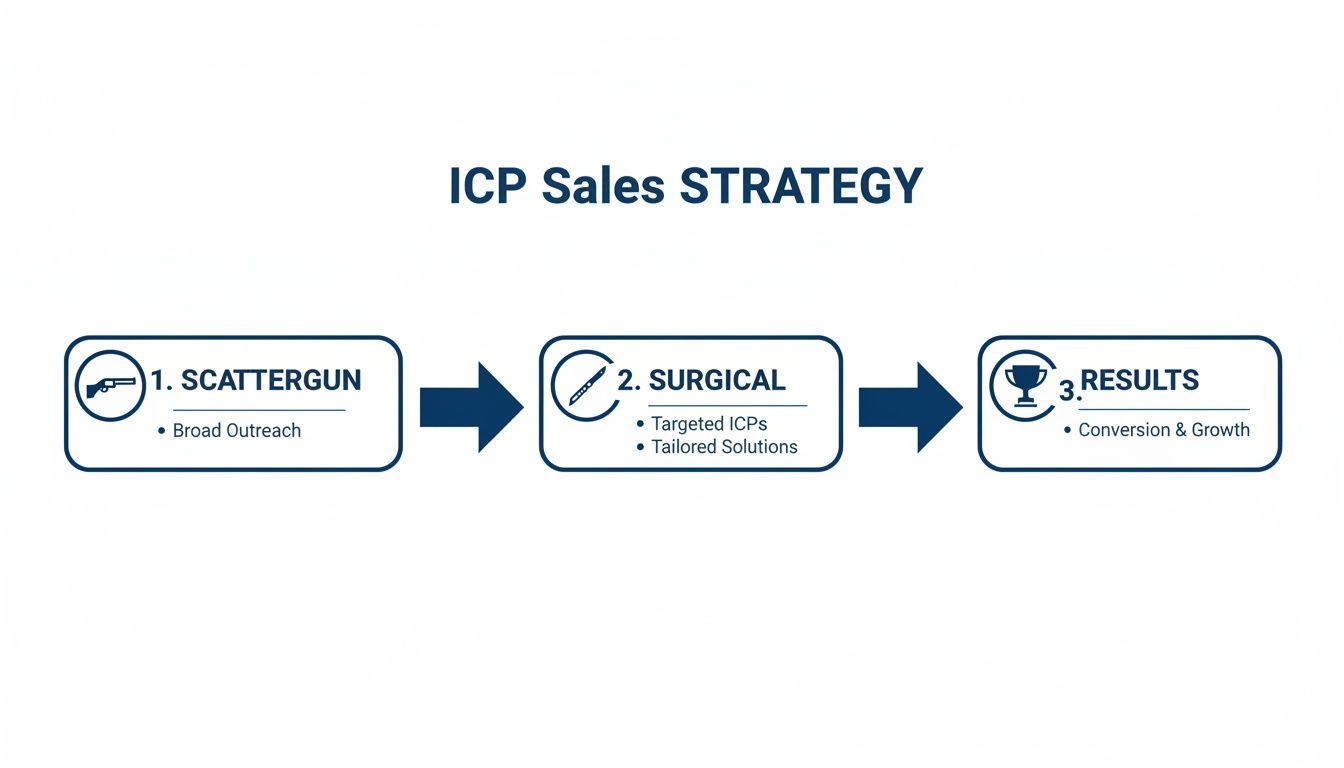
As you can see, shifting from a "scattergun" to a "surgical" mindset is the most direct path to winning more of the right deals.
Uncover the Qualitative Story
With your data organized, it is time to add context. Uncover the human story behind the data points. Your goal is to understand the motivations and frustrations that led these customers to choose you.
Your best customers chose you for a reason. Your job is to find out why and codify it so your sales team can replicate that success.
To do this, go to the source.
Interview Your Best Customers: Schedule 30-minute calls with a few top clients. Ask open-ended questions. "Walk me through what was happening in your business before you sought a solution like ours?" Or, "What is the one problem our product solves that makes your day easier?" Listen for recurring themes and the exact words they use.
Analyze Sales Call Transcripts: Review recorded discovery calls and demos from those closed-won deals. What were their initial pain points? What objections did they raise? A tool like Samskit can automatically highlight key topics, objections, and buyer intent signals from these conversations.
Combining quantitative data with these qualitative insights creates a multi-dimensional ICP. To see how this fits into your broader go-to-market efforts, read our guide on building an effective marketing and sales strategy.
This ICP becomes a living guide for all your daily icp sales activities. It ensures your team always focuses on the opportunities that matter most.
Validate Your ICP Against Real-World Signals
An ICP built on internal data is a hypothesis. It is your best-educated guess. An untested guess can be a liability, pointing your icp sales team in the wrong direction.
You have drawn the battle plan. Now, you must see if it survives contact with the market. The validation step involves a small, focused campaign to test your assumptions under real-world pressure. The goal is to test the theory, not just close deals.
First, build a small, targeted list of prospects who match your new ICP. Then, launch a dedicated outreach sequence. The only goal is to measure every signal you get back.
Run a Focused Prospecting Campaign
You are looking for positive indicators that you have struck a nerve. Does this new, focused approach perform better than your old, broader one? The proof is in the numbers.
Keep a close eye on these specific metrics:
Higher Engagement Rates: Are your email open and reply rates better? This is the first sign your message is landing with the right people.
More Qualified Meetings Booked: The goal is not meeting quantity. It is booking time with prospects who fit the profile and recognize the pain point you solve.
Faster Pipeline Movement: Are these opportunities moving quickly through your sales stages, or are they getting stuck? Fast movement suggests less friction and a stronger product-market fit.
If the data shows a clear lift, you are on the right track. If the results are flat, that is not a failure. It is a sign your ICP needs adjustment. Go back to the drawing board. This feedback loop prevents you from wasting months chasing accounts that will never close.
Analyze Conversations for Deeper Insights
Metrics tell you what is happening. The conversations you have with prospects tell you why. This is where you find qualitative gold.
This dashboard from Samskit shows how you can automatically analyze key topics from your sales calls. Breaking down conversations like this helps you spot recurring themes, pain points, and buying signals that either confirm or challenge your ICP.
Use call intelligence tools to listen for:
Specific Language: Are they describing their problems using the same words you are?
Common Objections: What is their main pushback? This reveals how they perceive value and risk.
Buying Signals: What makes them lean in? Note any mention of budget cycles, new initiatives, or frustrations with competitors.
This data-driven feedback loop transforms your ICP from an idea into a proven model. You are no longer guessing who your best customer is; you are using market signals to prove it.
This cycle of testing and refining ensures your icp sales strategy is always grounded in current market reality, not stale assumptions.
How to Operationalize Your ICP in Daily Sales Workflows
A perfect Ideal Customer Profile is useless if it sits in a document. To impact your icp sales results, the profile must become part of your team's daily habits and tools.
The goal is to make your ICP an active guide, not a dusty document. It should shape how your team prospects, qualifies leads, and crafts messaging. When you do this right, focusing on best-fit accounts becomes the easiest way to work.
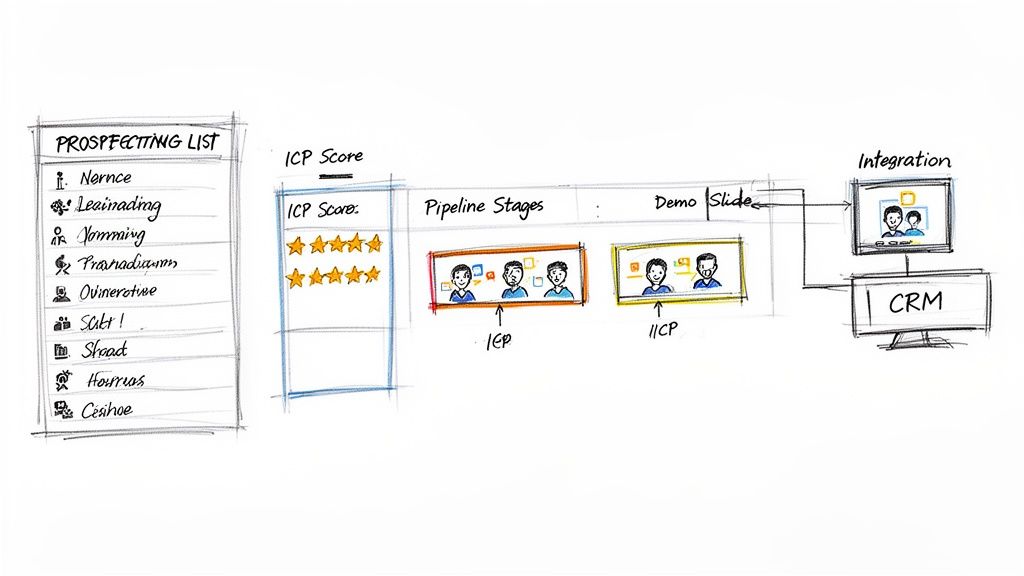
This shift does not happen automatically. It requires redesigning your core sales workflows.
Refine Your Prospecting and Outreach
Generic outreach goes straight to the spam folder. A sharp ICP gives reps the intelligence to build focused lead lists and write messages that get responses. This trades the spray-and-pray approach for surgical precision.
Build Targeted Lists: Turn your ICP firmographics (industry, company size, region) into filters in your sales tools. This step ensures every account your team chases is a potential winner.
Personalize Messaging: Stop using generic lines. Instead, use the pain points you uncovered. Try something like, "I've spoken with several VPs of Sales at Series B SaaS companies struggling with inaccurate forecasting. We help solve that by..."
This turns prospecting from a numbers game into a strategic activity. You prioritize conversation quality over email quantity, which leads to a healthier pipeline.
Automate Qualification and Prioritization
Your CRM should be the home for your ICP. Build your criteria directly into the system to automate qualification and highlight the leads that matter most.
Top-performing sales teams use technology to surface ICP-fit accounts. This guarantees reps spend their time on deals with the highest probability of closing.
Set up an automated lead scoring system. A lead matching your target industry, company size, and key technologies gets a high score. It is then flagged for immediate follow-up. This is a simple but powerful change.
This creates an express lane for your best opportunities. Our guide on effective lead qualification strategies offers more tips. A systematic approach prevents high-potential deals from falling through the cracks.
Tailor Demos and Sales Conversations
Your ICP should guide every sales conversation. A one-size-fits-all product demo is a missed opportunity. Your ICP tells you what a prospect cares about, so you can tailor your narrative to their world.
When talking to an ICP-fit account, focus on the features that solve their specific problems. Skip the parts that do not apply. This shows you have done your homework and understand their business. It builds trust and moves you closer to a signed deal.
By operationalizing your ICP, you create a unified system. Your revenue team rallies around a single definition of a "great" customer. Every action becomes more efficient and effective. This is how you build a predictable and scalable icp sales engine.
Measure the Real Business Impact of Your ICP Strategy
How do you convince leadership that an ICP sales strategy is more than a theory? Show them the results. A well-defined ICP is about generating measurable outcomes that excite the entire company.
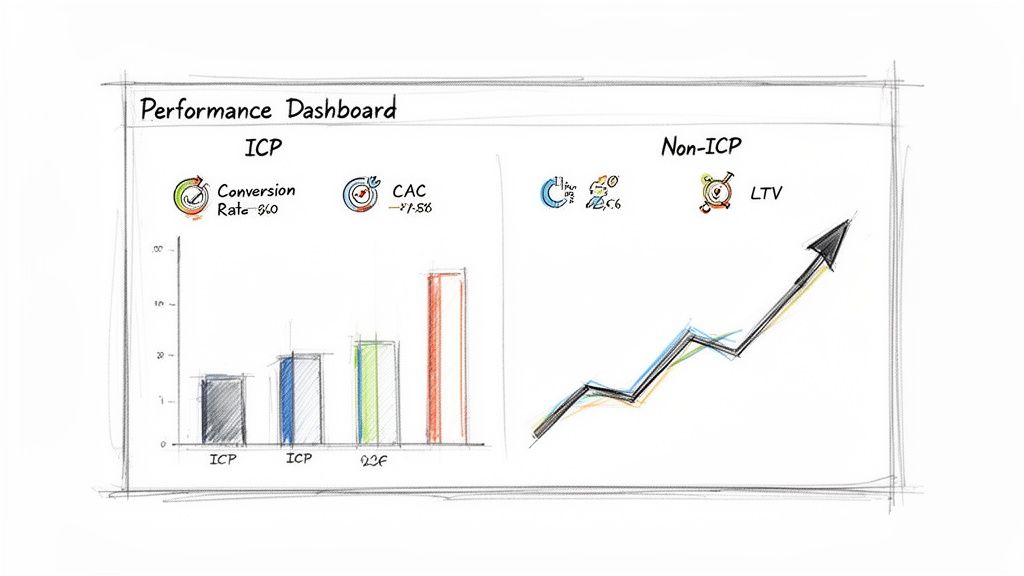
The proof is in the data. Compare how leads inside your ICP perform against those outside it. When you show one group is more profitable and predictable, the case for focus makes itself. This proves that selling to a smaller, more qualified audience is the fastest way to build a scalable sales machine.
The Metrics That Truly Matter
Forget activity stats like calls made. To show the value of your ICP, track the KPIs that connect sales efforts to revenue. Configure your CRM to split reporting between ICP-fit and non-ICP-fit accounts.
Here are the metrics that tell the real story:
Lead-to-Opportunity Conversion Rate: This is your most telling signal. If ICP leads convert into opportunities at a higher rate, your targeting is working.
Average Sales Cycle Length: ICP-fit prospects should move quickly through your pipeline. They understand the value and face fewer roadblocks, shortening the time to close.
Customer Acquisition Cost (CAC): This is simple economics. Closing deals faster and converting more leads lowers your cost to acquire each customer. You waste less time on dead-end conversations.
Customer Lifetime Value (LTV): This is the ultimate proof. Great-fit customers are happier. They stay longer, renew, and expand their accounts. This results in a higher LTV. A healthy LTV to CAC ratio of 3:1 or better is the gold standard for a sustainable business.
The argument for an ICP-driven strategy is simple math. When your ICP leads convert at double the rate and their sales cycle is 30% shorter, your team’s efficiency soars. Your forecast becomes reliable.
Building Your ICP Performance Dashboard
Present the story visually. Create a simple, at-a-glance dashboard that communicates the impact clearly.
A straightforward comparison table can show the stark difference in performance. It removes noise and focuses everyone on the financial upside of your team’s focus.
ICP vs. Non-ICP Performance Metrics
Metric | ICP Leads | Non-ICP Leads |
|---|---|---|
Lead-to-Opp Rate | 15% | 4% |
Sales Cycle Length | 45 Days | 90 Days |
Average Deal Size | £25,000 | £15,000 |
Customer Lifetime Value (LTV) | £120,000 | £40,000 |
Presenting data this way shifts the conversation. It moves from opinions to undeniable facts. This is how you prove that a disciplined ICP sales approach multiplies results by focusing energy where it matters most.
Common Questions About ICP Sales
Putting an ICP sales strategy into practice brings up questions. Here are straightforward answers to common hurdles.
The term "ICP" can be confusing. A quick search might lead to economic data from the World Bank overview of its International Comparison Program. In our context, ICP always means Ideal Customer Profile.
What Is the Difference Between an ICP and a Buyer Persona?
The distinction is simple.
Your Ideal Customer Profile (ICP) defines the perfect company to sell to. It focuses on firmographics: industry, company size, revenue, and tech stack. It answers the question: "Which organizations are the best fit for our product?"
Buyer personas describe the people inside those companies. They detail job titles, challenges, goals, and their role in the buying committee. A persona answers: "Who must we convince, and what do they care about?"
Think of it this way: your ICP tells you which building to enter. Your personas tell you who to talk to inside. You need both to get a signed contract.
How Often Should We Update Our ICP?
Your ICP is not a static document. It is a living guide that must evolve.
Plan a formal review every six to twelve months. This provides enough time to gather meaningful data. Also, validate it constantly by listening to your daily sales calls.
Certain events should trigger an immediate ICP review:
A major new product launch.
Expansion into a new market.
A new trend in your win-loss analysis.
Dipping win rates, which may mean your message is no longer connecting.
How Do We Get Sales Team Buy In for a Tighter ICP?
Sales reps often hear "tighter ICP" and think "fewer leads." They worry about smaller pipelines and commissions.
The key is to prove a focused ICP leads to better conversations and higher win rates. Use a pilot program instead of a company-wide mandate.
Choose a few top-performing reps for a one-quarter pilot.
Ask them to focus 100% of their prospecting on accounts that match the new ICP.
Track their pipeline generation, close rate, and commission.
At the end of the quarter, compare their results with the rest of the team.
When you show hard numbers that ICP-focused reps are closing more deals and making more money, the rest of the team will want to adopt the strategy. Nothing is more persuasive than success.
Samskit turns your customer meetings into reliable CRM updates and clear next steps, ensuring deal context is always up to date without manual work. Discover how Samskit can help your sales team focus on what matters most at https://samskit.com.