A great sales battlecard template is more than a document. It is a weapon that feeds your team real-time intelligence during a live conversation. The best battlecards are not static PDFs. They are evolving resources that help your reps win.
Why Your Static Battlecard Is Failing Your Sales Team
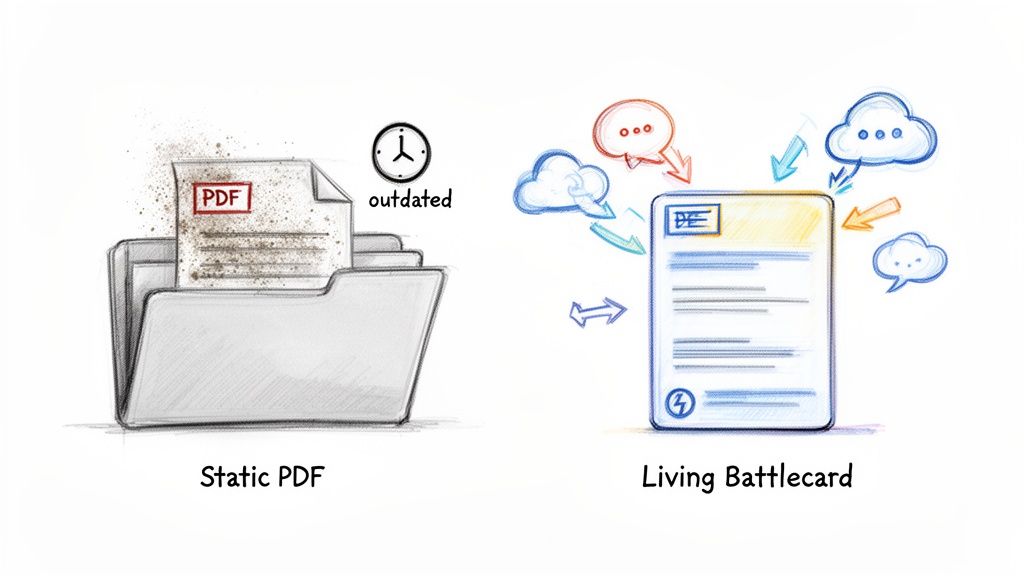
Let’s be direct. That PDF or slide deck you call a "battlecard" probably sits unused in a shared drive. It was likely out of date the moment you finalized it. Your rivals launch new features and tweak their messaging every quarter. Static intelligence is a liability.
Old battlecards operate on a flawed premise: that the market waits for you. The manual process is broken. A product marketer spends weeks gathering intel, formatting a document, and distributing it. By then, it is obsolete. Your reps know this. That is why they do not use it.
The Problem with Manual Updates
The traditional workflow cannot keep up. A product marketing manager listens to a few call recordings and skims competitor websites. They might chat with a top-performing rep. They compile this into a neat document.
But by the time it reaches the sales team, two things have likely happened:
The competitor has shifted its pricing or rolled out a new marketing angle.
New objections have surfaced on sales calls that are not in your new document.
This gap between intelligence gathering and real-world application leaves reps to fend for themselves. They rely on "tribal knowledge" and memory. This creates inconsistent messaging and lost deals. It is no surprise that reps often feel unprepared, even with battlecards. This is not a failure of your team. It is a failure of the tool you gave them.
From Static Document to Living Intelligence
You need to change your perspective. Stop creating a static document. Start building a living intelligence system. A dynamic sales battlecard template changes the game. A living battlecard updates continuously and automatically with fresh intelligence from the field.
A battlecard's value is not what you put into it once. Its value comes from the real-time insights your team can pull from it daily. It should reflect what buyers say today, not last quarter.
The difference between a static battlecard and a dynamic one is night and day. One is a historical artifact. The other is a live strategic asset.
Let's compare the two approaches.
Static vs Dynamic Sales Battlecards: A Comparison
Feature | Static Battlecard (The Old Way) | Dynamic Battlecard (The Modern Way) |
|---|---|---|
Updating | Manual, infrequent, and time-consuming. | Automated, continuous, and in real time. |
Data Source | A few calls, website scans, anecdotal evidence. | Every sales call, CRM data, and market signals. |
Relevance | Quickly becomes outdated and irrelevant. | Always current, reflecting today's market reality. |
Team Adoption | Low. Reps do not trust stale information. | High. Reps rely on it because it is proven to work. |
Impact | Inconsistent messaging, lost deals. | Consistent, winning narratives and higher win rates. |
Clinging to the old way means you are always a step behind. A dynamic approach gives your team a competitive edge.
Imagine if every sales call was automatically analyzed for competitor mentions, new objections, and pricing queries. Now, imagine that intelligence flowing directly into your battlecards. This enriches them with what actually works on the front lines. This is the modern, automated way forward.
For instance, a platform like Samskit can capture this data directly from conversations. It turns every interaction into a source of competitive insight. This creates a powerful feedback loop:
Sales calls generate data: A rep encounters a new claim from a competitor.
The system captures insights: AI pinpoints this key moment in the conversation.
Battlecards get updated: The new intel and a proven counter-argument are added instantly.
Reps win more deals: The entire team immediately benefits from the latest winning tactics.
This workflow transforms your sales battlecard template from a historical archive into your most powerful weapon for winning deals.
Building the Framework for Your Sales Battlecard Template
The biggest mistake with sales battlecards is treating them like a data dump. Teams cram them with so much information that they become unreadable. A sales rep on a live call does not have time to read a wall of text.
They need a scannable, actionable tool that serves up the right intel in seconds. When you build your sales battlecard template, think like an aircraft designer, not a librarian. You are building a cockpit display for your sales pilot. Only the most critical, flight-ready information should be visible at a glance.
The Three Pillars of a Winning Template
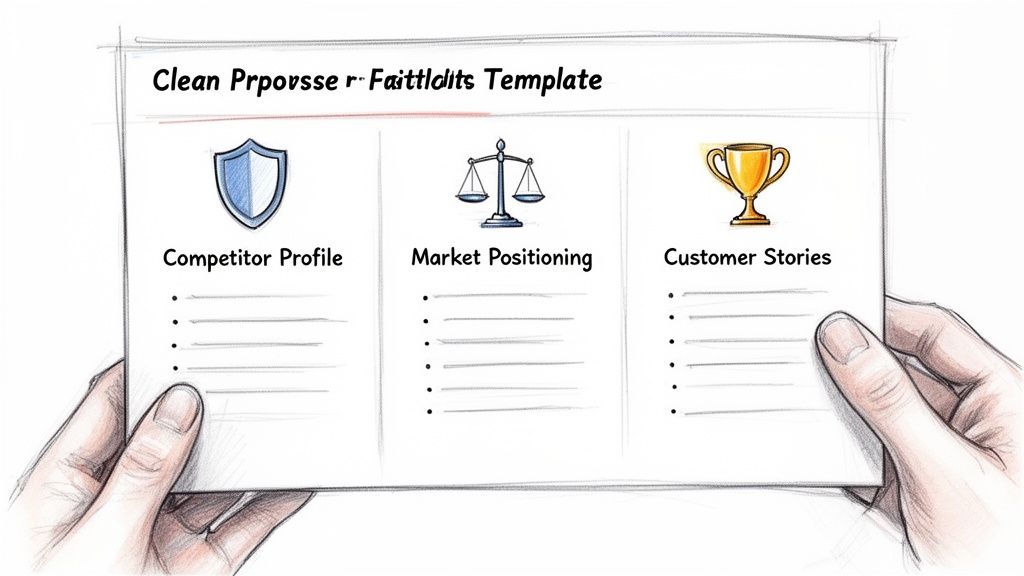
Every effective battlecard is built on three core pillars. Get these right, and you give your reps a complete view of the competitive landscape. This prepares them for anything a prospect might say.
Competitor Profile: This is your foundation. It is not just a feature list; it is a deep dive into their strategic DNA.
Market Positioning: Here, you cut through the marketing fluff. Contrast what your competitor claims with the reality your customers face.
Customer Stories: This is your ultimate proof. It is your arsenal of real-world wins and losses. It gives reps the evidence they need to back up every claim.
Structuring your template around these pillars ensures every piece of information has a clear purpose. It prevents your battlecard from becoming a disorganized mess.
Competitor Profile Key Fields
A great competitor profile is about velocity, not volume. A rep should absorb it in under 30 seconds. Forget listing every single feature. Focus only on details that matter in a sales conversation.
Your template must include fields for:
Strengths (What they’re good at): You must be honest here. Knowing what they do well is critical. It prepares your reps to pivot the conversation toward your differentiators instead of getting into a feature-for-feature fight.
Weaknesses (Where we can win): This is where you get tactical. Do not just list a weakness; frame it as a tangible vulnerability. For instance, if their integration process is clunky, do not write "Poor integrations." Write: "Slow, manual setup often requires IT resources, delaying time-to-value."
Pricing & Packaging: Never just list their prices. Detail their model (e.g., per-user, usage-based). Expose any hidden fees or mandatory add-ons that affect buyers later. This intel helps your rep position your pricing as more transparent and predictable.
This section gives your rep a quick, strategic snapshot of the opposition. It instantly answers the question: "Who am I up against, and what do I need to know right now?"
Market Positioning From Their Claims to Our Reality
Here, you give your reps the ammunition to dismantle a competitor's narrative. Prospects enter a call with marketing claims they have read online. Your job is to give your team the tools to reframe the conversation around reality.
The most powerful battlecards do not just counter a competitor’s strengths; they re-contextualize them. They help the rep move the conversation from the competitor's home turf to yours.
A simple "Their Claim vs. Our Reality" table in your template is very effective.
Their Claim | Our Reality |
|---|---|
"Our platform is fully automated." | "We find their automation is limited to basic tasks. Our customers who switched mentioned that complex workflows still required manual workarounds." |
"We offer the lowest price on the market." | "Their base price looks low, but critical features like analytics and priority support are expensive add-ons. Our all-inclusive pricing delivers more value with no surprises." |
This simple format gives reps a clear script to follow when a prospect repeats a competitor's talking point. Building this out with a dynamic sales account planning template helps ensure your positioning is relevant to each deal.
Customer Stories and Landmine Questions
The final pillar of your sales battlecard template is about proof and traps. Here, you move from theory to tactical execution. You give reps the exact words to guide the conversation.
Make sure this section includes:
Why We Win: Short, bulleted reasons you have won deals against this competitor, backed by anonymized customer examples. For instance, "Won against Competitor X because the customer needed real-time analytics for their QBRs, which they lack."
Why We Lose: This is just as important. It builds credibility and helps reps qualify out of unwinnable deals early. For example, "Lost to Competitor Y when the prospect's primary need was a niche legacy integration we do not support."
Landmine Questions: This is your secret weapon. These are questions designed to expose a competitor's weakness without you ever mentioning their name.
If you know a competitor has poor customer support, a landmine question could be: "When you think about implementing a new tool, what is your team's plan for getting dedicated, expert support during onboarding and beyond?"
These questions empower reps to lead the prospect to discover the competitor’s flaws on their own. It is more powerful than saying, "Our support is better." This framework turns a simple document into a strategic weapon that helps reps control the narrative and win more deals.
Fuelling Your Battlecard with Real-World Intelligence
An empty sales battlecard template is just a document. Its power comes from the intelligence you load into it. Forget generic advice to "do your research." To make a battlecard that wins deals, you need to tap into high-signal sources. These sources reveal what your prospects are truly thinking.
This means you must get your hands dirty. Move beyond a competitor's homepage. Dig into the messy, valuable truth of the market. You will not find this intel in broad market reports. It is hidden in the specific words buyers use, the objections they bring up, and the wins and losses your own team experiences.
Hunting for Intel in the Wild
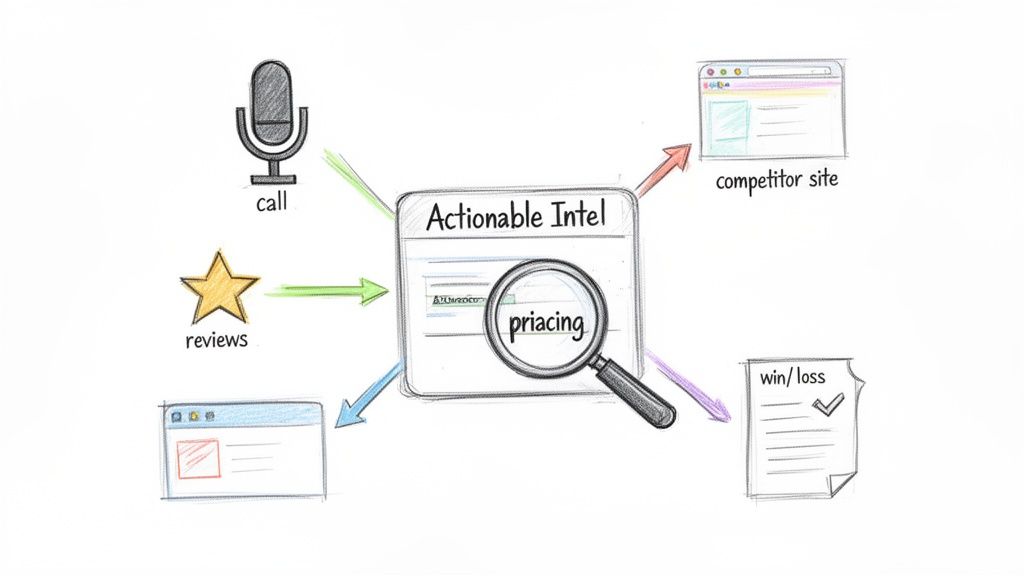
First, look outside your organization. The internet has clues that lead to your competitors' weaknesses and your customers' headaches. The skill is knowing where to look and how to translate finds into a competitive advantage.
Customer Review Sites: Platforms like G2, Capterra, and TrustRadius are gold mines. My advice? Skip the five-star and one-star reviews. The real story is in the three- and four-star ratings. Here you will find balanced feedback on a competitor’s shortcomings. This is perfect material for crafting landmine questions.
Competitor Marketing: Do not just skim their blog posts. Dissect their webinars and case studies. What pain points are they focusing on? Which customer profiles do they feature? This tells you who they are targeting and the story they are telling. This is what you need to build a counter-narrative.
Win/Loss Analysis: If you have win/loss reports, look for patterns. Do you consistently lose deals on price? Or do you win because your onboarding is faster? These trends are critical for sharpening your market position.
For instance, imagine selling payment solutions in Brazil. Pix, the instant payment system, drives 33% of e-commerce sales. Credit cards still hold the lead at 39%. This is a battleground. It shows your sales team needs precise intel to position your solution against both established and new players.
The Ultimate Source of Intelligence: Your Own Sales Calls
Looking outward is valuable, but the best source of competitive intelligence is inside your organization. It happens every day on your sales calls. Your frontline reps hold a treasure trove of raw market data. The challenge is capturing and making sense of it.
Your sales calls are not just conversations; they are live market research sessions. Every objection, competitor mention, and pricing question is a piece of the puzzle. Tapping into this data stream is how you build a battlecard that works.
Manually listening to hours of call recordings is a slow task that nobody has time for. You need a system that can automatically process these conversations and flag important moments. This is how you build a powerful feedback loop. You turn every discussion into a chance to make your team smarter.
This approach changes everything. It moves you from static assumptions to a dynamic, evidence-based strategy. It fills your sales battlecard template with content that closes deals.
Creating an Automated Intelligence Flywheel
Modern tools can put this entire process on autopilot. A sales assistant like Samskit can join your meetings on Zoom, Google Meet, or Microsoft Teams and do the heavy lifting.
Here is how the workflow operates:
The system automatically records and transcribes every sales call. This creates a searchable library of every conversation.
AI then analyzes the transcriptions to pinpoint crucial intelligence. It can automatically tag competitor mentions, flag buyer objections, and highlight pricing discussions.
This structured data feeds directly back to your sales assets. When a new objection to a competitor's product appears three times in one week, that insight can be instantly added to the relevant battlecard, complete with a field-tested response.
This creates a closed-loop system. Intelligence from the field directly sharpens your team's most important assets. For example, if reps hear "Competitor Z is cheaper," the system flags it. You can then arm the battlecard with a proven talk track like, "I understand price is a key factor. Could we talk about the total cost of ownership? Customers switching from Competitor Z save around 20% on admin costs because our automation is more effective."
This automated workflow ensures your battlecards are always up-to-date. They reflect what is happening in the market right now. You can explore our complete guide on sales intelligence tools to see how this gives teams a massive advantage. It stops your battlecards from being historical documents. It turns them into living assets that help your team win more.
Executing Advanced Battlecard Plays to Win Deals
You have built a solid sales battlecard. That is the foundation. Real wins come from turning static information into an active playbook for your sales team.
The goal is to move your reps from a defensive, reactive posture to one where they confidently control the conversation. It is more than handling objections. It is about proactively shaping the narrative based on who they are talking to and where your competitors are weak.
When you get this right, you can make your competitor's key selling points feel irrelevant before they even bring them up.
Crafting Persona-Specific Talk Tracks
I have seen it many times: a sales team using the same script for everyone. This is a quick way to lose credibility. The conversation you have with a CFO about ROI is different from one with an IT Manager about system integration.
Your battlecard needs to reflect this reality. Your talk tracks must be segmented by buyer persona. This allows reps to pivot their messaging to align with the person on the other end of the call.
For a CFO (Chief Financial Officer):
Their World: Financial metrics, total cost of ownership (TCO), risk mitigation.
How You Sound: "Many CFOs we partner with focus on controlling unpredictable operational costs. Our all-inclusive model eliminates the hidden fees you find with other platforms. This gives you a clear view of TCO from day one."
For an IT Manager:
Their World: Security, seamless integration, fast implementation, low maintenance.
How You Sound: "Our native integrations with platforms like Salesforce mean your team can be live in hours, not weeks. We have heard from other IT leaders that the manual data mapping for Competitor X often creates massive delays."
An advanced battlecard play anticipates the buyer's role. It equips the rep to speak their language. It is the difference between reciting features and solving business problems.
By segmenting your talk tracks, you empower reps to build immediate rapport. They are not just selling a product. They are demonstrating a deep understanding of the buyer's world. This makes the conversation more powerful.
Mapping Weaknesses to Pain Points with Landmine Questions
This is where your battlecard becomes a tactical guide for dismantling the competition. It is not enough to list a competitor’s weakness. The magic happens when you connect that weakness to a prospect’s pain point. Then, script a 'landmine' question that lets the prospect discover the problem themselves.
It is a subtle but effective shift. Instead of you saying, “Competitor Y has poor customer support,” you guide the buyer to that conclusion on their own.
Here is the three-step process:
Pinpoint the Competitor's Weakness: Your research shows their customer support response times are slow.
Link It to a Buyer Pain Point: Slow support means project delays and unresolved issues that impact business.
Script the Landmine Question: "As you evaluate new partners, what is your process for getting expert help when a critical issue pops up?"
This question forces the prospect to state their need for excellent support. Later, when the competitor glosses over their support model, your solution is already positioned as the safer choice in the prospect’s mind.
Let's look at another couple of examples:
Competitor Weakness | Buyer Pain Point | Landmine Question |
|---|---|---|
Clunky, manual reporting features. | Wasted hours pulling data; no real-time insights for quick decisions. | "When you prepare for your weekly pipeline reviews, how much time does your team spend manually exporting data?" |
Inflexible pricing that scales poorly. | Budget overruns as the team grows or needs change. | "Thinking about next year, how would your ideal pricing model need to adapt so you only pay for what you use?" |
These are not confrontational questions. They are discovery questions designed to expose gaps in your competitor's offering. This makes your value proposition hit harder when you present it.
A Real-World Scenario in Brazil's Retail Market
Let’s make this tangible. Imagine your team sells a data analytics platform to retailers in Brazil. The market faces a challenge. Promotional activity has exploded to 16.5 million offers in 2026. This is a 72% increase since 2019. This creates a price war with one promotion for every 16 Brazilians.
Your main competitor offers a basic tool that only tracks competitor pricing. Your battlecard cannot just say "we have better analytics." It needs to arm your reps to pivot away from a losing battle on price.
Here is how you execute a play. The talk track is for a Head of Merchandising at a supermarket chain.
Battlecard Intel:
Competitor: "PriceTracker Pro"
Their Pitch: "We help you win the price war by tracking every promotion from Atacadão and Assaí."
Your Landmine Question: "With millions of promotions in the market, how do you measure if your own promotional spend is driving profitable growth or just eroding your margins?"
That one question reframes the conversation. It steers the focus from a race to the bottom toward a discussion about profitability—your platform's core strength. When you win deals this way, proof is critical. Backing up your claims with a strong case studies template demonstrates how you have helped similar customers achieve profitable growth.
Weaving Battlecards Into Your Team's Daily Rhythm
Building a fantastic sales battlecard is a great start. But it is only half the battle. A powerful tool that nobody uses is just digital shelfware. True success comes when battlecards are woven into your sales team's daily work.
This is not about sending a memo and hoping for adoption. It is about making them simple to use and showing immediate value. If a rep has to leave their CRM and hunt for a battlecard during a live call, you have already lost.
The real goal is to get the right information to the rep at the exact moment it is needed, with zero extra effort. This means embedding battlecards where your team lives all day.
Make Your CRM the Single Source of Truth
The most direct way to drive adoption is to bring battlecards into the CRM. Whether your team uses Salesforce or HubSpot, your battlecards must be accessible from the opportunity or account page.
When a rep opens a deal and sees the battlecard for the listed competitor, you have transformed a static document into an active coaching tool. The rep does not need to search for intel. It is served up contextually. You can learn more by exploring strategies for managing an inside sales team with your CRM.
Integrating this way does two critical things:
For Reps: It gives them immediate, relevant talking points without breaking their flow.
For Managers: It ensures everyone uses consistent messaging across the team.
Turn Battlecards Into a Coaching Power Tool
Managers are key to making battlecards stick. They should use them as the foundation for deal reviews and coaching sessions. This shift changes the perception of battlecards from a chore to a deal-winning asset.
A battlecard is not just for the rep; it is a diagnostic tool for the manager. It shows which competitive plays are working, where reps get stuck, and what messaging needs a refresh.
Using call intelligence platforms like Samskit, managers get a clear view of how plays are executed. They can see which parts of a battlecard a rep used on a call and how the prospect reacted. This data-driven approach turns coaching from subjective feedback into objective guidance.
For instance, a manager might notice a rep struggles to land a specific "landmine" question. In their next one-on-one, they can role-play that exact scenario using the battlecard as the script.
This simple flow shows how powerful a well-executed battlecard play can be.
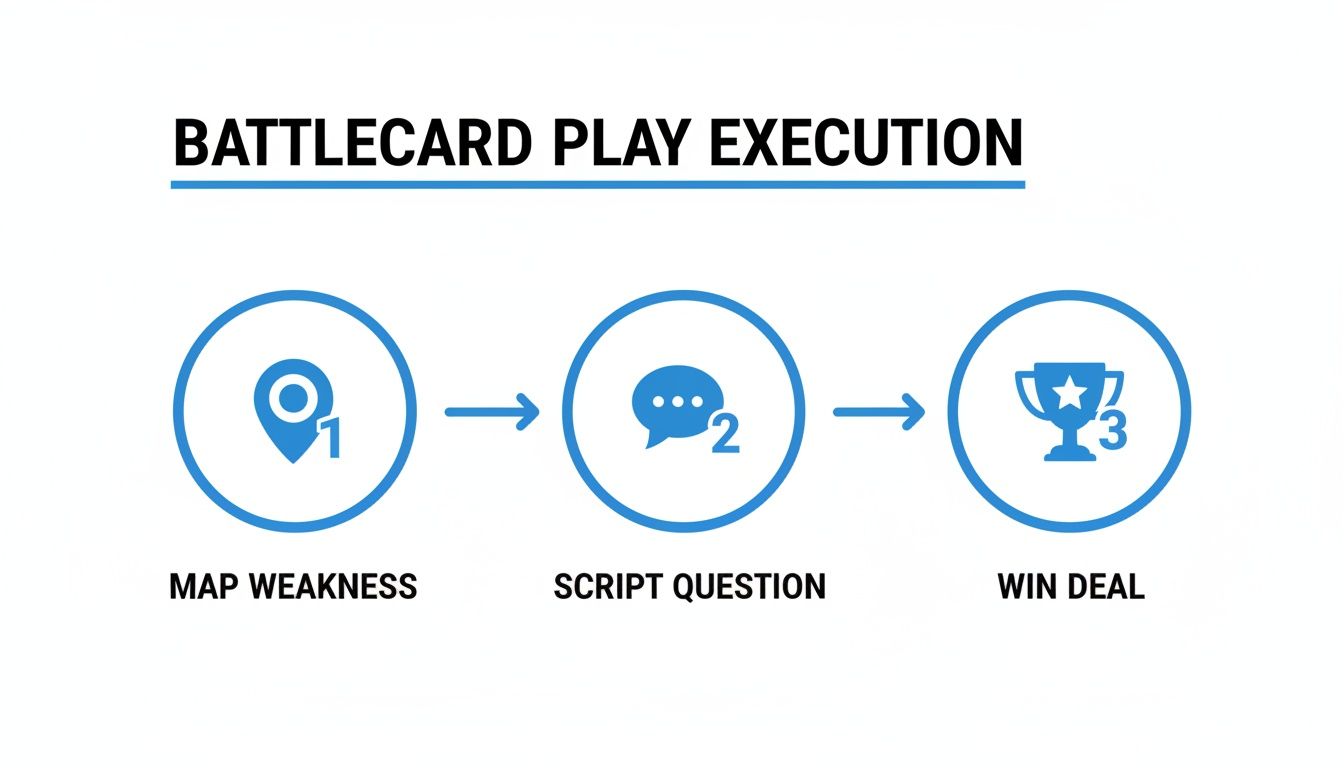
The strategy is simple: spot a competitor's weakness, use a scripted question to expose it, and position your solution as the choice to win the deal.
Create a Closed-Loop Intelligence System
Here you operationalize excellence. Build a system that learns and improves on its own. Your battlecards cannot be static. They must evolve with every sales conversation. This creates a feedback loop where field events directly sharpen your strategic assets.
Here is how that cycle works:
Capture Field Intel: A sales rep finishes a call. Your sales assistant has captured the entire conversation. The system automatically tags competitor mentions and new objections.
Update the Playbook: This fresh intelligence refines the sales battlecard template. A new talk track from a top performer gets added. A sharp rebuttal to a new competitor claim is instantly created.
Elevate the Team: The whole team gets immediate access to this updated, field-tested intel. They are ready to improve performance on the next call.
This virtuous cycle ensures your battlecards are packed with tactics that work right now. As battlecards get sharper, call performance improves. As call performance improves, the quality of intel flowing back gets even better, directly boosting your team’s win rates.
Common Questions (and Straight Answers) About Sales Battlecards
Whenever I help a team roll out a new battlecard system, the same practical questions pop up. It is one thing to build a template. It is another to make it a win-driving part of your sales motion. Here are the honest answers to the questions I hear most often.
How Often Should We Update Our Sales Battlecards?
Forget quarterly reviews. A battlecard that is not updated weekly—or even daily—is out of date. It must be a living resource.
The moment a rep hears about a new competitor claim, that insight needs to be in the battlecard. Immediately. If they learn something on a Monday morning call, it should be there for the Monday afternoon team. This might sound impossible. But with tools that automatically pull insights from sales calls, this real-time update becomes routine.
What Is the Single Most Important Section?
If I had to pick just one, it would be the “Why We Win / Why We Lose” section. This is where theory stops and reality begins.
This section gives your team the exact words that have proven to close deals or overcome hurdles. It is not about generic product features. It is about specific landmine questions to ask and killer responses based on what happened in past conversations. This is where the real tactical advantage lies.
The biggest mistake is creating battlecards that read like a product manual. Your reps do not have time for that. A battlecard should be glanceable in under 30 seconds during a live call. It should give them the exact information they need, right when they need it.
How Do We Get Sales Reps to Actually Use Them?
Getting your team to adopt battlecards is not about mandates. It is about making them so useful that not using them feels like a disadvantage. There are three non-negotiables for this.
Make them impossible to miss. Battlecards must live directly inside your CRM or sales engagement platform. If a rep has to click away, open another app, or search a folder during a call, they will not use it.
Fill them with real-world intel. Forget polished marketing copy. When a rep sees an objection-handler from a colleague's winning call last week, they will trust the resource. That is the content that helps them hit their number.
Weave them into your rhythm. Do not just launch the battlecards and hope. Make them the centerpiece of your deal reviews and one-on-one coaching. When they become part of the strategy conversation, they become part of the culture.
Ultimately, reps will use them when they see a clear line between the battlecard and the commission in their bank account.
Stop making your sales team chase context. Let them focus on what they do best: selling. Samskit turns every customer conversation into reliable CRM updates and actionable insights. It fuels your battlecards with the real-world intelligence your team needs to win. See how it works at https://samskit.com.