
Sales used to be a numbers game. More dials, more emails, more meetings. But top-performing revenue teams know the real edge is not just activity, it is precision. Sales intelligence tools promise this precision, but the market is crowded. It is no longer just about buying a static list of contacts.
Today’s platforms offer a range of capabilities. Some provide real-time buyer intent signals that show who is researching your solution. Others offer automatic CRM enrichment to keep your data clean. Some even analyze conversations to reveal why you win or lose deals. Making the wrong choice means wasted budget and frustrated reps. The right one gives your team a real advantage.
This guide cuts through the marketing noise to deliver a practical analysis of the top tools. We do not recycle feature lists. Instead, we analyze 12 leading platforms through the lens of a real sales professional:
How does it fit into a B2B sales workflow?
What results can you actually expect?
Which one is genuinely right for your team’s specific goals and budget?
We provide a direct look at how each tool works. This includes screenshots, ideal use cases, known limitations, and direct links to explore further. We will examine global giants like LinkedIn Sales Navigator and ZoomInfo and regional specialists like Ramper in Brazil. Our goal is to equip you with the practical insights to make a smart investment that shows up in your pipeline. Let’s get started.
1. Samskit
Samskit offers a different approach to sales intelligence. It focuses on insights generated directly from your customer conversations. Instead of only providing external data, it acts as an AI sales assistant. It joins your calls on Zoom, Google Meet, and Microsoft Teams to capture, transcribe, and analyze every interaction. This process turns raw conversation data into structured, actionable intelligence within your CRM and workflows.
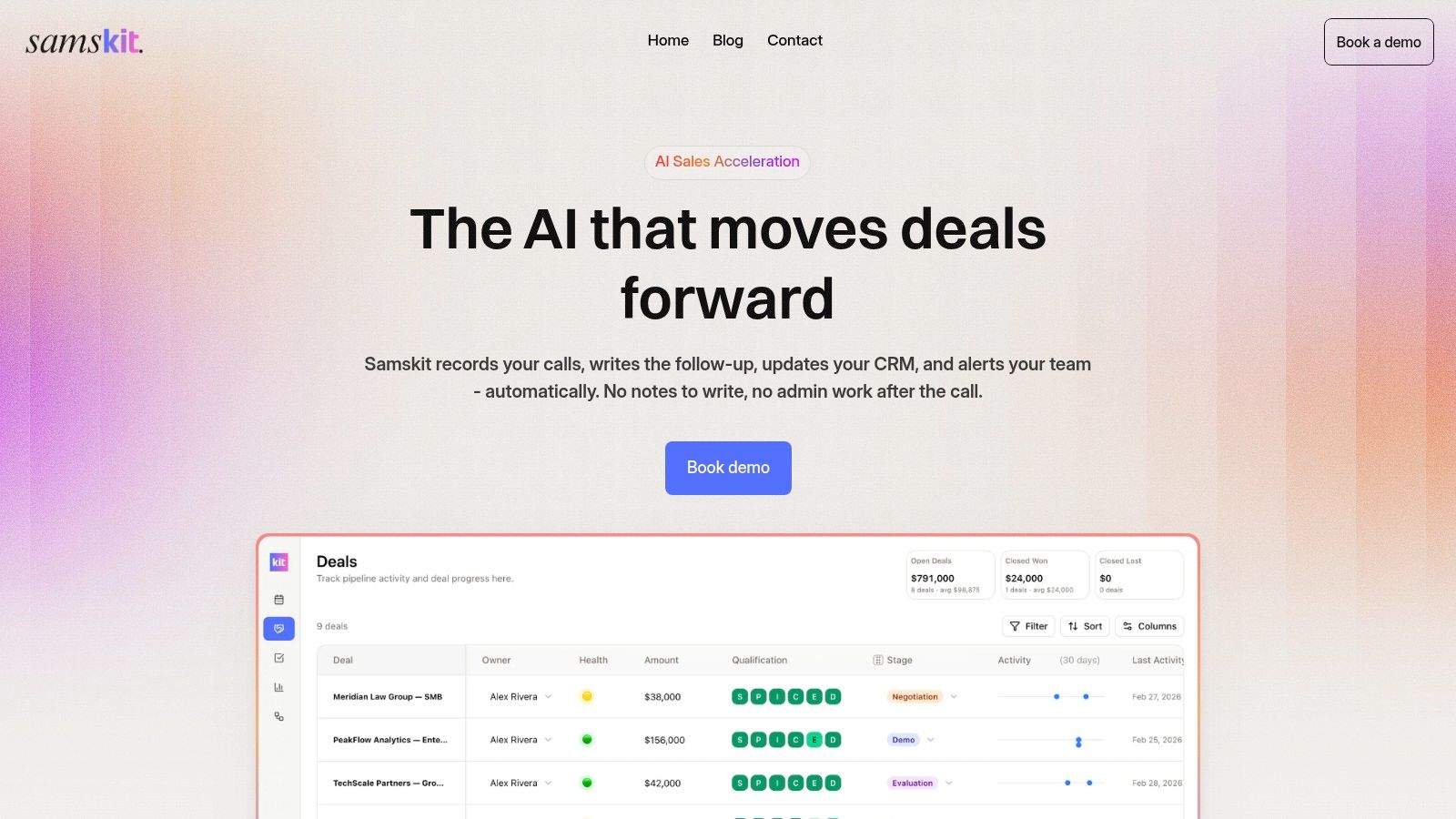
The platform’s strength is extracting critical deal information without manual effort. It identifies buyer intent signals, objections, competitor mentions, and key commitments. It then uses this information to draft follow-up emails and prepare detailed CRM updates. These updates respect your existing pipeline stages and data rules. The goal is to eliminate administrative work so reps can focus on selling. It also improves the accuracy of your pipeline data for more reliable forecasting.
For sales leaders, Samskit provides analytics on team performance. It surfaces risk alerts for deals that are stalling. This allows for evidence-based coaching and more productive pipeline reviews. Because it organizes call history and priorities, it also creates cleaner handoffs between sales and customer success teams, which can reduce churn.
Setup is reportedly fast. A 4-minute process connects to your calendar and core sales stack without needing IT support. It integrates with major CRMs like Salesforce, HubSpot, and Pipedrive.
Who is it for?
Samskit is best for B2B sales teams who want to automate non-selling tasks. It suits individual account executives and entire revenue organizations. These teams want to ground their sales intelligence in actual customer conversations. Sales and revenue leaders will find the team analytics and coaching signals useful for performance management.
Pricing: Not publicly listed. You need to book a demo for pricing details.
Key Advantage: Automates CRM updates and follow-ups by analyzing call data. This saves significant time and improves data quality.
Limitation: The quality of insights depends on clear call audio and accurate transcriptions. Organizations must also be mindful of call recording consent requirements.
Website: https://samskit.com
2. LinkedIn Sales Navigator
LinkedIn Sales Navigator is an essential starting point for most B2B sales teams. It is built directly on LinkedIn’s large professional network. It gives reps a dedicated interface for prospecting, account research, and relationship building. This interface is completely separate from their personal feed. Its data is self-reported and continuously updated by users. This makes employment history and job role information very reliable.
Its strength lies in the Advanced Search filters. These allow you to pinpoint decision-makers using specific criteria like seniority, function, company size, and geography. Once you identify key people, you can save them as leads. You will then receive alerts on job changes or company news. The platform’s TeamLink feature shows you which colleagues have existing connections to a prospect for a warm introduction. This focus on relationship mapping is a core part of its value. For a deeper look at using these features, our guide on LinkedIn social selling offers practical workflows.
While it is a foundational sales intelligence tool, Sales Navigator does not directly provide contact details like email addresses or phone numbers. Outreach is mainly channeled through InMail, which can be limiting. The seat-based pricing (starting with the Core plan and scaling to Advanced and Advanced Plus) means costs can add up quickly for larger organizations.
Best For: Sales teams whose process is built around social selling and relationship mapping.
Pricing: Starts around $99/user/month, with team and enterprise plans available.
3. ZoomInfo SalesOS
ZoomInfo SalesOS is a large go-to-market data platform. It is designed for revenue teams that need scale and precision. It combines a massive B2B contact and company database with advanced intelligence layers. This positions it as a central hub for sales, marketing, and operations. Its main strength is the depth and accuracy of its direct-dial phone numbers and verified email addresses. This helps sales development representatives (SDRs) connect with prospects more efficiently than with other sales intelligence tools.
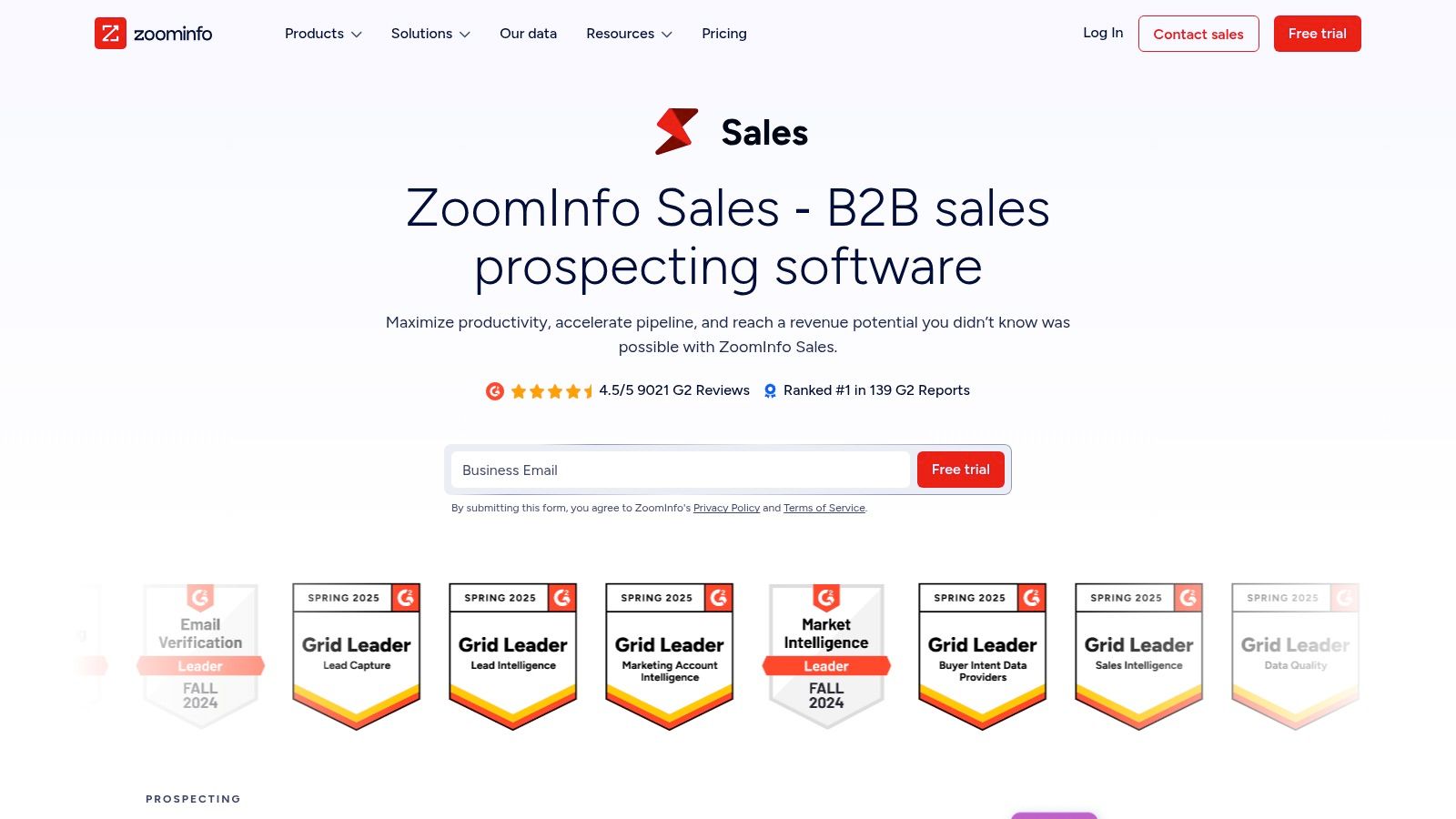
The platform’s real power comes from integrating multiple data types. You can build target account lists using firmographic data. You can identify buying committees with its org chart feature. You can also monitor intent signals to see which companies are actively researching solutions like yours. Furthermore, its technographics show what software a company already uses. This is critical for competitive takeaways or integration-focused sales plays. The workflow automation and deep CRM integrations mean this data can be pushed directly into your existing systems, enriching records automatically.
However, ZoomInfo is a significant investment. The pricing is often not public and is bundled into enterprise-level packages. This creates a risk of buying more features than you need. While its data coverage is excellent in North America and parts of Europe, some teams report it can be less reliable in regions like Latin America. The platform also requires formal DNC/Do-Not-Call list management to maintain compliance. This adds an operational layer for teams to manage.
Best For: Enterprise and mid-market revenue teams that need a single source for contact data, intent signals, and technographics.
Pricing: Customised quotes based on credits, features, and user count; often starts in the five-figure range annually.
Website: www.zoominfo.com/solutions/sales
4. Apollo.io
Apollo.io has become a favorite for SMB and mid-market sales teams. It consolidates a massive B2B database with a full suite of engagement tools. It stands out by packaging prospecting, sequencing, and analytics into one platform. This offers a powerful all-in-one solution that reduces the need for multiple separate tools. This integrated approach allows reps to find contacts, verify their information, and immediately enroll them into outreach campaigns without leaving the platform.
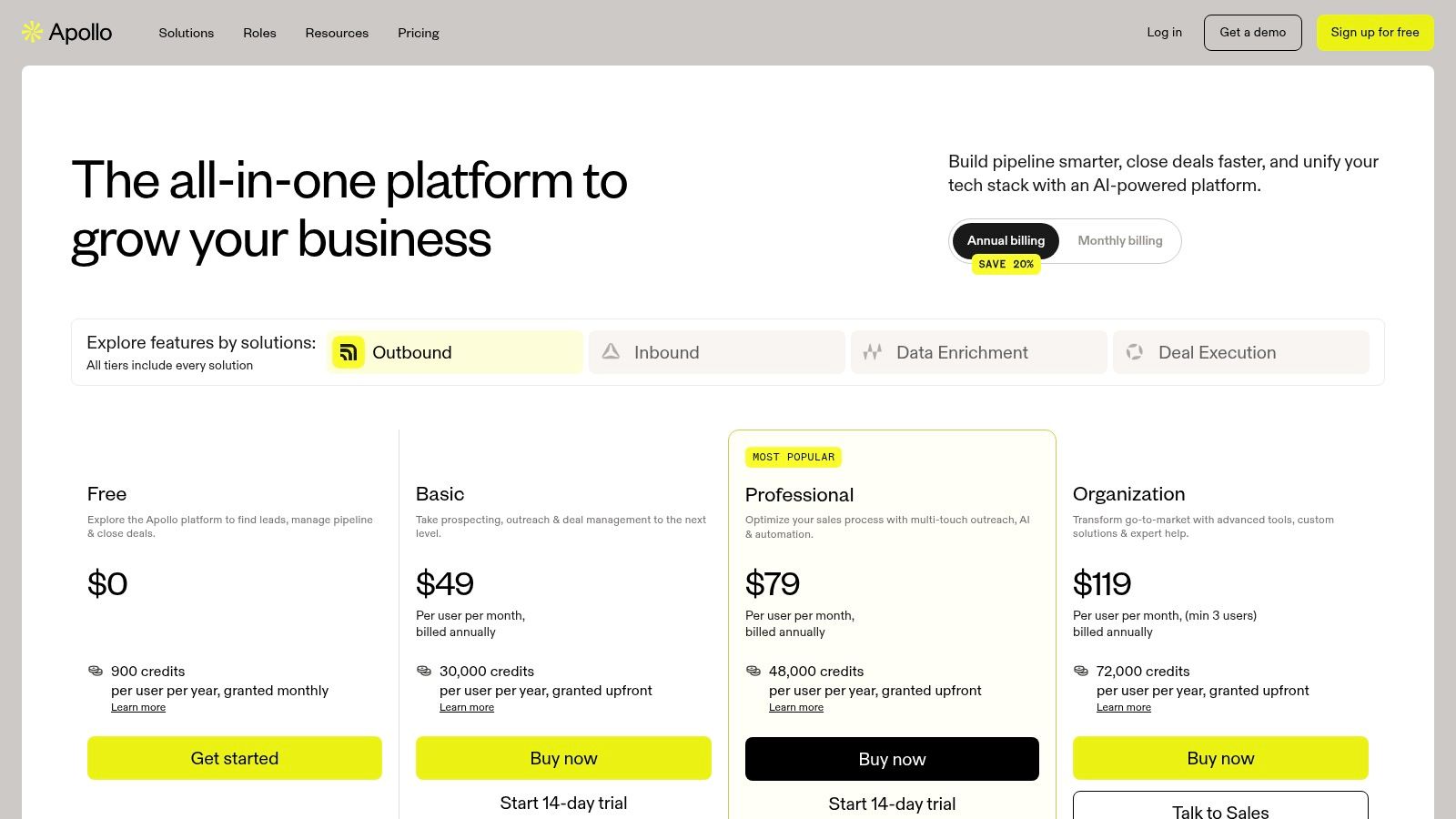
Its core value is in workflow efficiency. The Chrome extension is very effective. It lets you grab verified emails and direct-dial numbers directly from LinkedIn profiles or company websites. These contacts can then be pushed into its native Sequencer, which automates email and call tasks. The combination of a large contact database with built-in engagement functions provides one of the fastest paths to value among sales intelligence tools. For teams focused on high-volume outbound, this is a significant advantage.
On the other hand, the platform uses a credit-based system for revealing contact details. This can make budgeting unpredictable if usage spikes. While the database is extensive, data accuracy can vary, especially outside of North America or in very niche industries. This sometimes requires additional verification steps. The rapid addition of new features can also mean the user interface feels cluttered at times.
Best For: Outbound-heavy SMB and mid-market teams looking for an all-in-one prospecting and engagement platform.
Pricing: Offers a free plan; paid plans start around $49/user/month, with custom business and enterprise options.
Website: www.apollo.io/pricing
5. Cognism
Cognism positions itself as a premium sales intelligence tool. It has a strong focus on data compliance and mobile phone coverage, especially across EMEA. Its core value is providing accurate, verified contact information that sales teams can use with confidence. This is backed by checks against Do Not Call (DNC) lists. This makes it a go-to choice for organizations in regions with strict data privacy regulations like the GDPR.
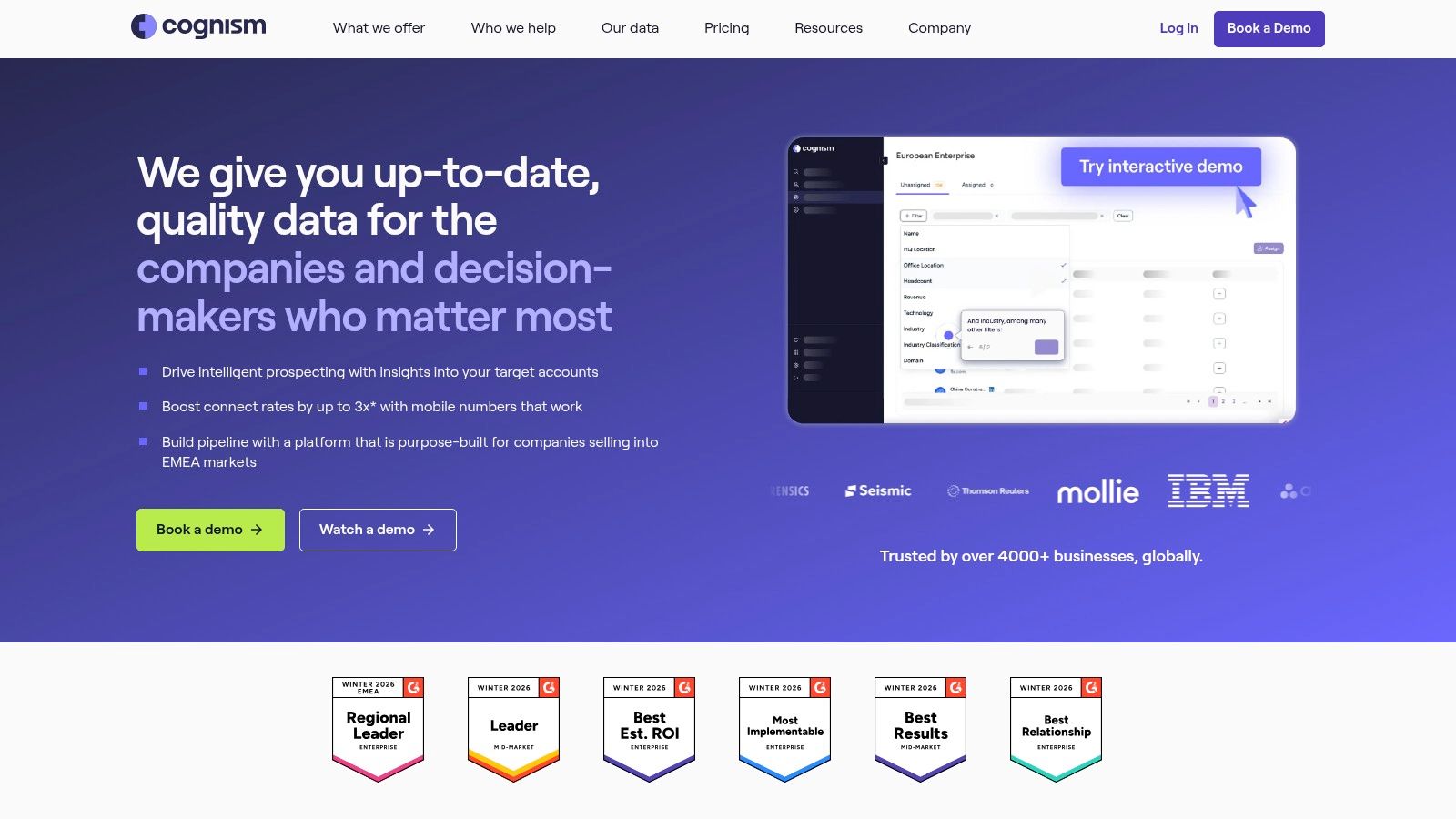
The platform's standout feature is its proprietary Diamond Data. This represents manually-verified mobile numbers. It offers teams a higher probability of connecting directly with decision-makers. The workflow is straightforward. Reps use the web application or browser extension to find prospects. They then export their contact details directly into a CRM or sales engagement platform. This emphasis on providing high-quality, actionable phone numbers is a key differentiator from tools that are more email-centric.
However, Cognism’s commitment to quality and compliance comes at a higher price. This makes it less suitable for smaller businesses or those with limited budgets. Its pricing is customized and generally requires a conversation with their sales team. It is more expensive than entry-level B2B databases. While its EMEA data is excellent, coverage in other regions can be less comprehensive. It is wise to request a data sample for your target markets during evaluation.
Best For: Global sales teams, particularly those targeting the UK and EMEA, who need compliant, high-quality mobile numbers.
Pricing: Customised plans based on user count and data needs; generally considered a premium-priced tool.
Website: www.cognism.com
6. Lusha
Lusha is a contact discovery platform known for its simple user experience and clear, credit-based pricing. It is often the first choice for sales teams that need straightforward email and phone number reveals without a complex setup. Its main function is to quickly give sales development representatives (SDRs) the direct contact information needed for cold outreach.
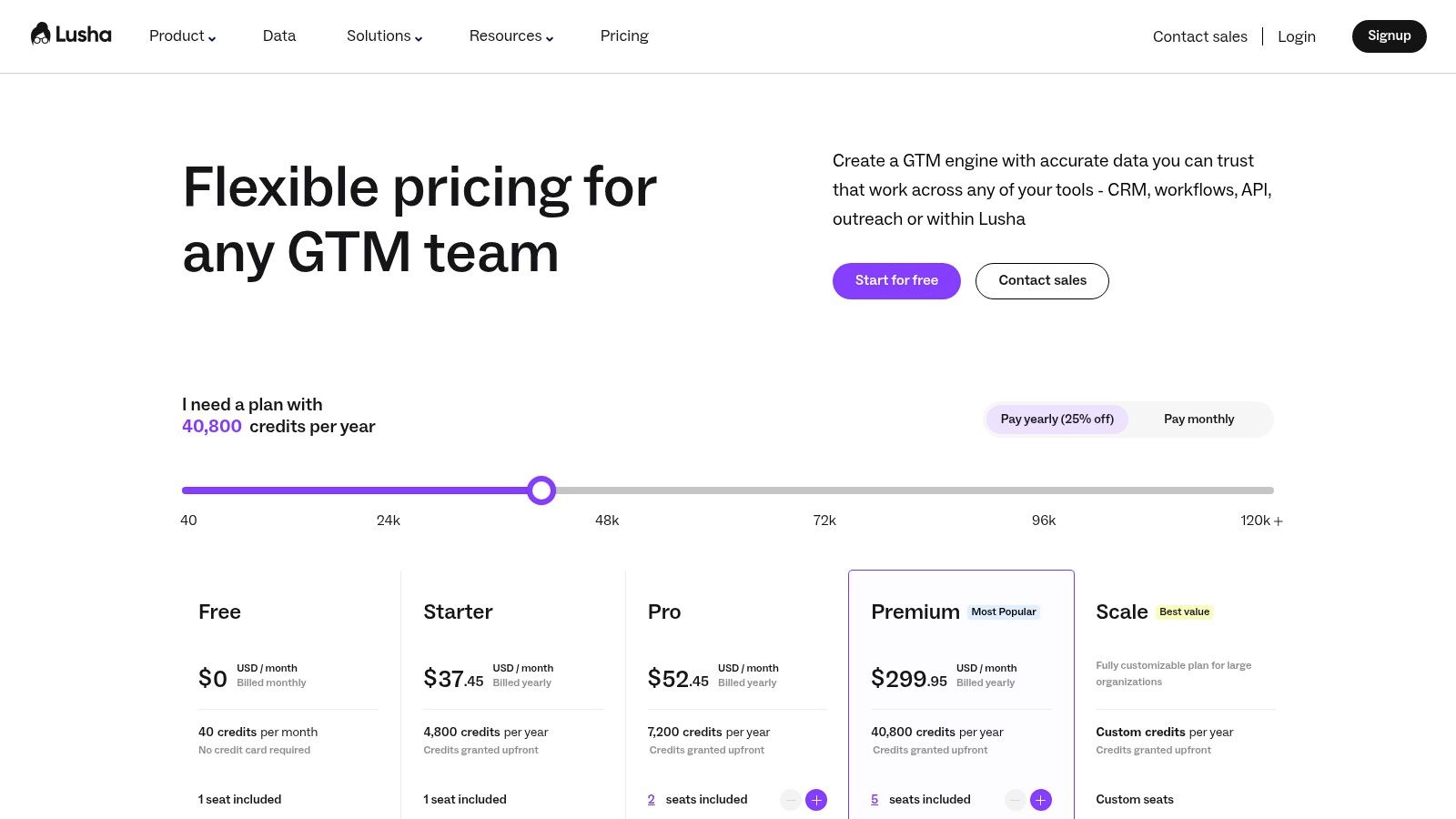
The platform’s core strength is its browser extension. It works over LinkedIn and company websites to reveal contact details in a single click. This workflow is very fast and easy for new reps to adopt. The credit-based system is also a key feature, as it provides clear budget control. You only pay for the contacts you reveal. This makes it an accessible entry point among sales intelligence tools, especially for small businesses or teams testing data providers. A free plan with monthly credits allows for a no-commitment evaluation.
However, Lusha's model has limits. The data depth and accuracy can vary a lot by region and industry. Some users report better results in North America than in Europe or APAC. Phone credits are also much more expensive than email credits. This can quickly drain a team's budget if they rely heavily on cold calling. While effective for top-of-funnel prospecting, it lacks the deep account intelligence or buyer intent signals found in more advanced platforms.
Best For: Teams needing a fast, easy-to-use tool for direct contact discovery and quick onboarding.
Pricing: Offers a free starter plan; paid plans start around £23/user/month (billed annually).
Website: www.lusha.com/pricing
7. Clearbit by HubSpot
Following its acquisition, Clearbit is now deeply integrated into the HubSpot platform. It offers a native data enrichment solution for teams using that ecosystem. Its core function is to add detailed company and contact data directly within your HubSpot records. It turns a simple email address into a rich profile with over 100 attributes like role, industry, and company size. This makes it a great tool for organizations looking to standardize their tech stack and automate lead qualification without leaving their central CRM.
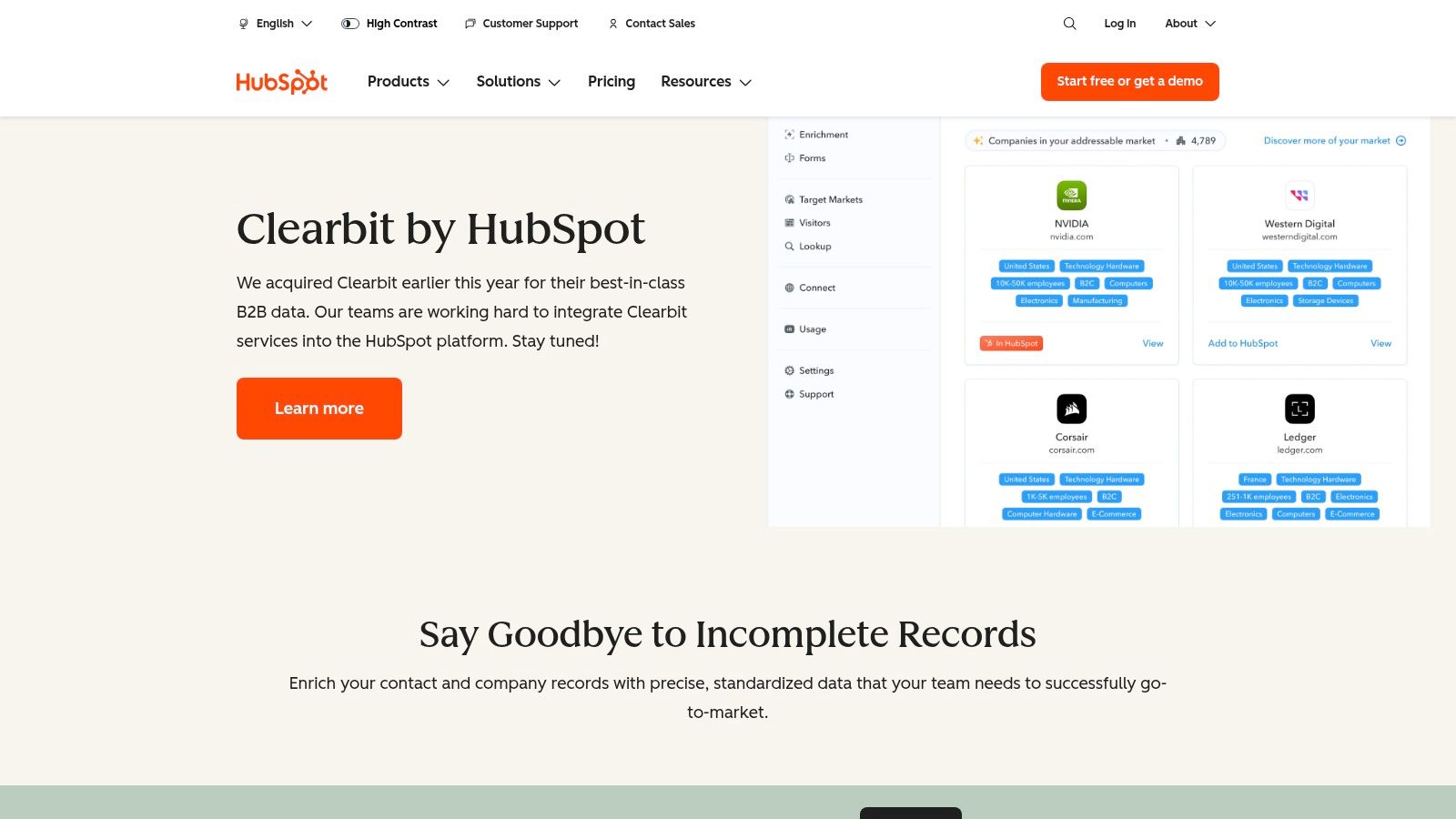
One of its most practical features is dynamic form shortening. Clearbit automatically fills in details after a visitor enters their email. This means you can ask for less information upfront, reduce friction, and still capture high-quality data for lead routing. The platform also includes website visitor identification (Reveal). This identifies anonymous companies visiting your site. It provides account-level intent signals directly to your sales team. This focus on connecting marketing activity to sales intelligence is its main advantage.
However, its tight integration is also a limitation. Clearbit is no longer a standalone product. Its features and pricing are bundled within HubSpot's offerings. This primarily benefits those already invested in the platform. While its enrichment capabilities are powerful, some of its tools are geared more towards marketing automation than pure-play sales prospecting. This makes it a different type of sales intelligence tool compared to others on this list.
Best For: Teams fully standardized on the HubSpot ecosystem who need native data enrichment and marketing-to-sales alignment.
Pricing: Bundled within HubSpot’s paid plans; not available as a standalone purchase.
Website: www.hubspot.com/products/clearbit
8. 6sense Revenue AI for Sales
6sense Revenue AI for Sales is an account-centric platform. It helps revenue teams identify and prioritize accounts that are actively looking for solutions. It moves beyond simple lead scoring by analyzing intent data from across the web. This predicts which of your target accounts are "in-market" right now. This allows sales and marketing teams to coordinate their efforts on accounts with the highest chance of closing. This avoids wasting time on those not ready to buy.
The platform’s real strength is its predictive scoring and timing. It tells reps not just who to target but when. It identifies anonymous website visitors and maps them to accounts. This provides a clear picture of buying committee engagement. For sales teams, this means receiving alerts on surging account interest directly in their CRM or sales engagement tool. This enables timely and relevant outreach. Our guide on using AI for sales prospecting details how to turn these insights into effective workflows. This makes it one of the most powerful sales intelligence tools for mature account-based marketing (ABM) programs.
However, 6sense is a big investment. It requires a solid data foundation to work effectively. If your CRM data is messy or incomplete, you will struggle to get its full value. The platform is custom-priced and aimed at enterprise-level organizations. This puts it out of reach for many smaller teams. Implementation also requires significant change management to align sales and marketing around its account-based method.
Best For: Enterprise organisations with a mature ABM strategy and a need for powerful account prioritisation.
Pricing: Custom pricing, typically geared towards enterprise contracts.
Website: 6sense.com
9. Bombora (Company Surge Intent Data)
Bombora operates differently from many other sales intelligence tools. It focuses only on third-party B2B intent data. It tracks which companies are actively researching specific business topics across a cooperative network of thousands of B2B websites. This provides its core offering, Company Surge®. It signals when an account is showing heightened interest in a solution like yours, even before they visit your site. This allows sales teams to prioritize accounts that are already in a buying cycle.
Its strength is being a vendor-agnostic data source. It can be integrated directly into your existing sales and marketing platforms, such as Salesforce, HubSpot, or various ABM tools. Instead of providing a separate prospecting interface, Bombora’s data feeds your main systems with timely intelligence. Sales reps can use these surge alerts to time their outreach perfectly. They can also personalize their messaging around the exact topics an account is researching. This makes cold outreach feel much warmer and more relevant.
However, Bombora’s data is at the account level. It tells you which company is interested but not who is doing the research. It does not provide contact-level details like emails or phone numbers. To act on its insights, you must pair it with another tool for contact acquisition and outreach. This makes it a powerful but incomplete piece of the sales intelligence puzzle. It requires careful orchestration with other platforms in your tech stack.
Best For: ABM-focused sales and marketing teams that need to prioritise account outreach and ad spend based on active buying signals.
Pricing: Custom pricing based on data usage, integrations, and the number of topics tracked.
Website: bombora.com
10. LeadIQ
LeadIQ is a prospecting tool designed to streamline contact capture and CRM data hygiene. It works mainly through a Chrome extension. It allows sales reps to grab contact details directly from LinkedIn profiles and other websites. The platform's core function is to find verified email addresses and, sometimes, mobile numbers. It also checks for and prevents duplicate records from entering your CRM. This focus makes it a practical tool for sales development representatives (SDRs) who spend a lot of time building lists.
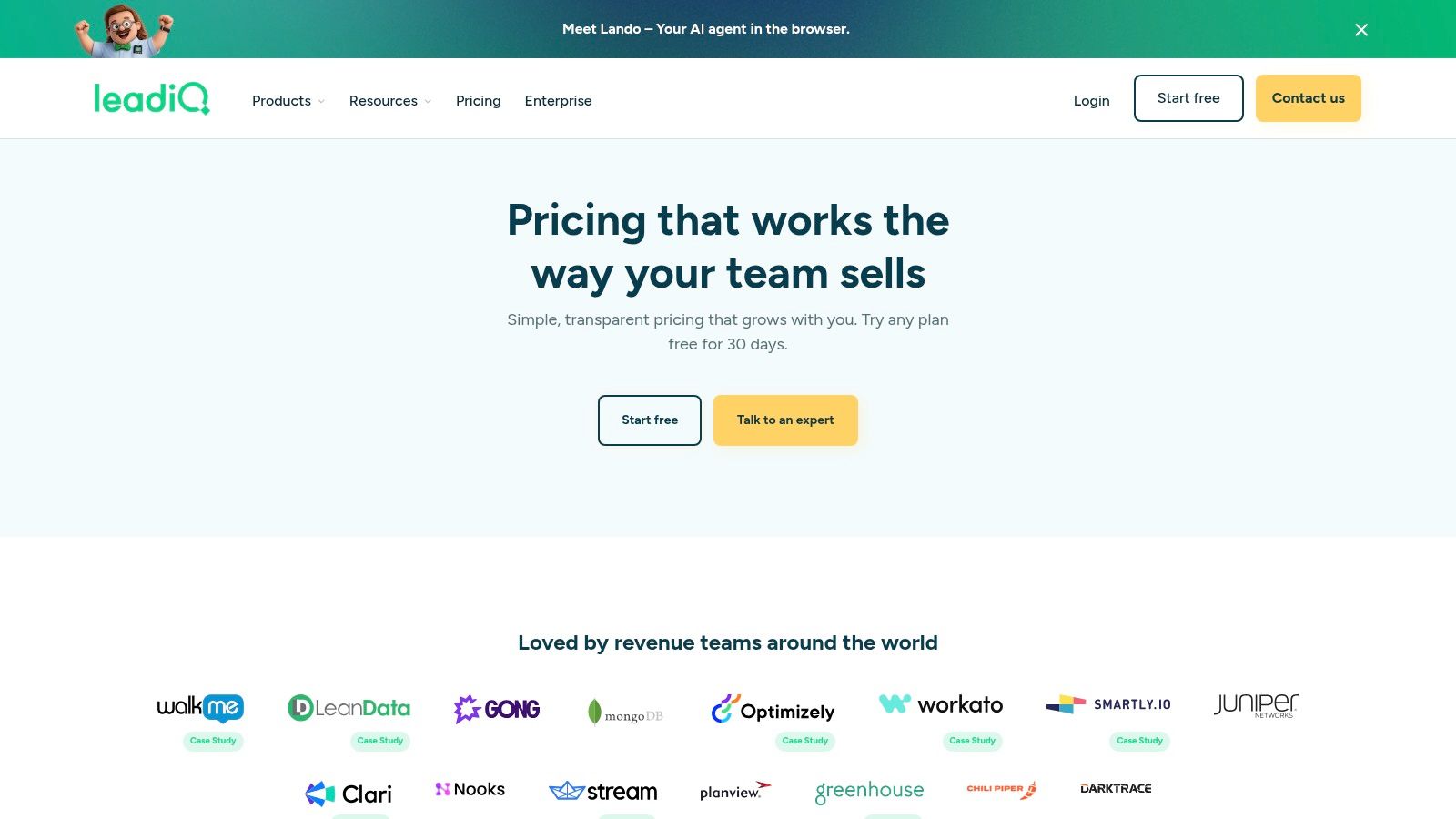
Its main strength is its purpose-built workflow for SDRs. The tool simplifies capturing, enriching, and syncing contacts to Salesforce or HubSpot. It has strong duplicate detection and field mapping controls. This ensures that the data entering the system is clean from the start. Features like job change alerts and an AI-powered message writer support ongoing outreach. The credit-based system is clear, though it can become costly for teams that rely heavily on phone outreach, as mobile numbers use more credits than emails.
While effective for its specific use case, LeadIQ is not an all-in-one data provider. Its database is more limited compared to larger platforms like ZoomInfo or Cognism. It works best as a specialized tool within a broader sales intelligence stack. It fills the gap between prospecting on social networks and executing outreach campaigns.
Best For: SDR teams needing a fast, simple way to capture contacts from LinkedIn and maintain a clean CRM.
Pricing: Free plan available. Paid plans start around $39/user/month with a credit-based model.
Website: leadiq.com/pricing
11. UpLead
UpLead presents itself as a B2B database focused on data accuracy and transparent costs. It is a strong choice for teams that prioritize email deliverability and want to avoid unpredictable pricing. Its core promise is 95% data accuracy. This is backed by a real-time email verification process that runs just before you export a contact list. This step helps protect your sender reputation and makes outreach more efficient.
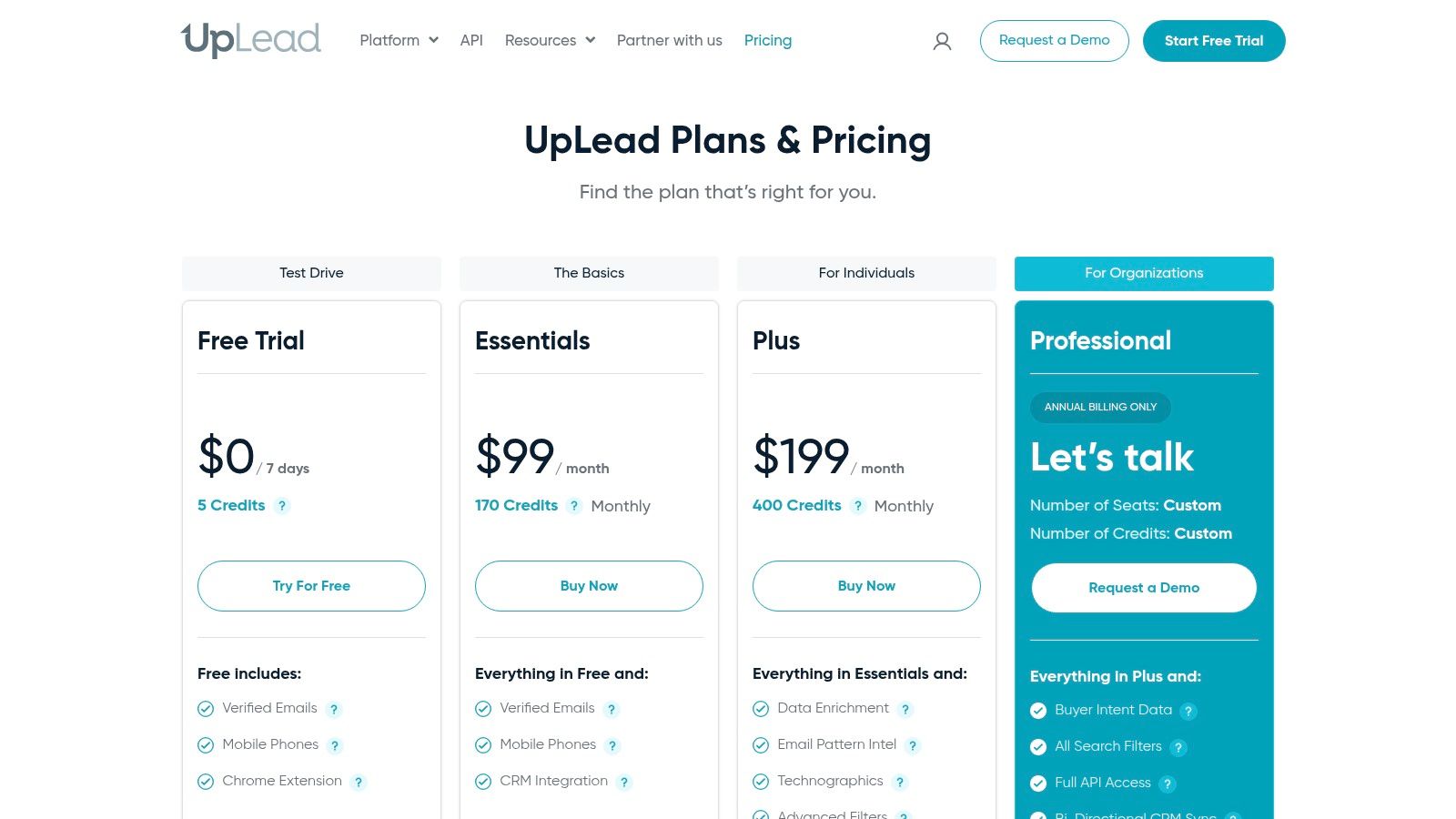
The platform operates on a credit-based system. One credit unlocks a full contact profile, including a verified email and mobile number. This simple model makes it easy to understand what you get for your money. UpLead also includes useful features like technographics, which show what technologies a company uses. It has direct integrations with major CRMs like Salesforce and HubSpot, allowing for smooth workflow implementation. The included 7-day free trial gives teams a practical way to test data quality against their ideal customer profile before committing.
While its focus on verified emails is a big advantage, the credit system means that heavy prospecting can burn through your allowance quickly. This might require a plan upgrade. The depth of contact data, particularly for mobile numbers in regions like Brazil, can vary. It is crucial to use the trial period to check its coverage for your specific target market. As a database, it is one of the more straightforward sales intelligence tools to adopt.
Best For: Sales teams that need a reliable source of verified B2B email contacts with predictable pricing.
Pricing: Starts at $74/month for a single user, with team and professional plans available. A 7-day free trial is offered.
Website: www.uplead.com/pricing/
12. Ramper (Brazil)
Ramper is a Brazil-born platform designed for go-to-market teams in Latin America. It combines B2B prospecting, marketing automation, and a built-in CRM into a single system. The platform’s main advantage is its deep localization for the Brazilian market. It offers a Portuguese user interface, regional support, and guidance on complying with Brazil's General Data Protection Law (LGPD). This focus makes it a practical choice for teams navigating the local business environment.
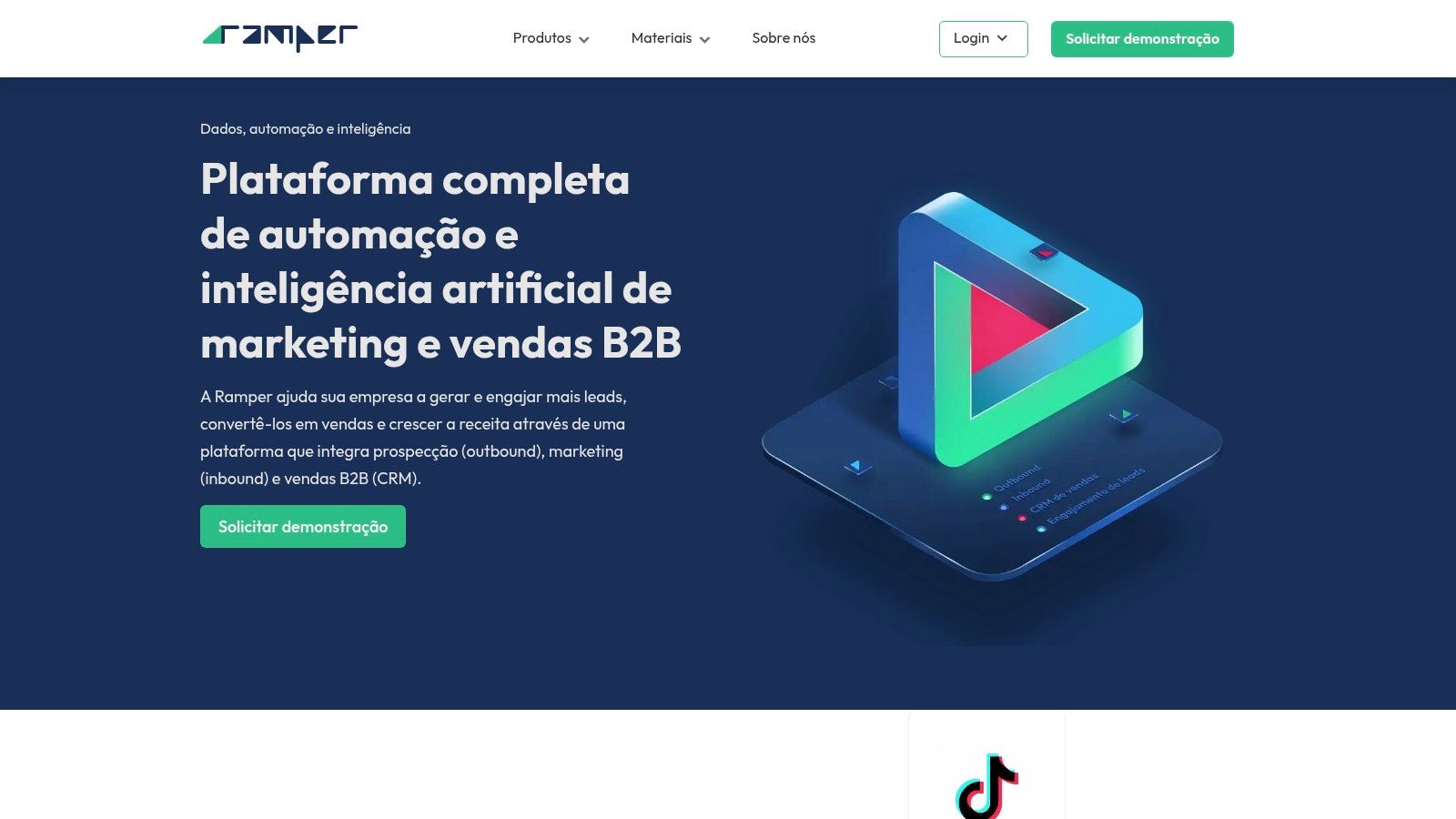
Its core strength is the integration of prospecting and outreach tools. Reps can build prospect lists directly from corporate social profiles and websites. They can then immediately enroll them in automated outbound sequences with email and call tasks. Ramper also includes marketing automation features like landing pages and lead scoring. This helps teams qualify inbound interest before passing it to sales. The system alerts reps when leads are actively engaging, allowing for timely follow-up. This complete workflow, from lead generation to pipeline management, is handled in one tool.
The main limitation of Ramper is its market focus. While perfect for Brazil, its global dataset may not match larger international vendors. This could limit its effectiveness for companies selling worldwide. Pricing is also not public and requires a demo to get a custom quote. This can slow down the evaluation process for teams comparing multiple sales intelligence tools.
Best For: Sales and marketing teams based in Brazil or focused on the Brazilian market.
Pricing: Custom plans available upon request; no public pricing is listed.
Website: ramper.com.br
Top 12 Sales Intelligence Tools Comparison
Product | Core features | UX & Quality (★) | Value & Pricing (💰) | Target audience (👥) | Unique strengths (✨) |
|---|---|---|---|---|---|
Samskit 🏆 | Auto‑join Zoom/Meet/Teams; transcription & analysis; automated CRM updates & sync (SF/HubSpot/Pipedrive/Zoho) | ★★★★☆ (4.9 private beta); 4‑min setup | 💰 Demo/custom; high time‑savings for reps | 👥 Sales reps, managers, CSMs, RevOps | ✨ Actionable next steps & MEDDIC/BANT/SPICED extraction; team analytics; privacy focus 🏆 |
LinkedIn Sales Navigator | Advanced lead/account search; InMail; TeamLink; CRM sync | ★★★★☆; familiar LinkedIn UX | 💰 Seat‑based tiers; predictable for LinkedIn workflows | 👥 B2B sellers, social sellers, account teams | ✨ Largest professional graph; warm‑intro network |
ZoomInfo SalesOS | Company/contact DB; direct dials; intent; enrichment & integrations | ★★★★☆; enterprise feature set | 💰 Enterprise/opaque; modular bundles | 👥 Enterprise sales, RevOps, GTM at scale | ✨ Deep signals (technographics, org charts); DNC tools |
Apollo.io | Large B2B DB; sequences, dialer, scheduler, AI assistant; Chrome ext | ★★★☆☆; rapid iteration | 💰 Aggressive pricing; credit limits | 👥 SMB & mid‑market outbound teams | ✨ High feature density for price; integrated engagement |
Cognism | Global contacts with mobile; DNC screening; CRM integrations | ★★★☆☆; compliance‑oriented | 💰 Custom / generally higher cost | 👥 Teams needing compliance (EMEA/LATAM) | ✨ DNC‑screened mobile coverage; compliance tooling |
Lusha | Credit‑based reveals (email/phone); browser extension; integrations | ★★★☆☆; simple UX | 💰 Credit‑based, transparent pricing | 👥 SDRs and small teams needing quick reveals | ✨ Easy trial/onboarding; straightforward credits |
Clearbit by HubSpot | Real‑time enrichment; Reveal visitor ID; form shortening; HubSpot native | ★★★★☆; native to HubSpot | 💰 Bundled in HubSpot; less modular | 👥 HubSpot‑centric marketing & sales teams | ✨ Native enrichment & audience building inside HubSpot |
6sense Revenue AI | Predictive account scoring; intent & timing; orchestration; CRM views | ★★★★☆; enterprise AI | 💰 Custom/expensive; enterprise investments | 👥 Mature ABM programs, enterprise sales | ✨ Account prioritization & timing intelligence |
Bombora (Company Surge) | Company Surge intent across topics; visitor ID; audience activation | ★★★☆☆; vendor intent data | 💰 Intent‑data pricing; vendor‑agnostic | 👥 Marketing, ABM, demand gen teams | ✨ Broad topic‑level intent for prioritization |
LeadIQ | Chrome capture; dedupe & enrichment; CRM sync; AI message writer | ★★★☆☆; SDR‑focused UX | 💰 Credit model; clear pricing | 👥 SDRs prospecting on LinkedIn | ✨ CRM hygiene, job‑change alerts & clean syncs |
UpLead | Contact unlocks with real‑time email verification; CRM/CSV exports | ★★★★☆; deliverability focus | 💰 Transparent credit pricing; trial available | 👥 Teams prioritizing email deliverability | ✨ Real‑time email verification; predictable cost |
Ramper (Brazil) | Prospecting lists; automated cadences; marketing automation; built‑in CRM | ★★★☆☆; Portuguese UI | 💰 Demo/custom; localized plans | 👥 Brazil‑based GTM teams | ✨ LGPD resources, Portuguese UI & local support |
Making Your Choice: It's About Workflows, Not Just Data
We have explored a dozen powerful sales intelligence tools. They range from broad platforms like ZoomInfo SalesOS and Apollo.io to specialized data providers like Bombora and Ramper. Each offers a unique approach to solving the core challenge of modern sales. This challenge is finding the right people, understanding their needs, and engaging them effectively. Yet, the biggest mistake a team can make is getting impressed by the sheer volume of data a tool promises.
The best sales intelligence tool for your organization is not always the one with the largest database or the most features. It is the one that integrates most naturally into your team's daily activities. It is the one that solves a specific, measurable problem. The central question should always be: "How will this change the way my reps work for the better?"
Shift Your Focus from Features to Outcomes
Before you sign a contract, move your evaluation beyond a simple feature comparison. A long list of capabilities on a pricing page means nothing if your team does not adopt them. Instead, focus on the practical application and the specific outcome you need.
For Prospecting Efficiency: If your BDRs spend hours manually searching for contact details, a tool like Lusha or LeadIQ might be a good fit. The goal is simple: reduce admin time and increase dial volume. Success is measured in more conversations per day, not in the number of contacts in the database.
For Strategic Account Targeting: If you run an account-based marketing (ABM) strategy, intent data from platforms like 6sense or Bombora becomes critical. Here, the outcome is not just more leads. It is higher-quality engagement with accounts that are actively showing buying signals.
For Deeper Deal Intelligence: If your challenge is understanding what happens during sales calls, traditional contact finders fall short. This is where tools like Samskit provide a different kind of intelligence. The objective is to automatically capture deal context, identify risks, and improve forecast accuracy. The desired outcome is a more predictable pipeline and better coaching, based on reality, not just CRM notes.
A Practical Evaluation Framework
As you narrow down your options from this list of sales intelligence tools, ask yourself and your team these workflow-centric questions:
Where does the friction exist? Is it finding accurate mobile numbers? Is it knowing which accounts to prioritize? Or is it losing critical information from a 60-minute demo? Pinpoint the exact bottleneck you want to remove.
How much setup is required? Does the tool need a complex, multi-week implementation managed by RevOps? Or can a sales rep connect it to their CRM and start seeing value in minutes? The answer determines your time-to-value.
Does it reduce or create work? A great tool automates tasks and provides clear signals. A poor one just adds another dashboard to check or more data fields to manually update. Watch for this during your trial.
How does it integrate with our core systems? A smooth, bi-directional sync with your CRM is not negotiable. Data should flow into your system of record, enriching profiles and activities without manual work.
Ultimately, your choice of sales intelligence tools is a strategic one. It is an investment in your team's productivity and effectiveness. The right platform will feel less like an external tool and more like an extension of your own sales process. It will provide the clarity and direction needed to not just hit quota, but to build a truly scalable revenue engine. Choose the platform that empowers your workflows, solves your most pressing challenges, and gives your team a genuine advantage.
While many sales intelligence tools help you find the next customer, what happens once you start the conversation? Samskit captures the ground-truth from your sales meetings, automatically syncing deal context, customer needs, and action items to your CRM. Instead of just giving you more leads, we provide the intelligence to win the deals you already have.