What is revenue operations software? It is not just another tool. Think of it as the connective tissue for your go-to-market teams. It gets your sales, marketing, and customer success departments working as one unit. This software bridges the gaps between them, turning siloed activity into a predictable revenue engine.
What is Revenue Operations Software, Really?
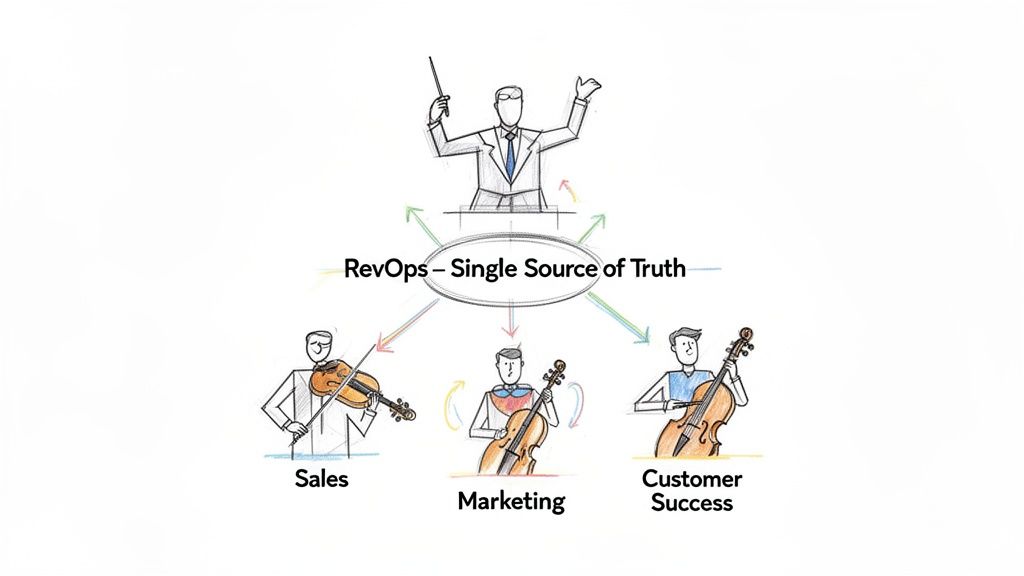
Your business is like an orchestra. Sales are the strings, marketing is percussion, and customer success handles the woodwinds. Without a conductor, each section plays its own tune. The result is noise, not music. Revenue operations software is that conductor. It ensures everyone reads from the same sheet music to create predictable revenue.
The core problem this software solves is fragmentation. Fragmentation kills growth. When teams operate in separate worlds, data gets messy and customer handoffs are fumbled. Forecasting becomes a guess. This internal friction affects your customers. They feel it every time they have an inconsistent or disjointed experience.
The True Purpose of a RevOps Platform
A revenue operations software platform creates a single source of truth for the entire customer journey. It solves the operational problems that CRMs and other tools were not built to handle.
A dedicated RevOps platform focuses on three critical areas:
Unifying Siloed Data: It pulls customer information from your CRM, marketing platform, and support desk. It puts everything into one clean, reliable view.
Automating Manual Work: It handles repetitive tasks like data entry, lead routing, and activity logging. This frees your teams to focus on generating revenue.
Delivering Usable Insights: It gives you clear, accurate analytics on pipeline health and team performance. You can make decisions based on data, not guesswork.
People often confuse RevOps with Sales Ops. They are different. Sales ops optimizes only the sales function. RevOps takes a broader view. It optimizes the entire revenue process, from the first marketing touchpoint through customer renewal.
Why This Matters More Than Ever
In today's market, efficiency is essential for survival. Clunky, manual processes threaten your bottom line. We see this in fast-growing markets. For example, Brazil's e-commerce sector is projected to hit R$224.7 billion by 2025. This boom demands flawless back-end operations.
This shift forces companies to fix their internal inefficiencies. For many sales teams, 70-80% of their processes involve manual CRM updates. This wastes time and creates bad data. Bad data can cost companies up to 20% in lost revenue opportunities. You can explore the full report on Brazil's IT services market for more details.
Ultimately, revenue operations software gives you control over your revenue lifecycle. It connects your teams' daily actions to the revenue they generate. This builds a resilient and scalable foundation for growth.
The Core Capabilities That Unify Your GTM Teams
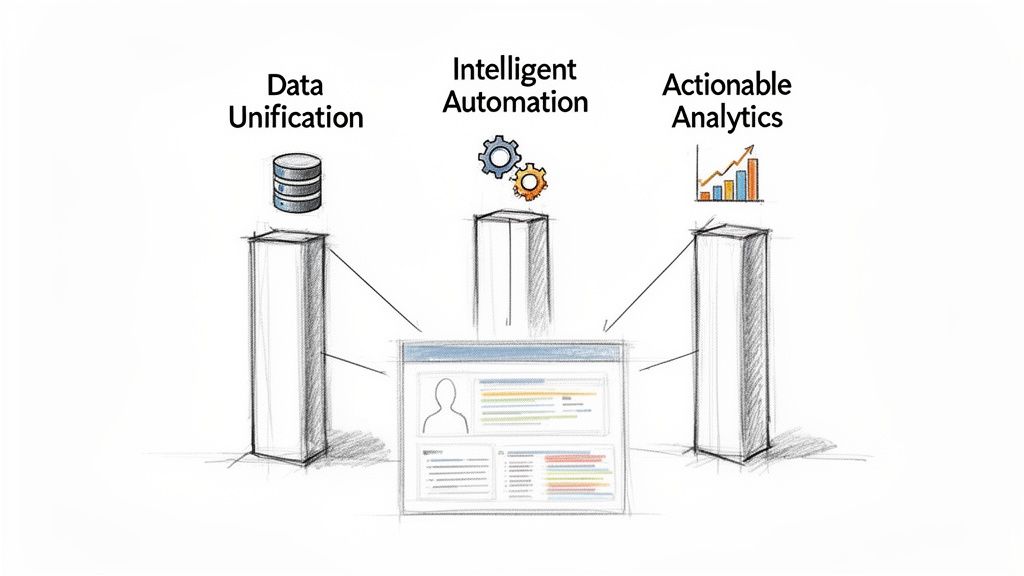
A proper revenue operations platform is more than a list of features. Its job is to unite your go-to-market (GTM) teams by solving the problems that drive them apart. Let's look at the three pillars that actually work. These pillars transform siloed departments into a single revenue engine.
This software changes how your teams see data, run processes, and measure results. It pulls everyone out of their bubbles and points them toward shared, revenue-focused goals. The aim is to create a smooth path from the first ad a prospect sees to their renewal.
Data Unification And Hygiene
Most companies have messy data. Information is scattered across CRMs, marketing tools, and spreadsheets. Revenue operations software acts like a professional organizer. It automatically cleans, de-duplicates, and consolidates that information into one reliable source of truth.
This process has a real daily impact. When a sales rep opens an account, they see the full picture. They see every marketing email opened and every support ticket filed. This context allows for an intelligent conversation. The rep avoids asking questions the customer has already answered three times.
When everyone works from the same playbook, finger-pointing stops.
Marketing can see which campaigns build a real sales pipeline, not just a list of names.
Sales gets a complete view of a prospect's journey before the first call.
Customer Success knows what was promised during the sale, leading to smoother onboarding.
Getting this alignment right matters. According to Boston Consulting Group, organizations that achieve this see a 10% to 20% increase in sales productivity. It all starts with clean, accessible data.
Intelligent Process Automation
The second pillar is automating tedious tasks. We are not talking about simple calendar reminders. A modern revenue operations platform uses intelligence to handle complex processes like lead routing, territory assignments, and commission calculations.
Think about the admin that follows a sales call. A rep can spend 30 minutes re-watching a recording, typing notes, and updating CRM fields. That is a half-hour they could have spent on another call.
An intelligent assistant like Samskit can join your meetings. It transcribes the conversation and automatically pushes structured notes and action items into the correct CRM opportunity. This one automation saves a rep hours each week and keeps deal data current.
This kind of automation does not replace people. It lets them do the work they were hired for. By automating tasks like quoting, contract generation, and post-call data entry, you clear roadblocks that slow your sales cycle.
Actionable Analytics And Forecasting
Finally, a true revenue operations platform delivers analytics that tell you what to do next. It moves beyond vanity metrics like call volume. It offers predictive insights into pipeline health, team performance, and where your revenue is headed.
Because all your data is unified, the software can connect activity to outcome. You can see which sales behaviors lead to closed deals. You can identify which marketing channels bring in customers with the highest lifetime value.
This gives your leadership confidence to forecast accurately. Instead of using gut feelings, they can use data-driven models to get a realistic view of the quarter. Public companies with a dedicated RevOps function report 71% higher stock performance. This shows the value of predictability. With actionable analytics, you can spot trouble early and make corrections before it is too late.
How to Evaluate The Right RevOps Software for Your Business
Picking the right RevOps software is about your process, not the product. Before you book a demo, get your sales, marketing, and customer success leaders in a room. Map your entire customer journey on a whiteboard, from first touchpoint to renewal.
This is not a simple exercise. It is an honest conversation about where things break. Does the handoff from marketing to sales lose good leads? Do reps spend more time on CRM admin than on selling? Mapping this out identifies the real friction in your revenue engine. This creates a practical checklist of problems a new platform must solve. It stops you from being distracted by flashy features that do not address your core issues.
Focus on Seamless Integration
A RevOps platform that does not integrate with your existing tools is harmful. It creates more work and new data silos, the exact problems you are trying to solve. Your top evaluation point should be how deeply the software integrates with your core tech stack.
Do not accept a simple "yes" from a vendor. Ask tough, workflow-based questions. Instead of, "Do you integrate with Salesforce?" ask, "Show me how your tool automatically pushes call notes, action items, and a meeting recording into a Salesforce opportunity, without a rep doing anything." The difference in those questions is critical.
You need to test your key integrations, which almost certainly include:
CRM: Tools like Salesforce or HubSpot. The connection must be deep and bi-directional.
Communication Tools: Platforms like Slack or Microsoft Teams. Can the software send real-time deal alerts to your team's channels?
Marketing Automation: Tools such as Marketo or Pardot. Data must flow smoothly between marketing activities and sales results.
Prioritise User Adoption and Ease of Use
Here is a hard truth: the most powerful revenue operations software is worthless if your team will not use it. Sales reps and ops managers have low tolerance for clunky software. If a new tool adds friction to their day, they will work around it. Your investment becomes expensive shelfware.
The test for adoption is simple: does the software save your team time, or does it create more work? A platform that automates tedious CRM updates provides immediate value. This is how adoption becomes a welcome relief for your team, not a mandate.
In a demo, demand to see the end-user's perspective. How many clicks does a common task take? Is the interface intuitive? Or will everyone need a user manual? Better yet, run a small pilot with a few reps. Get their honest feedback before you sign a contract. You can find more practical tips on this in our guide to improving your CRM and inside sales process.
Demand Scalability and Reporting Flexibility
Your business plans to grow. Your software must be ready to grow with you. A solution for ten reps might fail with one hundred. Scalability is not just about adding user licenses. It is about the platform's ability to handle more complex territories, rules, and processes as your GTM strategy evolves.
Reporting flexibility is just as important. Your leadership team wants dashboards that connect team activities to revenue, not just vanity metrics. Can you build a report that shows pipeline health based on conversational data? Can you forecast with confidence because your data is clean and centralized?
The right tool gives you answers, not just more data. This is a competitive necessity, especially in high-growth regions. The Brazilian market for this kind of software is projected to jump from USD 4.49 billion in 2025 to USD 9.56 billion by 2030. This growth is fueled by companies fixing broken processes that cause an estimated 30% pipeline leakage due to poor data visibility. Discover more about Brazil's growing RevOps software market and see why a solid platform is no longer optional.
Your Step-By-Step Implementation Plan
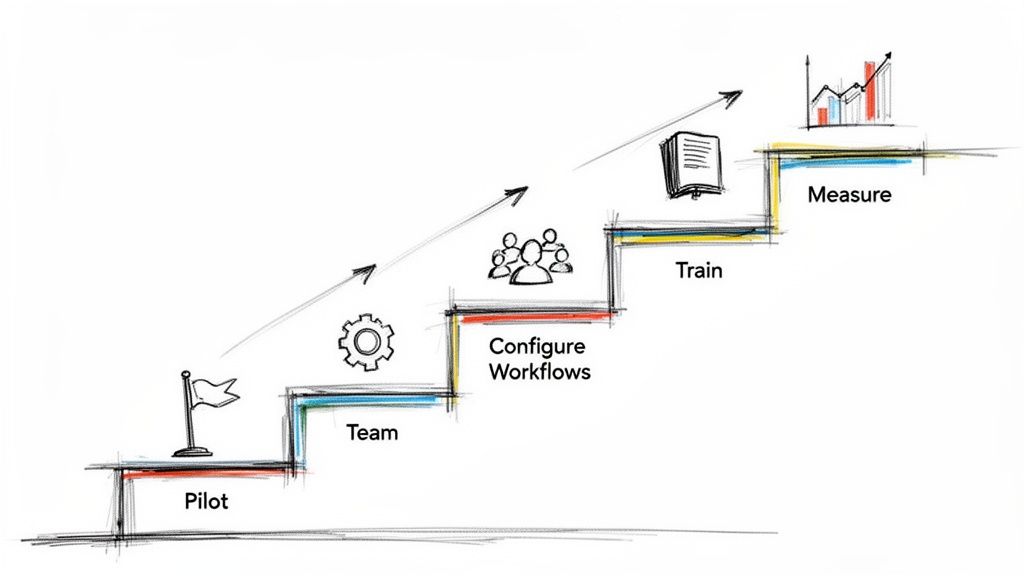
Rolling out new revenue operations software can feel overwhelming. A common mistake is the "big bang" launch—turning on every feature at once and hoping for the best. This usually ends in confusion, poor adoption, and a return to old, broken processes.
A smarter approach is to think of implementation as a series of small wins. Focus on delivering immediate value to a small group first. This builds momentum and provides crucial feedback. It also creates a solid business case for a company-wide rollout.
This practical guide helps you get a return on your RevOps platform as quickly as possible.
Define Clear, Narrow Objectives
Your first move is to define the most important problem you want to solve. Vague goals like "improve efficiency" are useless. You need a specific, measurable target.
Ask your teams: What is the most painful, time-consuming task we do every day? The answer is often manual data entry in the CRM.
A great starting objective is: “Reduce the time our sales reps spend on post-call CRM updates by 50% in the first 90 days.”
This objective works because it is:
Specific: It targets one workflow—CRM updates after a call.
Measurable: Success is tracked by time saved.
Achievable: It focuses on a high-pain, high-gain area the software is built for.
Starting with a tight scope sets a realistic goal. It lets the software prove its worth immediately.
Build Your Pilot Implementation Team
You need buy-in from the start. An implementation led only by the ops team will fail. Your initial team should be a small, cross-functional group of people who will use the software.
This pilot team is your champion and feedback engine. Include stakeholders who feel the pain of the current process most acutely.
Your team should have members from sales, marketing, and customer success. A sales rep who hates manual admin, a marketing manager who cannot track lead quality, and a CS manager frustrated by poor handoffs are perfect candidates. Their success stories will become your internal marketing for the full rollout.
This group will test the initial workflows, give honest feedback, and help refine the process before it goes live to the whole company.
Configure High-Impact Workflows First
Now you can touch the software. Resist configuring every feature. Go straight to the workflow that solves your defined problem. Focus on automating your most broken process, not your most complex one.
For example, if your goal is to reduce CRM admin time, your first configuration should be automatic call transcription and CRM data syncing. Do not get bogged down with complex lead-scoring rules or forecasting dashboards yet.
The goal is a quick win. You want your pilot team to feel immediate relief from a daily headache. The moment a rep sees call notes logged automatically in the CRM, you have created a fan.
Drive Adoption Through Workflow Training
Do not just give your team a new tool and a user guide. Training should be about workflows, not features. Teach them how to solve their problem with the tool.
Frame your training around a "before and after" story. Show the old, painful way. Then, walk them through the new, automated workflow. Focus on the time saved and headaches eliminated.
For example, name your training session "How to Never Manually Update Salesforce Again." This is more effective than "Samskit Feature Overview." Make it hands-on and let them run through the new workflow themselves.
Measure What Matters and Prove ROI
Finally, prove that it worked. Since you set a clear, measurable objective, this part is simple. Use the revenue operations software's analytics to track progress against your goal.
Gather metrics on:
Adoption Rates: How many people in the pilot team actively use the new workflow?
Time Saved: Survey the pilot team or use platform analytics to quantify hours saved.
Data Quality: Is CRM data more complete and accurate with automation?
Present these findings to leadership. Showing a 50% reduction in admin time for the pilot group builds momentum. It secures the resources you need for a full deployment.
Where the Rubber Meets the Road: Real-World Workflows That Work
Let's move past theory and look at how revenue operations software untangles the messy workflows that impact your quarter. These are practical ways to give your team an edge. The goal is to transform chaotic, manual tasks into smooth, repeatable systems. Here are three examples showing how a platform like Samskit overhauls core business processes, starting with the sales call.
The Zero-Admin Sales Call
A top account executive finishes a 45-minute discovery call. What comes next? A half-hour of admin: re-listening to the recording, deciphering notes, and updating CRM fields. This is a massive drain on their time.
Now, imagine a different scenario powered by an AI assistant that joins the call. The tool analyzes the dialogue as it happens, automatically identifying and tagging critical information. When the rep hangs up, the software works.
It pinpoints every action item, buyer pain point, and competitor mention.
It flags potential risks or objections raised by the prospect.
It syncs a concise, structured summary to the right CRM opportunity, populating fields and attaching the recording.
This is the ‘zero-admin’ sales call. Your rep hangs up and focuses on the next revenue-generating activity, not data entry. The CRM is updated instantly and accurately. This saves hours each week and ensures trustworthy deal data. See how this works in our guide on how an AI note-taking app transforms sales workflows.
To make this clear, here is a step-by-step breakdown of how a platform like Samskit automates this process.
Example Workflow Automation with Samskit
This table shows how a sales call transforms from a manual task into an automated, data-rich event.
Step | Action | Responsible Party | Outcome |
|---|---|---|---|
1 | Sales rep starts a discovery call with a prospect. | Sales Rep | Conversation begins. |
2 | AI assistant automatically joins, records, and transcribes the call in real-time. | Samskit Software | Full, accurate transcript is created. |
3 | Software analyses the transcript for key business insights (e.g., pain points, budget, next steps). | Samskit Software | Structured data is extracted from unstructured conversation. |
4 | Call ends. AI generates a summary and syncs all notes, data points, and the recording to the CRM. | Samskit Software | CRM opportunity is updated instantly with zero manual work. |
As you can see, the sales rep only needs to sell. The software handles all administrative overhead. No detail is lost.
The Seamless Customer Handoff
A sloppy handoff from Sales to Customer Success (CS) is an easy way to start a new relationship badly. When a deal closes, the CS team often gets disconnected notes or nothing at all. They must ask discovery questions again, creating friction and undermining customer confidence.
The structured data from the zero-admin sales call solves this. That automated CRM summary is the perfect handoff document for the CS team.
Because the revenue operations software captured every promise, pain point, and goal from the sales process, the onboarding team has a complete history. They can start the relationship from a position of knowledge and trust.
This smooth transition directly impacts customer retention. Your CS team knows what success looks like for the client from day one. They can tailor onboarding to specific needs, avoiding frustrating "start from scratch" conversations that lead to churn.
The Data-Driven Deal Review
Finally, let's look at how clean, automated data empowers sales managers. Deal reviews are often based on a rep’s subjective optimism. This leads to "happy ears" and a pipeline full of deals that were never going to close.
With revenue operations software, managers can inspect pipeline health with objective evidence. They can analyze call data across the team to spot execution gaps. This allows for coaching that actually improves performance.
For example, a manager might notice deals stalling after the pricing discussion. Instead of guessing why, they can dive into call transcripts. Are reps struggling to articulate value? Are they fumbling pricing objections? This allows for targeted, evidence-based coaching, not generic advice.
The results are clear. Revenue leaders report that teams using these AI-powered tools achieve a 25% faster sales cycle and 15% higher close rates. In a market where multi-cloud adoption is already at 54% among Brazilian firms, integrated tools are mission-critical. You can read more about the Brazilian IT market trends to understand why. By freeing AEs to sell instead of taking notes and ensuring structured handoffs, this process alone has been shown to reduce churn risk by 18%.
The Future of Revenue Operations Is Autonomous
The conversation around revenue operations software is changing. For years, we have talked about tools that assist our teams. Now, we are moving toward tools that operate autonomously. The future is not just about making workflows easier. It is about building systems that run parts of the revenue process on their own. This frees your people for strategic, human-centric work.
This is not science fiction. It is the reality being built with artificial intelligence. AI allows these platforms to deliver accurate forecasts by analyzing real-time conversational data, not just old pipeline metrics. Imagine a system that flags a deal at risk because it detected hesitation in a customer's voice. That is the new standard.
From Assistance to Autonomy
The goal is to get as close to zero admin as possible. Modern software can now independently manage entire processes. It can update your pipeline the moment a meeting ends, based on what was said. This ensures your CRM data is always fresh and reliable, without a rep doing anything.
This diagram shows what a 'zero-admin' sales call process looks like.
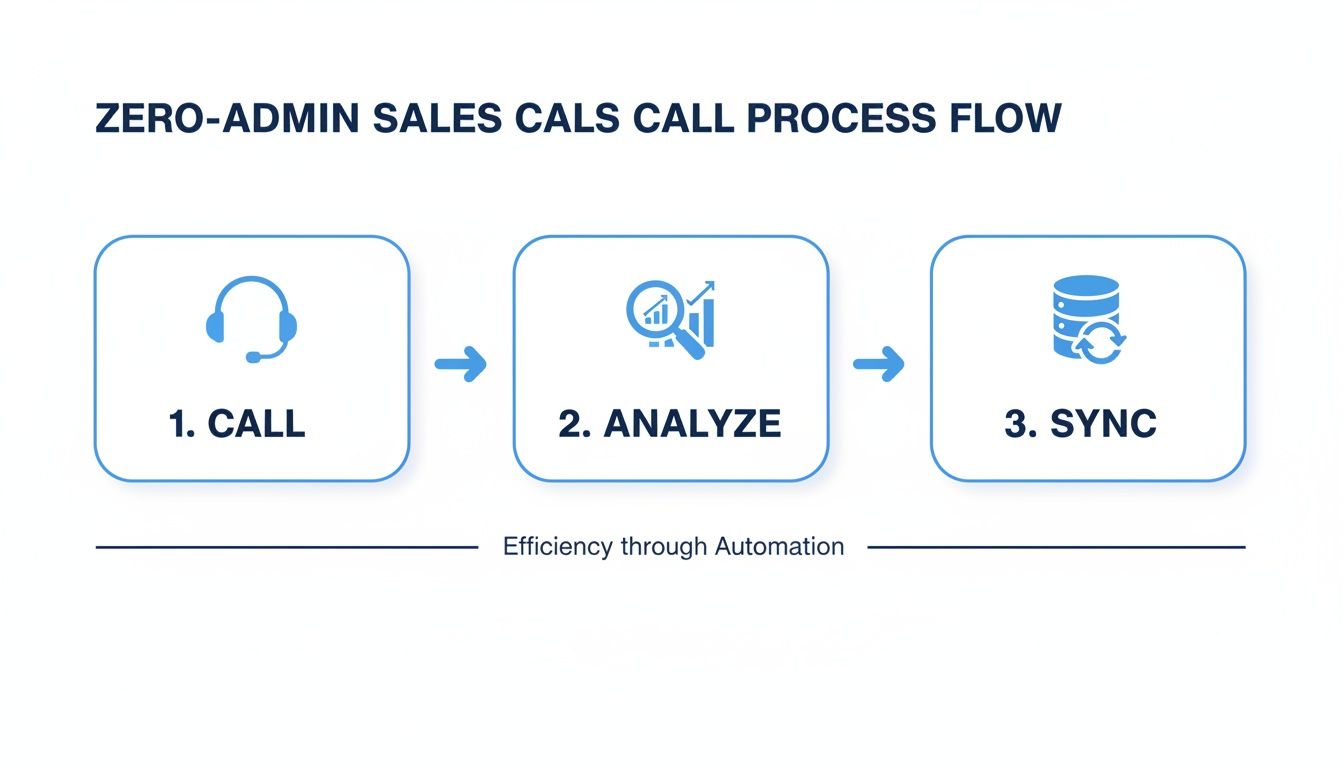
The key takeaway is that human effort goes into the conversation. The software autonomously handles the analysis and data entry that follows.
For instance, a B2B sales rep in Brazil closes a contract over Google Meet. An autonomous tool like Samskit can record the call, analyze it for commitments, and automatically sync details into their Zoho CRM. This automated workflow gives back 10-15 hours weekly per seller. They can now spend that time on activities that drive revenue. This model is gaining traction in Brazil’s IT services market. Cleaner handoffs to customer success teams also help reduce onboarding friction and cut churn by up to 22%. You can learn more about the operational software trends in Brazil to see the bigger picture.
Investing in an AI-native platform is about preparing for an autonomous future. It secures a competitive edge for years to come. The right software grows with you, learning and taking on more operational work over time.
Frequently Asked Questions
Thinking about revenue operations software brings up a few key questions. Let's tackle cost, team roles, and how to get started.
How Much Does Revenue Operations Software Cost?
The price of revenue operations software varies. Most platforms use a per-user, per-month model with different tiers.
But the sticker price is not the whole story. The real cost includes setup and training time. A cheap tool that no one uses is more expensive than a platform that delivers a clear return. Map the software's license fee against the value it creates, like hours saved on admin or a boost in sales productivity.
What Roles Do I Need on My Team to Use It?
You do not need to hire a new department to get started. Often, a sales or operations leader who feels the pain of disconnected systems champions the project.
As you grow, you might build a formal RevOps team. To begin, you just need a few key people:
A Project Lead: Someone who understands your GTM process and can own the implementation.
Team Champions: A few enthusiastic users from sales, marketing, and customer success to help test the software and get others on board.
The best revenue operations software is built for the people doing the work. It should not require a team of developers to maintain.
What Are the First Steps to Get Started?
Getting started is about your process, not the tech. Before you look at a demo, map out your current revenue process.
Find your single biggest bottleneck. What one thing creates the most friction and wastes the most time? That is your starting point.
The demand for this efficiency is clear. In Brazil, the related market for manufacturing operations management software was USD 441.8 million in 2024 and is projected to reach USD 1,731.5 million by 2033. This growth is fueled by tools that deliver results, like cutting deal review time by 40% and increasing efficiency by 20-30%. You can discover more about Brazil's operations software market trends. Focus on solving one high-priority problem first to get a quick, measurable win.
Ready to stop chasing your team for manual CRM updates and give them more time to sell? Samskit turns your customer conversations into reliable data and actionable next steps, automatically. See how it works at https://samskit.com.