
Pipeline management is the active process of organizing and tracking opportunities through your sales process. It's the system that turns potential deals into predictable revenue. Forget wishful thinking; this is about controlling the flow of business from the first call to the final signature.
What Is Sales Pipeline Management and Why It Matters
Think of your sales pipeline as a logistics network. Your job is to move deals from lead generation to a closed-won state as efficiently as possible. Effective pipeline management isn't just counting deals; it's clearing roadblocks, managing speed, and ensuring every opportunity is on the right path.
This active control is what separates high-performing sales teams from the rest. When you manage your pipeline, you stop reacting to monthly numbers and start shaping them. This gives you the clarity to make forward-thinking decisions.
From Guesswork to Predictable Revenue
An unmanaged pipeline is a mess. It's clogged with stalled deals and driven by guesswork. Reps feel busy, but opportunities stall for unknown reasons. Forecasting revenue becomes a shot in the dark. This creates a chaotic cycle where managers chase reps for updates and deals slip through the cracks.
A well-managed pipeline is a predictable revenue engine. By setting up clear stages and rules, you build a smooth, data-driven system. This clarity makes your forecast more reliable and gives you a real-time pulse on your business's health.
Effective pipeline management gives sales teams the visibility and control to convert more leads into customers, faster. It’s the difference between hoping for revenue and actively building it.
Key Benefits of a Managed Pipeline
When you take pipeline management seriously, the benefits build over time, creating a more resilient sales organization.
Accurate Sales Forecasting: A clear view of where each deal stands lets you predict future revenue with confidence. This is crucial for budgeting, resource allocation, and setting achievable company goals.
Improved Sales Efficiency: Reps can stop wasting time on dead-end leads. They can focus their energy on the most promising opportunities. This means more time in high-value conversations and less administrative work.
Higher Win Rates: Spotting stalled deals or risks early allows teams to focus on opportunities with the best chance of closing. For a deeper look, check this guide on how to build a sales pipeline that converts.
Shorter Sales Cycles: Pinpointing bottlenecks in your process helps you fix what's broken. Removing this friction allows deals to move through the stages faster, boosting your team's velocity.
The contrast between a manually managed pipeline and one supported by automated tools is stark. One relies on memory; the other is built on real-time data and process.
Manual Guesswork vs Automated Pipeline Management
Aspect | Manual Management | Automated Management |
|---|---|---|
Data Accuracy | Relies on reps manually entering data; often outdated or incomplete. | Captures meeting and email data automatically, ensuring information is always current. |
Forecasting | Based on "gut feel" and reps' opinions; highly unreliable. | Data-driven and based on actual deal progression and engagement signals. |
Rep Productivity | Reps spend hours on CRM data entry and administrative tasks. | Reps focus on selling, as admin work is handled automatically. |
Manager Coaching | Based on lagging indicators and anecdotal evidence from reps. | Focused on leading indicators and real-time deal health signals. |
Deal Visibility | "What happened?" – Managers are often in the dark until it's too late. | "What's happening now?" – Full visibility into deal activity and risks as they emerge. |
Relying on manual updates is like navigating with a hand-drawn map. An automated approach provides a live GPS with real-time alerts, showing a clear path to your destination: consistent, predictable revenue.
How to Design Pipeline Stages That Reflect Reality
Many sales pipelines are built around the sales team’s to-do list, not the customer’s buying journey. This is a common mistake.
Stages like "Demo Scheduled" or "Follow-up Sent" tell you your reps are busy. They tell you nothing about whether a customer is closer to buying. This turns your CRM into an activity log, not a reliable forecasting engine.
To get pipeline management right, you must shift your perspective. Your pipeline stages must mirror the buyer's journey. Each stage advancement needs to be tied to a concrete commitment from the customer. This is the only way to know if a deal is actually progressing.
This is the difference between chaos and clarity.
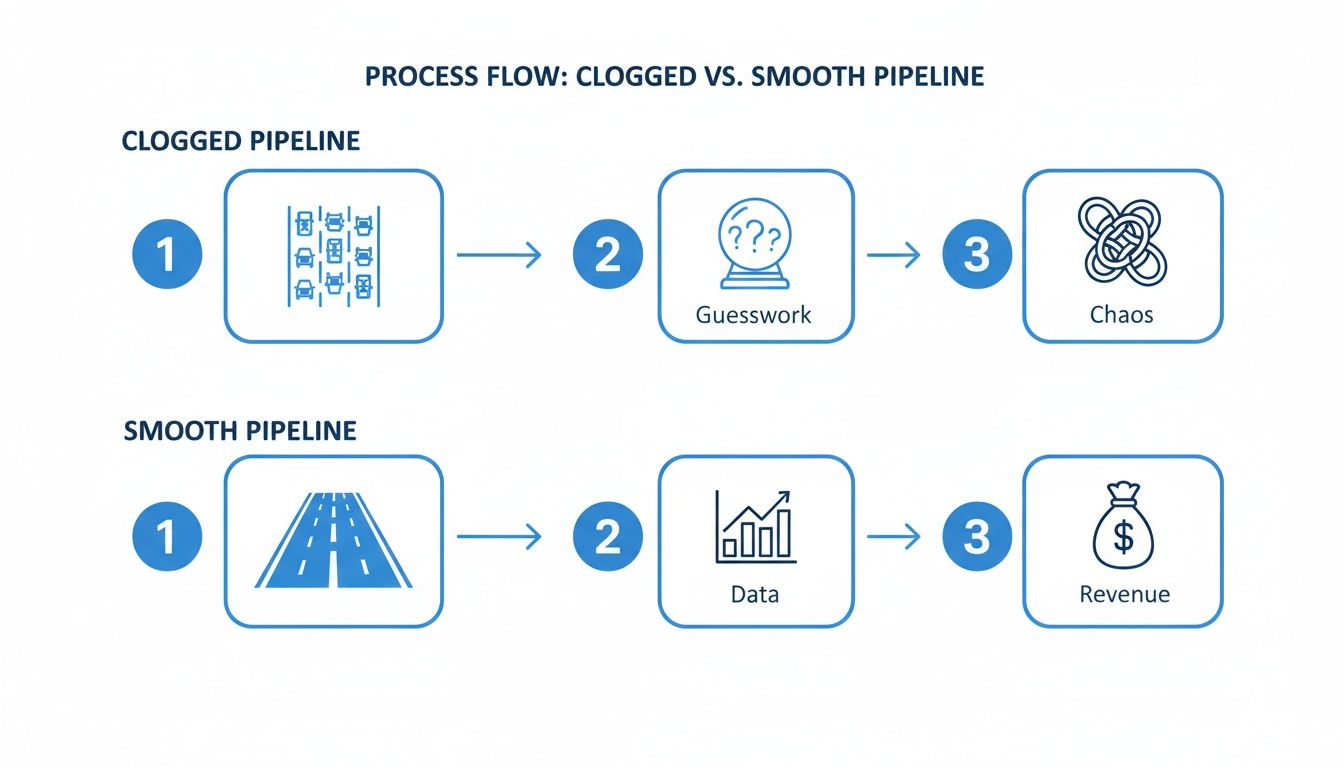
A pipeline choked with guesswork leads to missed forecasts. A smooth, data-driven pipeline, built on real buyer signals, predictably generates revenue. It all starts with how you design your stages.
Build Stages Around Buyer Milestones
To build a pipeline that reflects reality, every stage must have strict, non-negotiable exit criteria. These are not tasks for your rep. They are tangible commitments you get from the buyer. A deal cannot move forward until you have documented proof of that commitment.
For example, a deal doesn't move from "Discovery" to "Solution Validation" just because a call happened. To advance, the buyer must have explicitly confirmed their main challenges. They must also agree that your solution is a potential fit worth exploring with other stakeholders.
A pipeline stage without a clear, buyer-centric exit criterion is just a guess. Real progress is measured by customer commitment, not sales activity.
This evidence-based approach forces discipline into your sales process. It gets rid of "happy ears" and ensures a deal’s position is based on facts. Your CRM becomes a genuine source of truth.
A Practical Pipeline Stage Template
For most B2B sales organizations, 5-7 core stages are enough. The goal is to track meaningful forward movement without overcomplicating the process.
Here is a practical framework you can adapt:
Stage 1: Qualification The opportunity is created. Initial research confirms it fits your Ideal Customer Profile (ICP). A potential contact has been identified.
Stage 2: Discovery Your rep has connected with a key contact. They have confirmed a business pain the company is actively trying to solve. The buyer has agreed to a deeper exploratory meeting.
Stage 3: Solution Validation The buyer has acknowledged their specific challenges and confirmed key decision-makers. They have agreed your proposed solution is a viable way forward and commit to a formal evaluation or detailed demo with the full buying committee.
Stage 4: Proposal After validating the solution, the buyer has requested a formal proposal. All key stakeholders have reviewed the solution, and it meets their requirements.
Stage 5: Negotiation & Close The buyer has the proposal. They are actively discussing terms, pricing, and contracts. There's a clear, mutually agreed-upon timeline for a final decision.
This structure gives you a clear map for every deal. For a detailed look at visualizing this, see our guide on creating a sales process flowchart.
By enforcing these buyer-centric exit criteria, you can be confident that when a deal moves to the next stage, it represents real, measurable progress.
The Real Metrics That Reveal Your Pipeline’s Health
A pipeline full of deals can look great on a dashboard but be a dangerous illusion. Counting opportunities is a vanity metric. It tells you nothing about their quality or your chances of winning.
To understand your pipeline's health, you have to go deeper. Think of your key metrics as a doctor's chart for your sales engine. Each one is a vital sign.
A high win rate might look healthy, but if your average deal size is small, you're just spinning your wheels. A long sales cycle paired with a low win rate is a clear symptom of reps wasting time on deals that were never going to close. The skill isn't just knowing the numbers—it's reading them together to diagnose problems before they hurt your revenue.
Pipeline Velocity
If you track only one "power" metric, make it Pipeline Velocity. It combines several vital signs into one number. It tells you how much revenue moves through your pipeline each day. It is the true speed of your revenue engine.
The formula is: (Number of Opportunities x Average Deal Size x Win Rate) / Sales Cycle Length (in days)
A higher velocity means you are closing more deals, bigger deals, or closing them faster. Tracking this over time shows the real impact of your decisions. For instance, if you roll out a new qualification process and your velocity increases, you know you are on the right track.
Win Rate
Your win rate provides a dose of reality. It's the percentage of concluded deals (won or lost) that you actually won. Do not calculate this based on all your open deals. That will give you an inaccurate number.
Win rate cuts through the noise of a busy pipeline. It shows how often your team's work results in a signed contract. A consistently low win rate often points to issues in how you qualify leads or demonstrate value.
For example, losing many deals after the proposal stage is a red flag. It suggests your proposals are not effective, or you missed a key decision-maker earlier. By analyzing win rates at each stage, you can pinpoint where deals are failing and coach your team on how to fix it.
Average Deal Size and Sales Cycle Length
These two metrics should always be analyzed together. They provide crucial context about your sales team's efficiency and focus.
Average Deal Size: This is the average value of all your closed-won deals over a set period. If this number is shrinking, your team may be discounting too aggressively or chasing smaller deals instead of strategic accounts.
Sales Cycle Length: This measures the average time it takes for a deal to move from creation to close. A longer sales cycle could indicate new friction in your process, more complex buying decisions, or reps struggling to build urgency.
This is where real diagnosis happens. A short sales cycle but a low average deal size? Your team is likely chasing easy wins instead of more valuable contracts. A large average deal size but a long sales cycle and low win rate? This suggests reps are sinking too much time into large deals they cannot realistically close.
This need for an efficient flow is not unique to sales. In 2025, Brazil’s oil and gas output hit a record 4.897 million BOE/d, a 13.3% increase. This surge put immense strain on the country's 9,400 km pipeline network. Just as their physical infrastructure must handle increased volume without bottlenecks, your sales pipeline must be robust enough to manage more deals without them getting stuck. You can explore more about Brazil's production records to see how critical infrastructure is when facing a surge in volume.
Diagnosing and Fixing Common Pipeline Problems
You built an organized sales pipeline. It looks great. But what happens when deals stop moving? Even well-designed pipelines encounter problems. True pipeline management is not just about setup; it's about constantly diagnosing and fixing clogs and kinks.
Think of yourself as a pipeline doctor. You spot the symptoms, find the root cause, and prescribe the right treatment. Telling your reps to "close more" is like shouting at a car with a flat tire. It misses the point. The fix is in the system, not the driver.
The Bloated Pipeline: Deals Going Stale
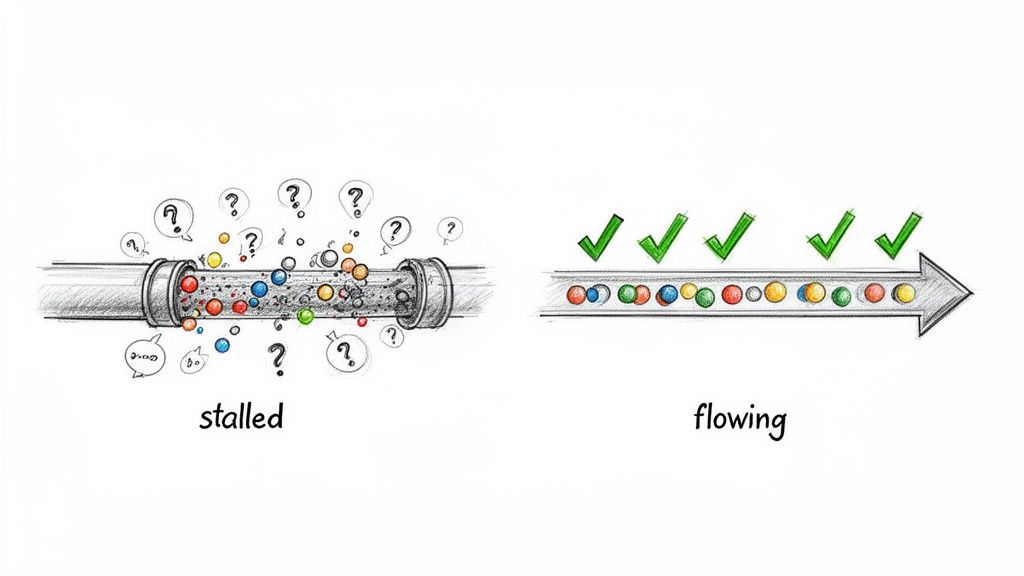
This is a common problem: the bloated pipeline. It is packed with opportunities that have not moved in weeks or months. They sit there, making your forecast look good while they quietly die.
This problem almost always stems from one issue: a failure to establish urgency or lock in a clear, mutual next step. A rep might have a great initial call, but if they hang up without a firm, time-bound action item from the buyer, the deal will stall.
A stalled deal is a symptom of a process problem, not a lazy rep. It means the value wasn't compelling enough for the buyer to commit to the next step, or the next step itself was never clearly defined.
First, define what "stalled" means for your sales cycle (e.g., no meaningful activity for over 21 days). Filter your CRM to find these deals. The solution is not a generic "just checking in" email. It's re-engaging with a specific, high-value reason that forces a decision.
The Lumpy Pipeline: From Feast to Famine
Another classic problem is the "lumpy" pipeline. Your revenue stream is a rollercoaster—a huge quarter followed by a disastrous one. This makes planning for growth feel like a guessing game.
The culprit is usually inconsistent prospecting. Reps prospect hard for two weeks, filling the top of their pipeline. Then they spend the next six weeks focusing only on closing, neglecting to add new opportunities. After those deals close, they find the well is dry, leading to a drought.
The only way to smooth out a lumpy pipeline is to make prospecting a consistent habit. It should be a daily or weekly rhythm, not a frantic sprint. This ensures a steady flow of new deals, which translates to more predictable revenue.
The Leaky Pipeline: Opportunities Vanishing into Thin Air
Finally, there’s the leaky pipeline. Deals seem to disappear between stages. You might have a high volume of incoming opportunities, but very few make it to the proposal stage.
A leaky pipeline indicates poor qualification. Your team is pouring unqualified leads into the system. They burn time and energy on deals that were never a good fit, only for the buyer to go dark or admit they lack budget or authority.
The fix is to be ruthless about upfront qualification using verifiable criteria. Before an opportunity enters the core pipeline, your team must confirm the prospect has a real, acknowledged problem, a budget, and the authority to sign. Refining this process is key. Explore various sales funnel optimization strategies to plug these leaks for good.
The need for solid infrastructure is universal. Take Brazil's gas pipeline network. After reforms in 2023, production ramped up, but the pipeline system is now struggling to keep pace. This bottleneck highlights the need for clear visibility. Robust analytics can turn call insights into clear CRM data, preventing valuable leads from getting lost in an underbuilt system. You can read about Brazil's pipeline expansion challenges and see the powerful parallels.
Using Automation to Create a Pipeline Based on Facts
If your pipeline relies on reps manually updating the CRM, you have a work of fiction. When data entry depends on someone remembering to log a call, your pipeline is built on guesswork. This flawed data makes accurate forecasting impossible and forces managers to chase reps for updates instead of coaching them.
The only way out is to build your pipeline on a foundation of facts, not feelings. This means capturing deal intelligence directly from customer conversations. Modern pipeline management roots your process in hard evidence.
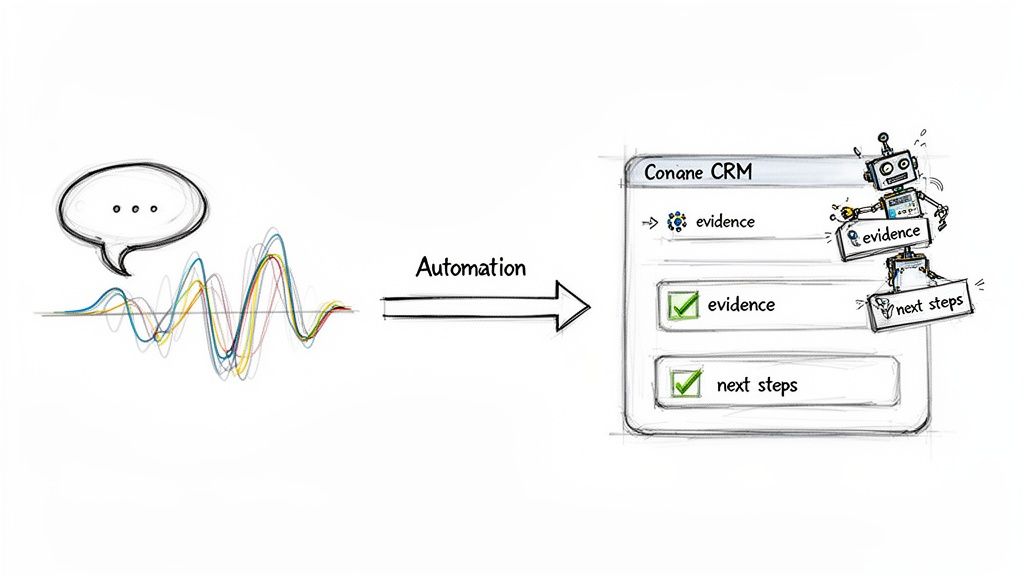
This is what it looks like in practice. Raw conversation data is automatically analyzed and sorted. The system identifies important moments and commitments, then uses that proof to create accurate tasks and update the CRM.
Shifting from Manual Entry to Automated Insights
Conversation intelligence tools drive this modern approach. These systems don't just record and transcribe calls. Their real value is in analysis. They are trained to listen for key signals that reveal a deal's true health.
It works by identifying specific words and phrases that signal genuine buyer commitment.
Buyer Intent: The system flags buying signals, like "This solves a major problem for us" or "When can we get started?"
Budget Confirmation: It can recognize when a customer confirms they have money, such as hearing, "We have a budget of £50,000 for this project."
Agreed Next Steps: It captures concrete commitments, like a buyer saying, "Let's schedule a demo with our technical team next Tuesday."
This captured intelligence creates an undeniable record of what was said. Your source of truth is no longer a rep’s memory; it’s an objective, time-stamped transcript.
The Automated CRM Update Workflow
Once this factual data is pulled from the conversation, automation takes over. Instead of reps blocking out time for data entry, the system can auto-draft CRM updates aligned with your evidence-based pipeline stages. To progress a deal to "Solution Validation," the system can require proof that the buyer confirmed their main problem and agreed to a follow-up meeting.
This changes your CRM completely. It is no longer a system reps have to feed. It becomes a system of intelligence that is automatically nourished with facts from the front line. It reflects reality, not just a rep's optimism.
The result is a perpetually clean, structured dataset. This is the foundation of reliable forecasting because your projections are based on real conversion signals, not gut feelings. It also unlocks a new level of coaching. Managers can review the exact moments in a conversation that prompted a stage change. This allows for coaching based on what was said, not a subjective summary. You can see how this improves the CRM experience for inside sales teams.
The importance of clean data and smooth handoffs is critical as volume increases. Think about large-scale industrial operations. Recent reports show Brazil's oil and gas production is soaring, creating an urgent need to modernize its pipeline infrastructure. Just as their physical pipelines demand clean data to prevent failures, your sales pipeline needs the right tools. A system like Samskit extracts buyer intent from calls and syncs it to CRMs like Salesforce or HubSpot, ensuring every deal flows smoothly. You can read more on how Brazil’s production surge highlights these infrastructure needs.
Automating pipeline updates isn't about replacing salespeople. It's about freeing them from low-value admin so they can focus on building relationships and closing deals.
Running Pipeline Reviews That Drive Action, Not Updates
Your pipeline reviews should be the most strategic meeting of the week. For most teams, they are a drag. They often devolve into a series of status updates. Managers ask, "What's the update on this deal?" Reps just repeat notes already in the CRM. This wastes time and does nothing to move deals forward.
You can change that dynamic. Everything shifts when your pipeline is built on facts captured from customer conversations. With this evidence, the review transforms. The question stops being, "What's new?" and becomes, "What's the proof?" This turns reviews into high-impact coaching sessions.
The Manager’s Playbook for Evidence-Based Reviews
When you have real conversation data, you can inspect deals for yourself. Look for the objective signals that indicate success or failure. This allows for focused coaching that solves real problems.
Your new review process should focus on inspecting every key deal for two things:
Risk Signals: Actively scan for evidence. Look for unaddressed objections, mentions of competitors, or a weak end to the last call without clear next steps. If a rep insists a deal is solid, but the recording shows the call ended without a firm commitment, you have concrete proof of a stall risk.
Buying Signals: Hunt for the good stuff. Find budget confirmation, positive feedback from stakeholders, or the moment a customer said, "That would solve our problem." These signals confirm a deal's health and give you ammunition to strategize on how to accelerate it.
This approach changes your role from an administrator to a strategist. You can help a rep craft a response to a tricky objection because you heard it yourself. You can guide them on how to use a powerful buying signal because you have the proof.
A pipeline review should feel like a film review for a sports team. You're not asking players to describe the game; you're re-watching critical plays together to find opportunities for improvement and strategize the next move.
The Rep’s Framework for Self-Diagnosis
This shift in focus also empowers your sales reps. Instead of just reporting activity, they come to pipeline reviews prepared to talk strategy. Armed with the same conversation data, they can self-diagnose their own deals before the meeting.
Give your reps a simple framework to prepare:
Review the Last Interaction: Before any review, they should re-examine pivotal moments from their last call. What did they promise? What did the customer commit to? Were there any hesitations?
Identify the Biggest Risk: For each major opportunity, the rep needs to pinpoint the single biggest obstacle to reaching the next stage. Is it a lack of access to the economic buyer? An unresolved technical question?
Propose a Next Move: Based on the evidence and identified risk, the rep must come with a clear plan of action. Not just "I'll follow up," but "The customer is concerned about implementation time. I plan to send our manufacturing case study and book a call with a solutions engineer this week."
This preparation leads to a richer discussion. The conversation moves from stale updates to collaborative problem-solving. This is how you build a culture of accountability and proactive pipeline management, where reps own their deals and managers act as expert coaches.
Pipeline Management FAQs: Your Questions Answered
Let's tackle some common questions about pipeline management. These are real-world roadblocks that leaders and reps face.
How Many Stages Should My Sales Pipeline Have?
For most B2B sales organizations, the sweet spot is 5-7 stages. Fewer stages leave you flying blind. More stages create administrative work that slows everyone down.
The non-negotiable part is that each stage must represent a verifiable milestone in your customer's buying journey. It is not a checklist for your reps. Avoid creating stages for minor tasks like "sent follow-up email." This clutters your view with false signals of progress.
What Is the Difference Between a Sales Pipeline and a Sales Funnel?
These two terms are often confused, but they serve different purposes. A sales funnel is a marketing concept focused on volume. It answers, "How many potential leads are we attracting and converting for our sales team to review?"
A sales pipeline is a sales tool focused on action. It tracks the specific steps your team takes to guide a qualified opportunity from conversation to contract. The pipeline answers, "How are we actively working our deals to win?"
In short: The funnel measures potential quantity from marketing, while the pipeline manages deal quality within sales.
How Do I Fix a Pipeline Full of Stalled Deals?
A pipeline clogged with stalled deals points to two problems: reps are not setting clear, time-bound next steps, or there are unaddressed buyer objections.
First, define what "stalled" means. A good starting point is any deal with no meaningful forward movement in 21 days. Filter your CRM for these opportunities. Dig into the history. Was a concrete next step agreed upon? Review call recordings or notes to pinpoint risks or hesitations.
The solution is never a generic "just checking in" email. That wastes time. You need to re-engage with a specific purpose that addresses the real roadblock and adds immediate value for the buyer.
Tired of deals stalling because key details from meetings get lost? Samskit turns your customer conversations into reliable CRM updates automatically. It joins your calls, extracts deal-critical information, and drafts accurate updates that match your pipeline stages, giving your team more time to actually sell. See how it works at https://samskit.com.