A proper sales coaching template is not a form to fill out. It is a workflow for turning feedback from real sales calls into measurable performance gains. Using conversation intelligence, it helps you find the exact moments where a rep needs guidance. This makes every coaching session a targeted meeting that improves skills and drives results.
Why Most Sales Coaching Templates Fail
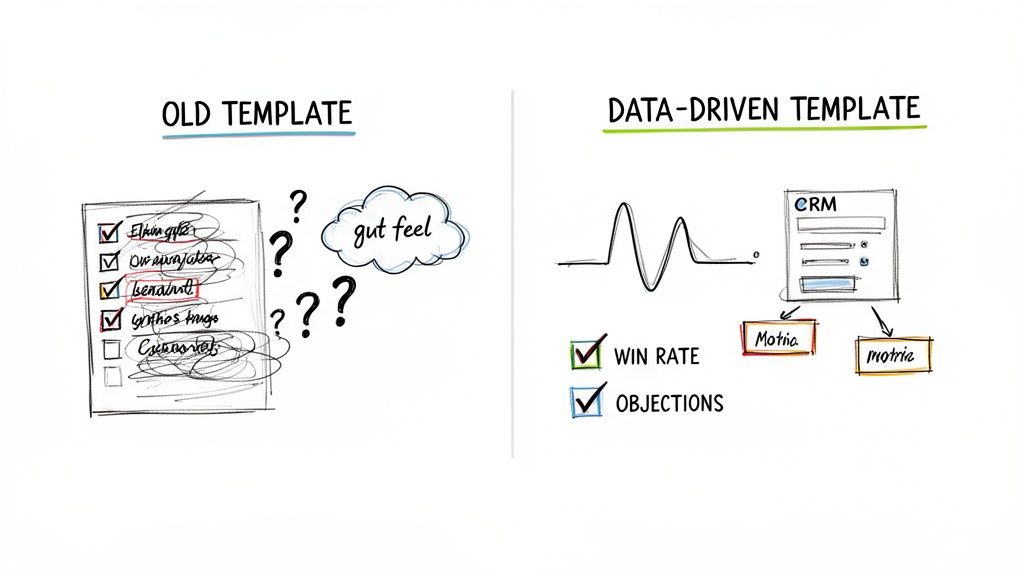
Most sales coaching templates are just checklists. They use vague fields like "Strengths" and "Areas for Improvement." This forces managers to rely on memory and gut feelings, which is an unreliable method.
This old-school approach is often ineffective. It detaches coaching from what actually happens on calls. When feedback lacks evidence, it feels like a personal opinion. This puts reps on the defensive and prevents real learning.
From Gut-Feeling to Data-Driven Coaching
The best coaching frameworks are built on evidence. Your CRM and call recordings are powerful coaching tools. Instead of guessing where a rep struggles, you can pinpoint the exact moment a conversation went off track.
A great template is only half the solution. Many sales coaching programs fail because managers lack proper training. Mastering coaching skills for managers is essential to guide constructive conversations around data.
This evidence-first method changes the tone of coaching. Instead of saying, “You need to handle objections better,” you can say, “On the Acme call at 04:32, the prospect mentioned a competitor. Let’s review your response and find a stronger approach.”
This is the key difference. You move from abstract advice to specific, actionable feedback that changes behavior.
A Head-to-Head Comparison
Old checklists focus on ticking boxes. Modern, evidence-based templates focus on driving revenue. Here is a direct comparison of the two approaches.
Component | Evidence-Based Template | Traditional Template |
|---|---|---|
Foundation | Call recordings & CRM data (Objective) | Manager's memory & opinion (Subjective) |
Feedback | Specific, contextual moments from calls | Vague, general advice ("Be more confident") |
Focus | Improving specific sales behaviors | Reviewing past performance |
Impact | Directly tied to KPIs like win rates | Difficult to measure or connect to results |
Rep Reaction | Collaborative, problem-solving mindset | Defensive, feels like a critique |
The difference lies in the coaching philosophy. One approach builds a culture of continuous improvement. The other creates friction and reinforces bad habits.
The Problem with Traditional Checklists
Traditional templates are not built for modern sales. They fail in several key areas:
They are Subjective: Feedback depends on a manager's opinion, which can be inconsistent or biased.
They Lack Specificity: Vague fields lead to vague advice that reps cannot apply.
They Show No Link to Outcomes: The template fails to connect coaching to measurable improvements in KPIs like win rates or sales cycle length.
They Create Administrative Work: They are just another form to fill, adding to a manager’s workload instead of simplifying it.
A successful sales coaching template should be a living document. It must be powered by data and integrated into your team's weekly rhythm. It is a guide for productive conversations focused on behaviors that close deals. Grounding your coaching in proof creates a culture where feedback is welcomed and performance improves.
Breaking Down a Sales Coaching Template That Works
Most sales coaching "templates" are just checklists used during one-on-ones. They are formalities, not working documents. An effective template is different. It is a structure that turns a subjective chat into an objective, collaborative session focused on specific behaviors that drive revenue.
Forget fields like "strengths" and "weaknesses". A powerful template is a blueprint for a productive conversation. It requires both the manager and the rep to arrive prepared. This turns a top-down lecture into a two-way discussion. The goal is to build a shared resource that guides development, not just judges performance.
The Three Pillars of a Working Template
Your template needs to map to the entire coaching workflow: before, during, and after the meeting. Each part serves a purpose, moving from preparation and analysis to concrete, accountable action.
Before the Session (The Prep Work): Both the manager and the rep complete this section before the meeting. It sets the agenda and ensures you are ready for a real discussion, not just a pipeline review.
During the Session (The Analysis): This is the core of the template, used live in the session. It provides a framework to dissect a specific call, identify what worked, and find skill gaps.
After the Session (The Action Plan): This section defines the next steps. It captures commitments, sets timelines for improvement, and establishes how to measure progress. It is all about accountability.
Laying the Groundwork: The Pre-Session Preparation Section
A productive coaching session is won before it starts. A well-designed prep section cuts through the noise and gets straight to the point. It ensures everyone has done their homework.
Here is what this section needs:
Rep Self-Assessment: Ask your rep to reflect on a recent call or deal. Have them pinpoint what went well and where they struggled.
The Evidence: Include a field for the link to the call recording in Gong or the opportunity in your CRM. This makes the conversation evidence-based.
The Objective: What was the goal of the call? This simple question anchors the analysis. Did they achieve it?
Manager's Initial Notes: After reviewing the call, note 1-2 key moments to discuss. This is not for delivering feedback yet; it is for flagging specific points.
The most effective change you can make is to require rep self-evaluation before the session. When reps identify their own areas for improvement first, they drive their own development. They arrive with buy-in, ready to solve problems, not just receive feedback.
In the Thick of It: Designing the Live Session Analysis
This is where the coaching happens. Together, you and your rep will use this part of the template to break down the call. The key is to guide the conversation toward an objective analysis of specific sales skills, not opinions.
Focus on tangible behaviors. Your template should prompt you to examine key stages of the sales conversation.
A Simple Framework for Analysis:
Area of Analysis | Guiding Questions and Prompts |
|---|---|
Opening & Agenda Setting | Did they state the purpose and agenda for the call? Did the prospect agree to it? |
Discovery & Qualification | Let's find the best discovery questions they asked. Did they uncover the business pain and its financial impact? |
Objection Handling | Note the exact objection (e.g., "We're already working with a competitor"). How did the rep respond? What is a better way to handle that? |
Commitment & Next Steps | Did they ask for a clear, concrete next step? Or was it a vague "I'll follow up next week"? |
This structured approach changes the dynamic from "I think you should have..." to "Let's look at what happened at the 15:32 mark...". The call recording is the source of truth, which depersonalizes feedback and makes it factual.
Turning Talk into Action: The Post-Session Plan
A coaching session without a clear action plan is just a chat. This final part of your template is critical because it turns discussion into measurable improvement. It connects the meeting to the rep’s daily work.
Keep this section focused and actionable. You must document:
One Key Skill to Develop: Focus on improving one specific behavior before the next session. For example, "Ask at least two questions to explore the root cause of an objection before responding."
Agreed-Upon Actions: What will the rep do to practice this skill? This could be role-playing, studying a top performer’s call recording, or using a new talk track.
How We'll Measure Progress: How will you know it’s working? This needs to be tangible. For example, success might be securing a next meeting on 80% of initial discovery calls.
Next Check-In Date: Schedule the next session immediately. This reinforces that the action plan is important and closes the coaching loop.
Powering Your Template with Conversation Intelligence
A sales coaching template is only as good as the data you put into it. Without evidence, you fall back on subjective feedback. Conversation intelligence (CI) tools change this by making coaching a data-backed, high-impact activity.
In the past, a manager had to spend hours reviewing call recordings to find coachable moments. It was a slow process. Conversation intelligence automates this discovery phase.
From Manual Review to Automated Insights
Modern CI platforms like Samskit automatically record, transcribe, and analyze every sales call. They act as an assistant, flagging the most important moments in a conversation. This allows you to stop listening to entire calls and jump straight to the parts that matter for coaching.
The growth of these tools reflects a shift in sales management. The global market for sales coaching tools is projected to grow from $2.5 billion in 2025 to $7.2 billion by 2033. This growth, particularly in markets like Brazil, is driven by AI's ability to deliver personalized coaching and spot performance trends early.
The practical benefit is clear. Instead of guessing where issues exist, you get data-driven alerts on key call moments.
Competitor Mentions: Instantly see when a competitor is mentioned and analyze how your rep handles it.
Buyer Objections: Get a list of every objection raised, helping you spot patterns in how your team responds to pushback.
Pricing Discussions: Pinpoint when pricing was discussed to coach on value articulation and negotiation.
This automated analysis turns hours of work into a few minutes of focused prep. For a deeper look at the technology, this podcast offers a deep dive into the future of conversation intelligence and its impact on sales teams.
A Real-World Coaching Workflow
Let's walk through a scenario. Imagine a rep is struggling to move deals past the discovery stage.
Instead of blocking your calendar to listen to their calls, you log into your conversation intelligence platform. You filter for that rep's recent discovery calls and see AI-generated summaries. The platform has already flagged moments where the prospect raised budget concerns.
You click on a "budget objection" tag from a key account’s call. You are taken to the exact 30-second snippet where the prospect said, "This sounds great, but I'm not sure we have the budget for it this quarter." You hear the rep immediately offer a discount instead of exploring the value.
That single data point becomes the foundation of your coaching session.
The workflow shifts from a frustrating search for evidence to a quick, targeted review. You enter the coaching session with a specific, time-stamped moment, which removes subjectivity. The conversation becomes about solving a specific problem, not critiquing general performance.
This simple, three-phase process helps you build a coaching session around solid data.
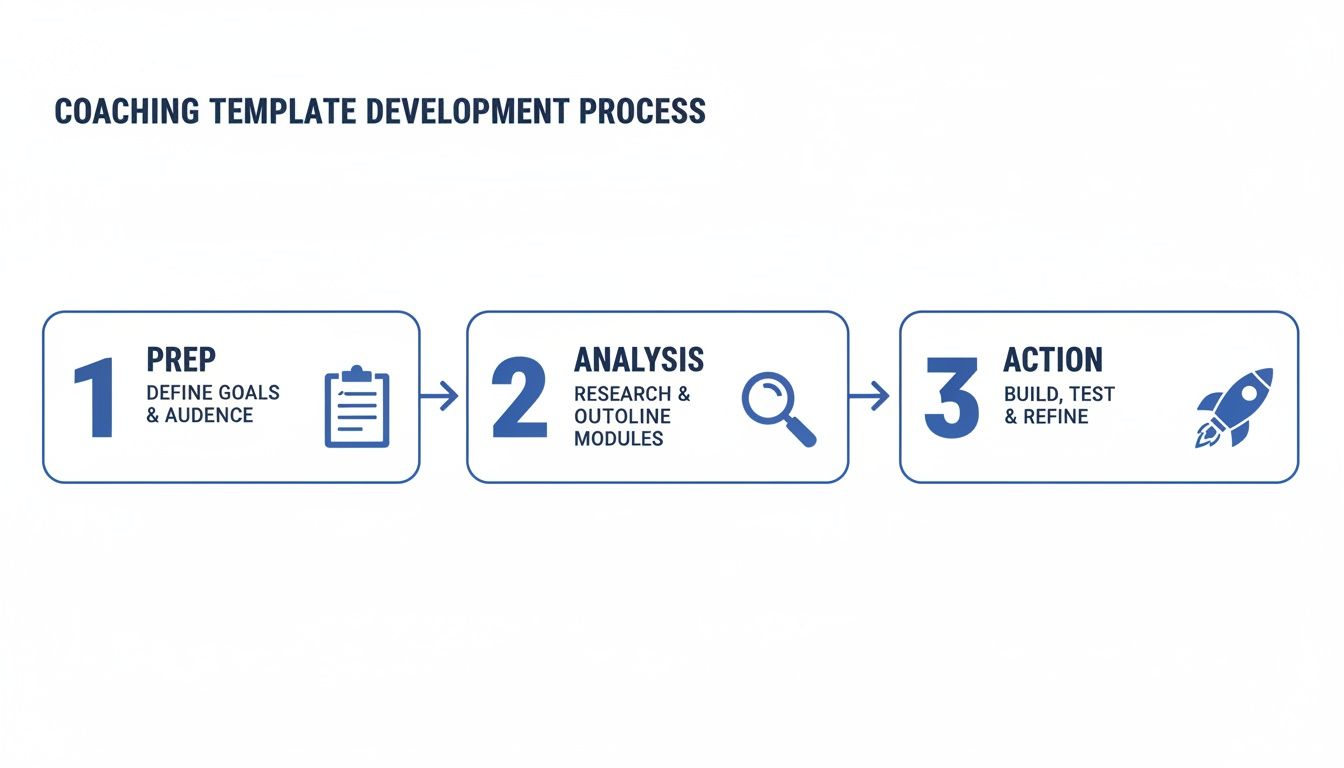
The key takeaway is that effective coaching begins with preparation and analysis before you meet with your rep. This makes the session focused and productive.
Connecting Insights to Action
With data-backed insights, you can populate your sales coaching template with concrete proof. Use specific call snippets to deliver feedback that is impossible to dispute.
For example, the "Objection Handling" section of your template is no longer a generic text box. It becomes an evidence-based tool:
Call & Timestamp | Objection Raised | Current Response | Brainstormed Alternative |
|---|---|---|---|
Acme Corp - 14:22 | "We're happy with our current provider." | "Okay, I understand." | "That's great to hear. What do you like most about them, and what's one thing you wish they did better?" |
This approach makes feedback tangible. The rep can see and hear what happened, which speeds up their development. Tools like Samskit also work as an AI note-taking app for meetings, automatically capturing these details so you retain context.
By fueling your sales coaching template with conversation intelligence, you create a powerful feedback loop. You identify a specific behavior, use undeniable proof to discuss it, and build an actionable plan to improve it. This is how you build a coaching culture that drives revenue.
A good sales coaching template is a start, but a template alone is just a document. To turn it into a tool that drives revenue, you need a consistent coaching process.
Without a reliable rhythm, even the best templates gather digital dust. Coaching becomes a reactive chore instead of a core driver of performance.
The right cadence is not one-size-fits-all. It is about creating a mix of coaching formats that fit your sales environment. Consistency is the secret. When reps know when and how they will be coached, they arrive prepared and are more open to feedback.
Finding Your Coaching Rhythm
A successful coaching program includes different types of interactions, from individual deep dives to team-wide skill-building sessions. The goal is a predictable structure that makes professional development a habit.
This is a mix that works well for most B2B teams:
Weekly 1:1 Call Reviews: Keep these short, around 30 minutes. You analyze a single call using your template. This keeps feedback fresh and allows reps to apply learnings immediately.
Monthly Skill Deep Dives: Once a month, dedicate a session to one specific skill, like discovery questioning or handling pricing objections. Use call data to find a team-wide weakness and address it together.
Team-Based Call Reviews: Once or twice a month, have the team listen to a call together (with the rep’s permission). This creates a forum for brainstorming and sharing what works.
The biggest mistake managers make is canceling coaching for "more urgent" tasks. Protecting this time shows that development is a priority. A consistent cadence builds trust and shows you are invested in your team's success.
From Insights to Actionable Plays
A coaching session is successful only if the rep knows exactly what to do differently on their next call. Vague advice like "be more confident" is not helpful. This is where "plays" are useful.
A play is a specific, repeatable action a rep can use to improve performance. It is the tangible output of your coaching. You move from telling them what to do, to showing them how.
Building Your Playbook
After a coaching session, your action plan should lead to creating or refining a play. Over time, these plays become a library of best practices for your team.
Here are a few examples of simple but powerful plays:
The Objection Turnaround Play: The prospect says, "We're already working with a competitor." The play is a specific response, such as: "That’s great to hear you're already focused on this. To understand, what do you value most about their service, and what's one area you wish was better?"
The Discovery Depth Play: This is a checklist of five open-ended questions designed to uncover business pain, not just surface-level needs. It forces the rep to dig deeper.
The "Secure the Next Step" Play: This play offers two clear phrases to use at the end of a call to lock in the next meeting, avoiding the "I'll follow up next week" trap.
Effective sales meetings are a crucial part of this process. To learn more, check out our guide on how to run more productive sales meetings for additional strategies.
Guiding the Conversation with Manager Scripts
To ensure every session ends with a clear play, managers must guide the conversation purposefully. Having a few scripts helps keep the session on track and focused on outcomes.
Here is a simple script to transition from analysis to action:
"Okay, we've reviewed how that objection was handled. It’s great you identified the issue yourself. Now, let's build a play for it. What's one question we could ask right after they mention the competitor that would open the conversation back up?"
This collaborative approach is critical. It makes the rep a co-creator of their own solution. They are not just being told what to do; they are actively building the tools for their success. This ownership makes coaching insights stick and drives measurable improvement.
Measuring the Business Impact of Your Sales Coaching
A well-crafted sales coaching template and consistent one-on-ones are only meaningful if you can prove they impact the bottom line. To get buy-in for your team's development, you must show results.
This is not about tracking vanity metrics like call volume. It is about drawing a clear line from the skills you build in coaching to financial outcomes.
Connecting What You Coach to What You Earn
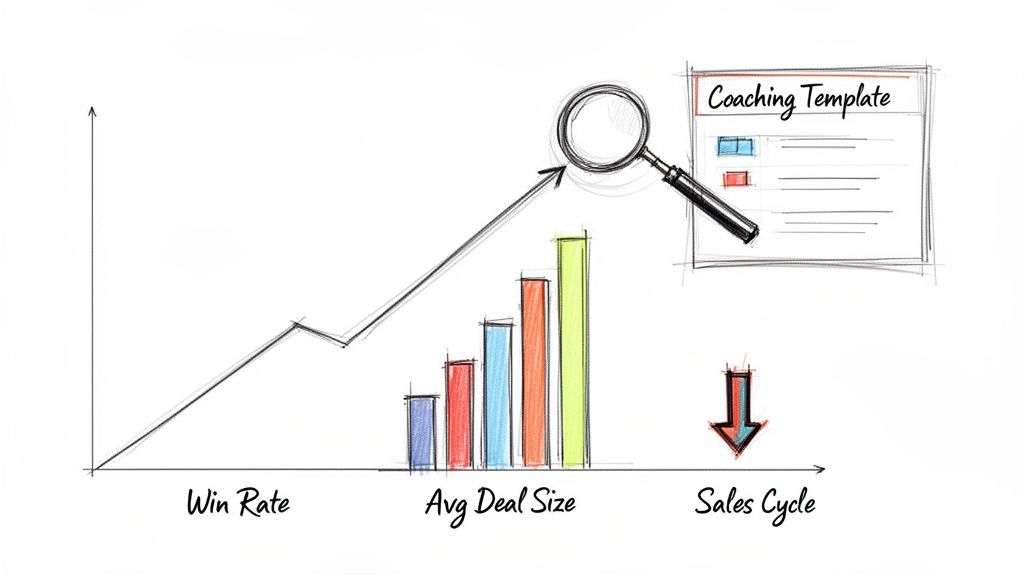
Measurement comes down to connecting specific behaviors to key performance indicators (KPIs). For example, if you coach reps on asking better discovery questions, you should see an impact on metrics like average deal size. Better discovery uncovers deeper pain, which creates urgency and justifies a higher price.
Your CRM and a conversation intelligence platform like Samskit are essential tools. Combining call data from Samskit with deal data from your CRM gives you what you need to build a business case for coaching.
First, you need a baseline. Before you roll out your new coaching program, take a snapshot of your key metrics. This benchmark is the "before" picture you will use to measure all future success.
The KPIs That Prove Coaching Works
To prove the financial return of your program, focus on a few powerful, outcome-driven KPIs. These are the numbers that get leadership's attention because they directly reflect the financial health of the sales organization.
Here are the most important ones:
Win Rate: This is the ultimate proof of sales effectiveness. If your coaching on objection handling is working, your team should win a higher percentage of qualified opportunities.
Sales Cycle Length: Good coaching helps reps build momentum and close deals more efficiently. A shorter average sales cycle shows your coaching is removing friction from the buying process.
Average Deal Size: When reps master discovery and value articulation, they become better at upselling and defending their price. A rising average deal size indicates your coaching on negotiation is paying off.
Forecast Accuracy: This metric is often overlooked but is very important. Coaching on deal inspection and qualification helps reps submit more realistic forecasts. Better accuracy shows alignment on what a "committable" deal looks like, which is valuable for business planning.
The key is to isolate the impact of a specific coaching initiative. For instance, after a month-long push on competitive positioning, you should be able to see an improved win rate in deals where competitors were mentioned.
Building Your ROI Dashboard
Do not let this data get lost in spreadsheets. Create a simple, visual dashboard that tells a story. It should show leadership the link between your coaching activities and the results you deliver.
A clear table is often the best way to present this information. We have created a table showing the essential KPIs to track before and after implementing your coaching program, connecting activities to business results.
Key Metrics for Measuring Sales Coaching Impact
Metric Category | KPI to Track | Example of 'Good' Improvement |
|---|---|---|
Sales Efficiency | Win Rate from Qualified Opportunity | An increase from 22% to 27% over six months. |
Deal Velocity | Average Sales Cycle Length | A reduction from 85 days to 72 days. |
Revenue Impact | Average Deal Size | An increase from £45,000 to £52,000. |
Predictability | Forecast Accuracy | An improvement from 75% to 90% accuracy. |
Presenting your data this way changes the conversation. Sales coaching is no longer seen as a "nice-to-have" expense but as a critical, revenue-driving function.
A Real-World Example of Proving ROI
Let's put this into practice. Imagine your call data shows that your reps struggle with pricing objections early in the sales cycle.
You decide to address this. Using your sales coaching template, you run targeted sessions on articulating value and handling price pushback, including role-playing and reviewing real call recordings.
Two months later, you go back to the data. You compare the performance of the coached reps against their own baseline. You find the coached group now has a 15% higher win rate on deals where pricing was a major issue.
Now you can calculate the ROI. A 15% lift in your win rate, applied to your average deal size, results in a specific amount of new revenue. This proves that a structured coaching program is a high-return investment, not an expense.
Answering Your Top Sales Coaching Questions
Even with a perfect template, you will face some real-world challenges when you start a coaching program. This is normal. Let’s address some of the most common questions.
How Often Should I Coach My Reps?
There is no magic number. The key is consistency. A predictable coaching rhythm is more effective than sporadic, intense sessions. It makes coaching a normal part of the job.
For most B2B teams, a blended approach works best:
Weekly Call Reviews: These are quick, 30-minute sessions. You and a rep review a single call using your template. The feedback is immediate.
Monthly Skill Workshops: Once a month, focus on a specific skill the whole team needs, like handling objections or discovery.
Team Call Breakdowns: A few times a month, analyze a call together as a team. This allows top performers to share their methods and helps everyone learn from a single example.
What if My Reps Push Back on Being Coached?
Resistance to coaching usually stems from two issues: reps feel criticized based on your gut feeling, or they see it as micromanagement. A data-driven coaching template helps avoid both problems.
First, anchor every conversation in evidence. When you can point to a specific moment in a call recording and say, "Let's listen to how they handled the budget question at 12:45," it is no longer your opinion versus theirs. You are both looking at the same facts.
Second, involve them in the process. Before you meet, ask reps to do a self-evaluation and pick a call they want to review. When they identify areas for improvement, they take ownership of their growth.
The moment a rep starts self-diagnosing, resistance fades. Coaching becomes a collaborative exercise, not a top-down judgment. You become a partner in their success, not a critic.
How Can I Coach if I’m Not an Expert on Everything?
You do not need to be the perfect salesperson to be a great coach. Your job is not to have all the answers. Your job is to ask the right questions that help your reps find their own answers.
Your sales coaching template is your guide. It provides prompts for powerful questions, such as:
What were you trying to achieve on this call?
Where do you feel the conversation went off track?
If you could do that part again, what would you change?
This approach empowers your reps. It teaches them to think critically and self-correct, long after the coaching session ends. You become a performance accelerator, not a bottleneck.
How Can I Get Started if I Don’t Have a Big Budget for New Tools?
Do not let budget stop you. You can start a coaching culture using the tools you already have. Your CRM can track deal progress, and your video conferencing software can record calls. It may be manual, but it is a good starting point.
The challenge comes as your team grows. You will find yourself spending more time searching through call recordings than actually coaching.
This is where conversation intelligence tools become a game-changer. They automate the busywork, surfacing the key moments and data you need. This turns a time-consuming task into a high-return investment.
A well-structured sales coaching template is your blueprint for developing a team of top performers. The magic happens when you fuel it with the right data. Samskit turns every sales conversation into a source of actionable insights, making your coaching sharper, more efficient, and impactful. See how you can build a smarter coaching program by exploring Samskit.