Hearing a “no” stings. But most sales objections are not rejections. They are questions in disguise. Mastering objection handling in sales means decoding what your buyer is really saying. This turns a roadblock into a real conversation.
Rethink Objections as Opportunities

Throw out the old playbook of defensive comebacks. Today's buyers have done their research. They can spot a canned response a mile away. What they want is a person who listens.
Think of an objection as a signpost, not a wall. When a prospect raises a concern, they are engaged. They are signaling what matters to them, what they worry about, and where they need more clarity. This is your chance to shift from defense to discovery.
From Confrontation to Collaboration
Top sales professionals do not fight objections; they welcome them. They know "It's too expensive" usually means "I don't see enough value yet." This simple shift changes the dynamic. The interaction moves from a confrontation to a collaboration.
This comes down to active listening. You must hear the intent behind the words. A timing objection is rarely about the calendar. It often masks deeper issues like a fear of change, a lack of internal resources, or uncertainty about the impact of your solution.
The goal is to move from arguing your point to exploring theirs. When you start digging into the 'why' behind an objection, you stop selling a product and start solving a problem. This is where real connection happens.
Decode Common Objections to Uncover Real Buyer Concerns
You need a simple way to categorize what you hear. Most objections fall into one of four buckets. Recognizing the pattern helps you ask the right follow-up questions instead of just reacting.
The table below breaks down what buyers say versus what they might actually mean. Use it to look past the surface-level comment and address the true concern.
What the Buyer Says | What the Buyer Might Mean | The Underlying Question to Address |
|---|---|---|
"It’s too expensive." | "I don't see the value," or "This isn't in my budget right now." | "How does this solution deliver a return that justifies the cost?" |
"Now isn't a good time." | "This isn't a priority," or "I'm afraid of the implementation hassle." | "What would it take to make this a priority for you?" |
"I need to talk to my boss." | "I'm not the decision-maker," or "I'm not confident enough to champion this." | "What information do you need to confidently present this to your team?" |
"We're happy with [Competitor]." | "I don't see how you're different," or "Switching sounds like too much work." | "What specific pain point is your current solution not solving perfectly?" |
Understanding these hidden meanings is the key to turning a stalled conversation into a productive one.
A Practical Framework for Understanding Objections
Once you can spot the category, you can tailor your approach.
Price and Value Objections: When perceived value does not match the price, you need to reframe the conversation. Your job is to build a solid business case focused on the return on investment (ROI). Also, highlight the cost of inaction.
Timing and Urgency Objections: These signal the prospect does not feel the heat. It is up to you to connect your solution directly to one of their urgent business priorities. Or, link it to an upcoming event that creates a natural deadline.
Authority and Decision-Maker Objections: This happens when you are not talking to the person who holds the budget. The goal is not to go around your contact. Instead, empower them. Turn them into an internal champion who can get the right people in the room.
Competitor and Alternative Objections: Do not panic when they mention a rival. It means they are actively looking for a solution. This is your moment to clearly state your unique differentiators. Prove why you are the best choice for their specific needs.
This is especially true in hyper-competitive markets. Take Brazil's retail sector, where sellers face relentless price-based objections. A mind-boggling 16.5 million promotional offers were recorded in a single year, a 72% increase from previous years. In that environment, you either master objection handling or you get left behind. You can read more about the trends in Brazil's retail sector to see just how fierce the competition is.
By learning to categorize and decode these signals, you can navigate tough conversations with confidence. This mindset is the foundation of modern, effective objection handling in sales.
Build Your Pre-Call Objection Handling Strategy
The most critical moments in handling objections happen before you even dial. Walking into a sales call unprepared is a surefire way to get derailed by the first sign of pushback.
Winning teams do not just react; they anticipate. They map out the battlefield and arm themselves with the right insights. This prep work separates the average rep from a strategic partner.
Anticipate Hurdles Through Smart Research
Your preparation starts with getting inside your prospect's world. Go deeper than a quick scan of their LinkedIn profile. Dig into their company, their industry, and their specific role. This gives you a feel for the objections most likely to surface.
For instance, is their industry known for tight budgets? You can bet a price objection is coming. Your response cannot just be about features. It needs to focus on hard ROI and cost savings.
A solid pre-call strategy is built on knowing your audience. It is worth learning how to qualify sales leads, as it helps you tailor every conversation.
Your research should answer a few key questions:
Company News: Have they had recent layoffs, a new funding round, or a big acquisition? These events change their priorities and budget.
Industry Trends: What are the top pressures hitting their sector? Frame your solution as the answer to one of those specific pains.
Competitor Mentions: Who are they using now? Are they looking at anyone else? Knowing this lets you prepare your counter-moves.
This homework allows you to lead the conversation with empathy. It shows you invested time and are there to solve their problems, not just push your product.
Create Your Objection Map
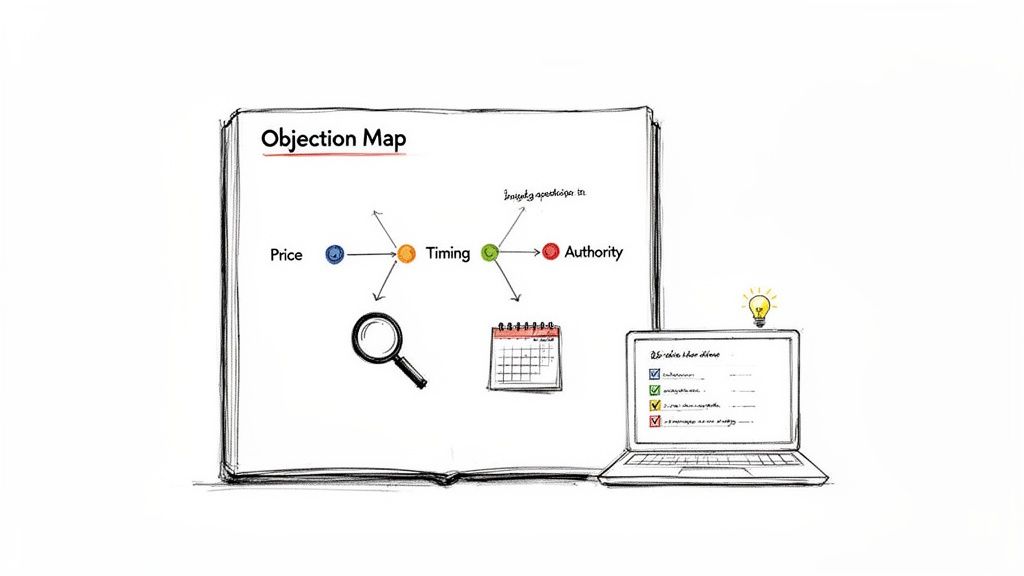
An objection map is your team's living playbook for tough conversations. This is not about memorizing robotic scripts. It is about documenting common objections and pairing them with proven responses. This turns one rep’s knowledge into an asset for the whole team.
Start with a simple spreadsheet. In one column, list every common objection. In the next, write the best clarifying questions. In the final column, outline the core talking points for a solid response.
An objection map is your strategic compass. It ensures that when a prospect says, "We're happy with our current provider," your team doesn't freeze. They have a documented, field-tested path to turn that brush-off into a conversation about what's really going on.
For example, if the objection is, "Your price is too high," your map should guide your reps through a smarter process:
Acknowledge and Clarify: "That's fair. When you say the price is high, could you help me understand what you're comparing it to? Is it against a competitor, or more of a general budget concern?"
Pivot to Value: "I understand. Many of our best customers felt the same way at first. They found that by solving [specific problem], they saw a 25% reduction in operational costs, giving them a full return in less than six months."
Provide Proof: Have a case study or customer story ready to back that claim up. Numbers talk.
Use Call Data to Build a Better Playbook
The best way to build an objection map that works is by analyzing what happens on your calls. Relying on memory is a recipe for inconsistent results. This is where conversation intelligence tools come in.
These platforms record and transcribe your sales calls. More importantly, they can analyze conversations to spot and categorize objections. You can see how often "timing" or "competitor" objections pop up for the entire team.
This creates an evidence-based feedback loop. You can pinpoint which reps are masters at handling certain objections and break down their talk tracks. Those proven responses become the gold standard for your playbook. This allows you to coach everyone with concrete examples of what success sounds like. This data-driven approach ensures your objection-handling strategy is always getting sharper.
Proven Frameworks for Navigating Objections in Real Time
When an objection hits mid-conversation, it is easy to panic. Your mind scrambles for a comeback, and the call stalls. A solid framework is your best defense. It gives your brain a reliable track to run on, helping you respond thoughtfully instead of reacting.
One of the most practical models is the LAER Framework—Listen, Acknowledge, Explore, and Respond. Think of it as a four-stage process that turns a confrontation into a productive discussion.
Let's break down how this workflow plays out.
Listen Fully Before You Say a Word
This sounds obvious, but it is the step most reps fumble. When a prospect raises a concern, the gut reaction is to jump in and correct them. Fight that urge. Let them finish their thought completely, without interruption.
Really listen. What words are they using? What is the emotion behind them? The real objection often hides just beneath the surface.
Acknowledge and Validate Their Concern
Acknowledging their point is not the same as agreeing with it. You are simply validating their right to feel that way. This small act immediately lowers their guard. It shows you are on their side.
Try using phrases that build a bridge:
"That’s a fair point, and I can see why you'd feel that way."
"I appreciate you bringing that up. It’s a question I get a lot."
"You're right to think about that. Many of our best customers felt the same way at first."
This technique de-escalates tension and buys you a moment to think. For a deeper dive into managing these live interactions, this resource on how to respond to objections in sales offers some fantastic insights.
Explore the Real Issue
The "Explore" phase is where you turn the conversation around. Use open-ended questions to dig for the root cause of the objection. The goal is to get them talking so you understand what is driving their hesitation.
Take the classic price objection. It is rarely just about the price. It is often a stand-in for a lack of perceived value or a budget mismatch.
When a prospect says, "It’s too expensive," don’t launch into a defence of your pricing. Get curious instead. Ask something like, "I understand. When you say the price is high, could you help me understand what you were budgeting for a solution like this?"
This question does two things. It shows you respect their budget, and it gives you critical information to reframe the value discussion. You can also borrow questioning techniques from other sales methodologies. For instance, you can learn more about SPIN selling questions to find out how to craft questions that uncover deeper needs.
This dynamic is especially true in tough economic climates. In Brazil, for example, a recent study found that a staggering 89% of consumers reported trading down to cheaper options. B2B sales feels that same pressure. Objections like "It's not in the budget" or "Show me the ROI" become more frequent.
Respond with a Precise Solution
Only after you have listened, acknowledged, and explored the objection should you respond. By now, you are not guessing what the problem is—you know. Your response can be laser-focused on the core concern you uncovered.
Use the exact information you gathered during the "Explore" phase to frame your answer in their terms.
Example Scenario
Objection: "We are happy with our current provider."
Listen: Let them finish. Note their tone.
Acknowledge: "That's great to hear you have a solution that's working for you. It's always smart to have a solid partner."
Explore: "Just so I can understand better, what do you like most about working with them? And if there was one thing you could improve, what would it be?"
Respond: This is your opening. If they mention a small frustration, you can pivot: "That's interesting. We actually built our platform to solve that exact issue. Customers who switched from [Competitor] often tell us they reduced time spent on [frustration] by 30%."
This structured approach to objection handling in sales keeps you in control. It positions you as a thoughtful advisor, not just another sales rep with a script.
Using AI to Build Smarter Objection Handling Workflows
Modern sales tech is not here to replace selling skills. Instead, think of AI as a tool that gives you the hard evidence needed to handle objections with confidence. Its power is in turning messy conversation data into sharp, actionable insights for coaching and pipeline management.
It starts with platforms that automatically record and transcribe your sales calls. A simple transcript is handy. The breakthrough comes from the analysis on top of it. This is where AI acts like a sharp-eyed analyst on your team.
From Manual Call Reviews to Automated Insights
Imagine you just wrapped up a sales call. Instead of listening back for 30 minutes, you get an instant summary with crucial moments flagged. The AI spots a "budget objection" at the 15-minute mark and a "competitor mention" at the 28-minute mark.
For a sales rep, this is huge. It gives you immediate, unbiased feedback on how the conversation went. You are no longer relying on memory or scribbled notes.
Syncing Objections Directly to Your CRM
The real magic happens when this information is pushed straight into your CRM. Your deal records become rich with specific context:
Categorised Objections: The deal in HubSpot or Salesforce now shows the prospect brought up a "timing objection" tied to their Q4 budget freeze.
Buyer Sentiment: The AI can analyze tone, flagging a call as having "high buyer engagement but negative sentiment" around pricing.
Identified Risks: A deal can be automatically flagged as "at risk" because the prospect mentioned a key competitor three times.
This eliminates manual data entry, a massive time sink. Using an AI note-taking app to handle this ensures the information in your CRM is both accurate and useful.
This automated data flow creates a single source of truth for every deal. It means anyone can get the full picture without listening to a call recording.
Creating an Evidence-Based View of the Pipeline
For sales leaders, this workflow offers an evidence-based view of the entire pipeline. You can finally move beyond a rep's subjective summary and see the actual objections stalling deals across the team.
Of course, a structured approach is still vital. The framework below illustrates the four-step LAER model—a simple but incredibly effective way to handle objections as they happen.
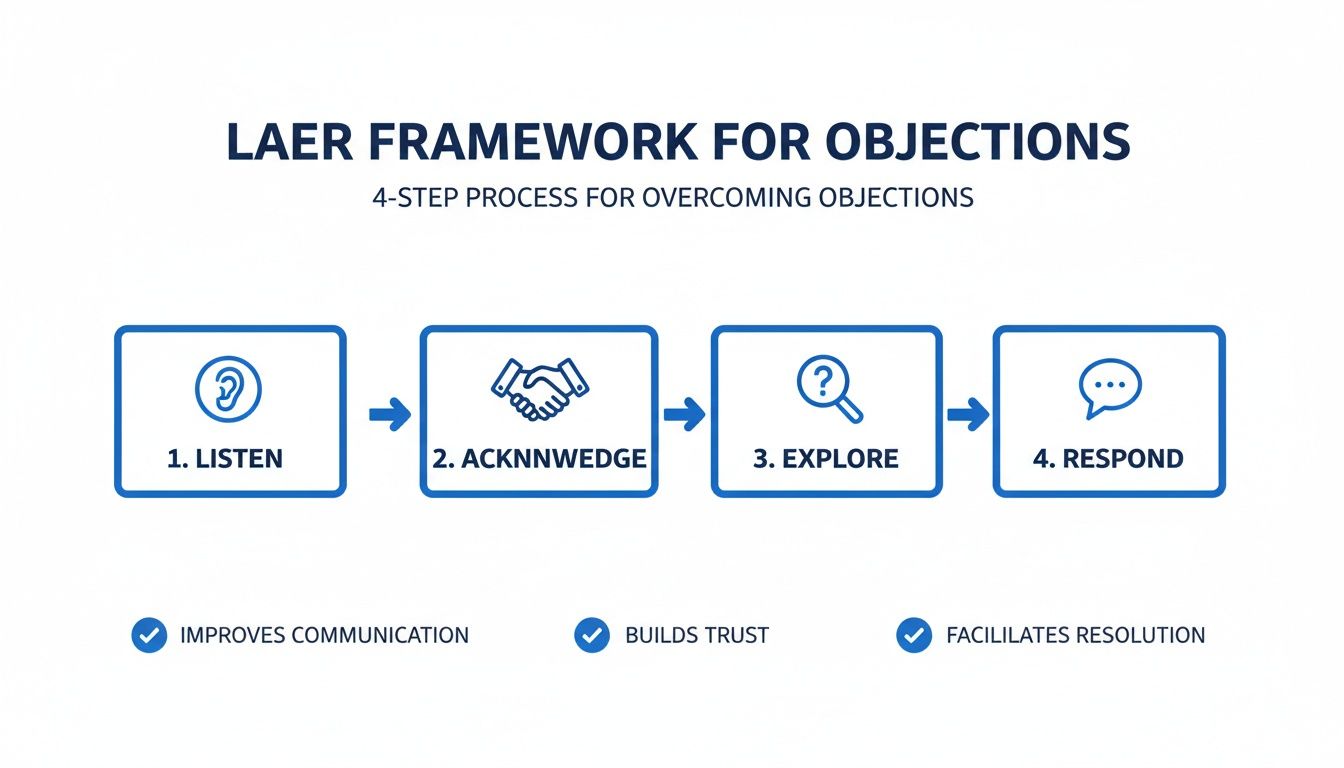
Think of it this way: the LAER model—Listen, Acknowledge, Explore, and Respond—provides the structure. The AI provides the data to help you perfect every step.
This data-driven approach has a direct impact on revenue. For example, recent Brazilian retail sales data showed that while overall retail saw a 5.0% increase in 2024, sectors like furniture and household appliances were volatile. This mirrors what we see on sales calls, where objections about timing or need ("We just don't need it right now") derail 30-40% of opportunities.
Using AI for objection handling in sales is not about taking the human out of the equation. It is about arming your team with the data and workflows to make every conversation sharper and more effective. It turns every call into a coaching opportunity and gives leaders tools to coach with precision.
Turning Call Insights into Effective Sales Coaching
The call might be over, but the real work is just getting started. Think of every conversation as raw material. Objection handling is a craft you sharpen through constant, focused practice. A data-led approach to post-call analysis and coaching separates top-tier teams from everyone else.
When your tech can automatically flag objections, pinpoint deal risks, and log sentiment into your CRM, you can stop asking, "So, how'd it go?" The conversation shifts from gut feelings to hard facts. That is the only way to deliver coaching that sticks.
Moving from Guesswork to Data-Backed Guidance
As a manager, you can now look at a team dashboard and see patterns. Imagine discovering one rep consistently fumbles when pricing comes up, while another sails through that same conversation 80% of the time.
This is not about playing gotcha. It is about spotting what works and sharing it with the team. The data gives you the evidence needed for a specific and helpful coaching session. You can move past vague feedback and pinpoint the exact moment a call went south.
The most powerful coaching conversations start with data. Reviewing a specific call moment and comparing a poor response with a best-practice example from a top performer turns abstract advice into a clear, repeatable action.
Suddenly, coaching feels less like an art and more like a science. You create a feedback loop where every call becomes a valuable lesson for your entire team.
A Manager's Workflow for Data-Driven Objection Coaching
A clear process turns insights into lasting changes. Here is a simple workflow for sales managers to turn call data into targeted, effective coaching on objection handling.
A Manager's Workflow for Data-Driven Objection Coaching This process shows sales managers how to leverage call data for targeted and effective coaching on handling objections.
Phase | Actionable Step | Key Tool/Resource | Expected Outcome |
|---|---|---|---|
Review | Analyse the team dashboard for objection patterns. Identify reps struggling with specific objections (e.g., competitor mentions). | Conversation intelligence platform (e.g., Samskit Analytics) | Pinpoint top coaching priorities for the week based on real performance data. |
Prepare | Select two call recordings: one where the objection was handled poorly and one where it was handled well (a "gold standard" example). | Call recording library with AI-flagged objections | Prepare specific, evidence-based feedback for a one-on-one session. |
Coach | During the one-on-one, play back the key moments from both calls. Discuss the differences in approach, language, and outcome. | Shared screen with call snippets | Rep understands what went wrong and has a clear model of what "good" looks like. |
Practise | Role-play the same objection scenario using the new, improved talk track. Provide immediate feedback and encouragement. | Live role-play or call simulator | Build muscle memory and confidence in applying the new technique under pressure. |
Reinforce | Create a shared playlist of "gold standard" call examples for the entire team to access on demand. | Shared content library or team wiki | Reinforce best practices and scale top-performer knowledge across the organisation. |
This is not just a checklist; it is a repeatable system for developing your people. By consistently following these steps, you build a coaching engine that drives continuous improvement.
Creating a Culture of Continuous Improvement
Adopting this workflow builds a coaching culture. Feedback is seen as a gift for professional growth, not a reason to be defensive. When reps know your guidance is rooted in objective data, they are more likely to embrace it.
This data-driven loop builds a more resilient and skilled sales team. You give your reps proven strategies to handle the tough conversations that define objection handling in sales. By turning call data into a system for improvement, you give every seller the tools they need to perform at their best.
Your Top Questions on Handling Sales Objections, Answered
Let's get straight to it. These are the questions I hear most often from sales teams about dealing with objections. Here is what actually works.
What’s the Single Biggest Mistake Reps Make?
Getting defensive. The moment a buyer raises a concern, most reps jump into a rebuttal. This instantly turns the conversation into a fight you are destined to lose. It signals you are not listening; you are just waiting for your turn to talk.
The smart move? Pause. Acknowledge their point with, “That’s a fair question.” Then, get curious. An objection is usually a veiled request for more information.
By digging in with clarifying questions, you show you are on their side. That is how you build trust and get to the real issue.
How Do I Handle “It’s Too Expensive” Without Offering a Discount?
First, resist the reaction to slash your price. A discount devalues your product and teaches customers your pricing is just a suggestion.
Instead, reframe the conversation around value and return on investment.
Start by validating their concern: "I get it, budget is always a top priority."
Then, probe deeper. Ask, "Help me understand—is the issue the overall price, or is it more about how it fits into this quarter's budget?" This tells you if you have a value problem or a timing problem.
From there, pivot hard back to the business case. What is the cost of them doing nothing? Tie your price directly to the money they will make or save.
A discount is a temporary fix that eats into your margins. A rock-solid business case is a permanent solution that proves your worth. Build the case, don't just drop the price.
How Can Managers Coach Their Teams on This More Effectively?
Generic feedback like “be more confident” is useless. Real coaching is surgical and backed by data. A conversation intelligence platform is your secret weapon. Dive into call recordings to see exactly where reps get stuck.
Are they fumbling every time a competitor’s name comes up? Once you spot these patterns, you have your coaching plan.
In your one-on-ones, do not just talk about it. Play the exact moment from a call where an objection went sideways. Then, play a clip from a top performer nailing it. Role-play the scenario. Build a library of these "gold-standard" calls that everyone can access. This turns coaching from vague advice into a clear, skill-building session.
Can You Actually Prevent Objections Before They Even Happen?
Absolutely. This is a pro-level move. It involves preemptively raising and resolving an objection you know is coming. This shows transparency, builds credibility, and lets you frame the conversation on your terms.
For instance, if you know your solution carries a higher price tag than a competitor, get ahead of it.
Try saying something like this:
"As you look at different options, you'll probably notice our price point is different from Competitor X. Many of our best customers saw that too. They ultimately found that our unique ability to [your key differentiator] ended up saving them an average of 20% in operational costs—something the cheaper tool simply couldn't touch."
You have just acknowledged the price gap, pivoted to your value, and backed it up with a hard number. The objection is neutralized before the prospect could voice it. That is how you control the narrative.
Stop wasting time on manual CRM updates and start closing more deals. Samskit turns your sales calls into accurate CRM entries, actionable insights, and clear next steps, so you can focus on what matters—selling. See how it works.