Generic sales pitch examples are just scripts. They fail in real conversations. They promise quick wins but deliver awkward monologues. This guide is different. It provides a practical breakdown of ten proven B2B pitch frameworks. You can adapt and use them immediately.
The goal is not to memorize lines. It is to master conversational workflows. These workflows build trust, uncover needs, and move deals forward. Forget sounding polished. Focus on being effective. This article shows you how to structure discussions that lead to results.
For each framework, you will find:
Annotated examples showing the methods in action.
Strategic analysis explaining why they work.
Clear use cases to help you know when to apply each technique.
Actionable next-step phrasing for CRM updates and follow-ups.
We will dissect everything from the quick Elevator Pitch to the data-driven ROI Business Case. This collection is for sales professionals who need reliable methods for every stage of the sales cycle. Let's analyze how to make every conversation purposeful.
1. The Elevator Pitch (30-60 seconds)
The elevator pitch forces clarity. You have 30 to 60 seconds to state a problem, present your solution, and show its value. This is a fundamental sales pitch example. It works in almost any initial contact, from a conference meeting to a cold call.
Its power is its brevity. You respect the prospect's time. You deliver a focused message that answers two questions: "What is this?" and "Why should I care?"
Example in Action: Samskit CRM Updater
Here is how Samskit might use an elevator pitch:
"Sales teams spend nearly a third of their day on manual data entry instead of selling. Samskit fixes this. It automatically updates your CRM after every sales call. Your pipeline stays accurate without the admin work. Your reps get hours back each week to focus on closing deals."
Strategic Analysis
This pitch works because it follows a proven structure:
Problem First: It starts with a specific pain point ("a third of their day on manual data entry"). This grabs the attention of a sales leader feeling that pain.
Solution & Value: It directly presents the solution ("Samskit automatically updates your CRM") and connects it to a clear benefit ("pipeline is always accurate").
Outcome-Focused: It ends by translating the feature into a business result: more time for selling.
The goal is to open a conversation, not close a deal. You trade a moment of their attention for a chance to schedule a proper discovery call.
How to Build Your Own
Identify the Core Pain: What is the single biggest frustration your ideal customer faces? Start there.
State Your Solution Simply: Avoid jargon. How do you fix the pain? Be direct.
Quantify the Impact: Use numbers. Do you save "time" or "5-10 hours per rep each week"? Specificity builds credibility.
End with an Opening: Finish with a question like, "Does your team struggle with keeping the CRM updated?" This turns the pitch into a dialogue.
2. The MEDDIC Framework (5-15 minutes)
The MEDDIC framework is a diagnostic questioning model for discovery calls. It is not a script. It provides a structured way to uncover critical sales information. MEDDIC helps you qualify deals thoroughly. You understand exactly what the buyer needs to make a decision.
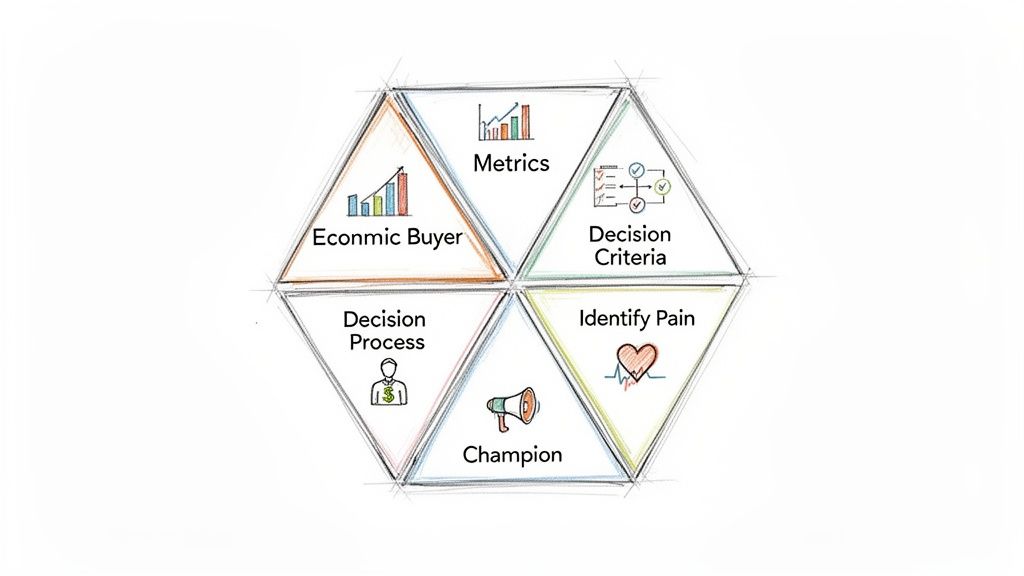
It turns a conversation into a qualification checklist. By addressing each component (Metrics, Economic Buyer, Decision Criteria, Decision Process, Identify Pain, Champion), you know you have the right information. This makes it one of the most effective sales pitch examples for building a business case from the prospect's own words.
Example in Action: Samskit CRM Updater
A Samskit account executive uses MEDDIC questions during a discovery call:
(Metrics): "You said reps spend Friday afternoon on updates. How many hours does your team spend weekly on manual CRM entry? If we gave them back 10+ hours each week, how would that impact your quarterly revenue?"
(Identify Pain): "Besides lost time, what are the consequences of an out-of-date pipeline? Does it affect your forecast accuracy?"
(Champion): "Who on your team gets the biggest benefit from cleaner pipeline data? How can we support their success?"
Strategic Analysis
This framework organizes a discovery call to get vital information:
Metrics-Driven: It forces you to connect the prospect’s pain to measurable outcomes. The conversation moves from features to financial impact.
Qualifies Deeply: It goes beyond surface-level pain. It uncovers who holds the budget (Economic Buyer) and the steps for purchase (Decision Process).
Creates Alignment: You build a case for your solution using the prospect's own logic, criteria, and metrics.
The objective is to qualify the opportunity rigorously. This ensures you spend time on deals that can close.
How to Build Your Own
Map Questions to MEDDIC: For each letter, prepare two or three open-ended questions for your product and the buyer's role.
Listen and Document: Listen more than you talk. Use the framework as a guide, not a script. Document answers in your CRM.
Confirm Understanding: After the call, send a follow-up email. Summarize what you learned using the MEDDIC components. For instance, "My understanding is your key criterion is reducing admin time by 5 hours per rep."
Find Your Champion: Focus on the person who gains the most from your solution. They will help you navigate the organization. For a deeper dive, you can explore the MEDDIC sales framework.
3. The Problem-Agitate-Solve (PAS) Formula (3-10 minutes)
The Problem-Agitate-Solve (PAS) formula is a persuasive framework. It does more than state a problem. It identifies a pain point, then amplifies the consequences of that pain. Finally, it presents your solution as the necessary relief. This approach creates urgency and positions your product as the clear path away from frustration.
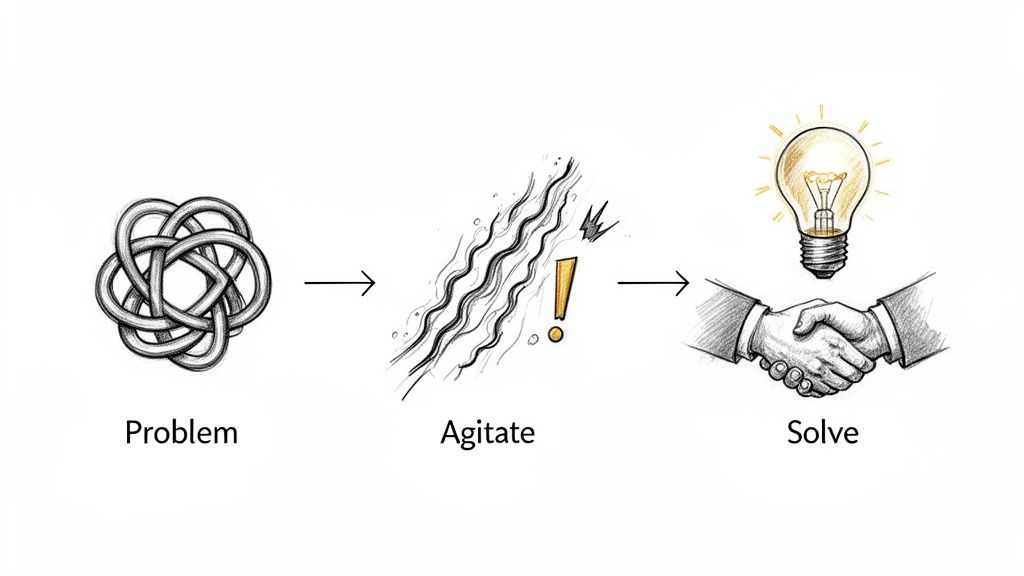
Unlike a direct pitch, PAS taps into the prospect’s experiences. By agitating the problem, you show you understand their world and its friction. This makes your solution feel like a welcome resolution, not a sales pitch. It is one of the most effective sales pitch examples for turning frustration into action.
Example in Action: Samskit CRM Updater
Here is how Samskit could apply the PAS formula in a call:
Problem: "Most sales leaders say their reps spend hours every week on manual CRM updates."
Agitate: "That's not just wasted time. It means your forecast is built on old data. Critical buyer signals get forgotten. Coaching conversations lack real evidence. Your expensive CRM becomes a graveyard of outdated information."
Solve: "Samskit eliminates that. It automatically syncs every key detail from your sales calls to the CRM. Your reps get that time back to sell. You get a pipeline you can trust."
Strategic Analysis
The effectiveness of this PAS pitch comes from its logical progression:
Shared Problem: It starts with a common issue ("reps spending hours on manual CRM updates"), making the prospect feel understood.
Agitation Amplifies Pain: The pitch connects the problem to bigger consequences: inaccurate forecasts, lost signals, and ineffective coaching. It turns an admin task into a strategic risk.
Solution as Relief: The "Solve" phase presents Samskit as the direct fix to the agitation. It provides immediate relief and a clear business outcome ("a pipeline you can trust").
The goal of agitation is not to create fear. It is to build a shared understanding of the problem's true cost. When done with empathy, it creates a powerful case for change.
How to Build Your Own
Pinpoint the Obvious Problem: Start with a pain point your prospect will immediately recognize.
Dig into the Consequences (Agitate): Ask yourself, "And what happens because of that?" List the downstream effects. Does it cause bad data? Wasted payroll? Missed opportunities? Use those points.
Frame Your Solution as the Answer: Connect your product's function directly to the agitated points. Show how it resolves the consequences, not just the initial problem.
Show Empathy: Use phrases like "I imagine that causes..." or "That must be frustrating when..." This shows you're on their side and builds trust.
4. The Feature-Benefit-Value (FBV) Presentation (5-20 minutes)
The Feature-Benefit-Value framework goes beyond listing what a product does. It connects a feature to its direct benefit, then to its measurable business value. This is one of the most effective sales pitch examples for showing a clear return on investment.
This structure translates technical specs into tangible outcomes. It forces the salesperson to answer the prospect's silent question: "So what does this mean for my business?" It is persuasive for technical buyers or RevOps leaders who need to justify a purchase with numbers.
Example in Action: Samskit AI Call Analysis
Here is how Samskit could present a feature using the FBV framework:
Feature: "Samskit's AI analyzes every sales call. It extracts buyer intent signals, key objections, and confirmed next steps."
Benefit: "This means your sales managers can coach reps based on what customers actually say, not on guesswork or secondhand summaries."
Value: "By identifying deal risks earlier, our clients typically see a 15-20% increase in their win rate. For your team, that improves pipeline predictability and adds significant revenue."
Strategic Analysis
This pitch succeeds by creating a logical chain from function to result.
Concrete Feature: It starts with a specific action the product performs ("AI analyzes... to extract..."). This is factual and easy to understand.
Direct Benefit: It immediately explains the consequence ("managers can coach based on actual signals"). This answers the "So what?" question.
Quantified Value: It finishes with a measurable outcome ("15-20% increase in win rate"). This is the "Why you should care" part, speaking to business goals.
The FBV model builds a solid business case, one feature at a time. It makes the final decision feel logical and justified.
How to Build Your Own
List Your Features: Catalog your product's core capabilities. Be specific. "AI call analysis" is better than "smart technology."
Ask "So What?": For each feature, ask, "So what does this let the user do?" The answer is your benefit. Frame it from the customer’s view.
Ask "What's the Impact?": For each benefit, ask, "What is the measurable result?" This is your value. Quantify it with time saved, money earned, or costs reduced.
Connect to Their Role: Tailor the value. A sales manager cares about win rates. A CFO cares about the cost of recovered productivity.
5. The SPIN Selling Approach (10-30 minutes)
The SPIN Selling approach is a consultative questioning framework. It guides a prospect to their own conclusion. Instead of pitching, you ask a strategic series of questions. These questions uncover problems and build the case for change. SPIN stands for Situation, Problem, Implication, and Need-Payoff questions.
This method shifts your role from seller to advisor. It is one of the most effective sales pitch examples for complex, high-value B2B sales. It builds trust by making the prospect feel heard and understood.
Example in Action: Samskit CRM Updater
A Samskit AE might use the SPIN framework during a discovery call:
Situation: "Walk me through how your sales manager currently reviews deals and coaches the team."
Problem: "What makes it hard to understand what’s happening in customer conversations from CRM notes alone?"
Implication: "What's the consequence when coaching is based on incomplete information or just the rep’s summary?"
Need-Payoff: "How valuable would it be to have clear visibility into buyer signals from all calls when preparing your next pipeline review?"
Strategic Analysis
This consultative pitch works because it puts the buyer in control:
Problem Discovery, Not a Pitch: The salesperson guides the prospect to state the problem themselves. This is more powerful.
Builds Consequence: Implication questions are key. They connect a small issue (poor notes) to a significant business pain (bad coaching, lost deals).
Focuses on Value: The Need-Payoff question encourages the prospect to state the value of a solution in their own words. This creates internal justification.
The goal is to co-create the business case with the prospect. This makes the close feel like a natural next step, not a hard sell. You can learn more about SPIN questions and how to apply them.
How to Build Your Own
Start with Situation Questions: Ask broad, open-ended questions to understand the current state. Example: "Tell me about your current process for..."
Move to Problem Questions: Probe for challenges or dissatisfactions. Example: "What’s the biggest challenge with that process?"
Explore Implications: Ask "so what?" questions that connect the problem to business consequences. Example: "How does that challenge affect your team's quota?"
Finish with Need-Payoff: Get the prospect to articulate the value of solving the problem. Example: "If you could fix that, what impact would it have on your revenue goals?"
6. The One-Call Close Script (1-5 minutes)
The one-call close is a high-velocity sales pitch example. It is a direct approach to secure a commitment on the spot. It works best for lower-priced products, trials, or when a prospect shows strong buying intent. Its purpose is to compress the sales cycle and get a "yes" or "no" immediately.
This method is effective when a prospect has a clear problem and your solution is a perfect fit. Instead of scheduling follow-ups, you present a clear path forward and ask for a decision.
Example in Action: Samskit CRM Updater
Here is how Samskit might use a one-call close script:
"Based on what you've shared, manual CRM updates are killing your team's productivity. We've helped over 200 similar teams fix this with Samskit. Let's get you a 7-day trial starting tomorrow. Does Thursday work for your kickoff, or is Friday better?"
Strategic Analysis
This pitch succeeds because it is built on confidence and clarity:
Summarize the Pain: It starts by confirming the core problem ("manual CRM updates are killing your team's productivity"). This shows you listened.
Present Social Proof: It mentions "over 200 similar teams" to build trust and reduce perceived risk.
Make an Assumptive Ask: The script doesn't ask if they want a trial, but when. It moves directly to logistics.
Offer a Binary Choice: "Does Thursday work... or is Friday better?" This simplifies the decision and steers the conversation toward a commitment.
The goal here is action, not just agreement. You move past the "why" and into the "how" and "when."
How to Build Your Own
Confirm the Fit: Before this close, get verbal confirmation that your solution fits their needs. Ask, "Does this sound like it solves your problem?"
Make the Ask Specific: Don't say "Let's discuss next steps." Say, "Let's get you set up on Monday." Propose a concrete action with a timeline.
Prepare for Immediate Action: Have the contract or trial agreement ready to send. Delays can kill momentum.
Use Urgency Ethically: Frame the urgency around their benefit. For example, "Let's start this week so your team can hit end-of-month targets." This connects the close to their goals.
7. The ROI-Focused Business Case (10-30 minutes)
When your buyer is a CFO or RevOps leader, a pitch based on features will fail. The ROI-Focused Business Case centers the conversation on financial return. It is a powerful sales pitch example for late-stage deals or economic buyers.
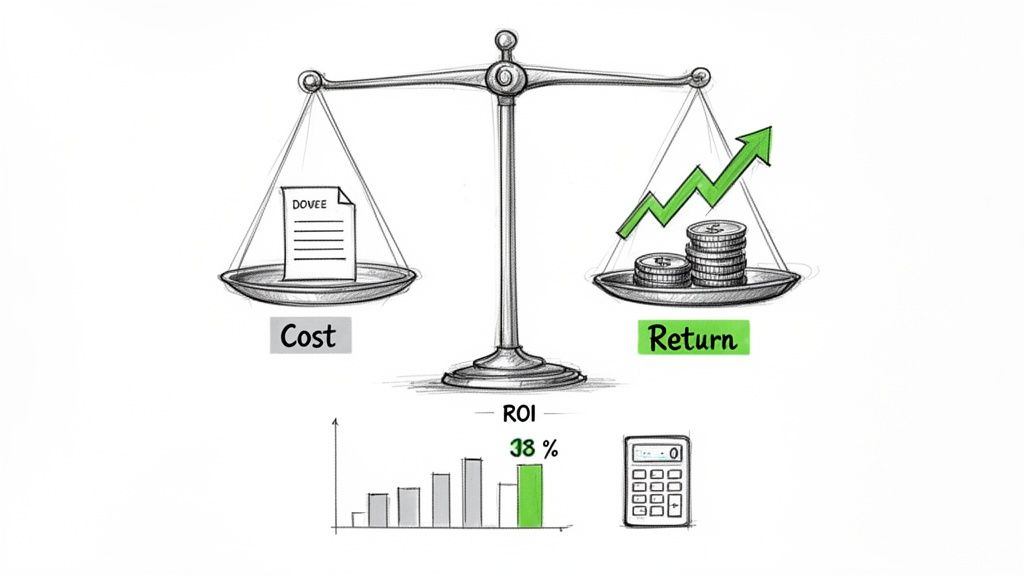
This approach translates your solution's value into the language of the balance sheet: cost savings, revenue gains, and risk mitigation. It presents a clear, data-driven argument for why the investment makes financial sense.
Example in Action: Samskit CRM Updater
Here is how Samskit could build a business case for a finance leader:
"Your team of 10 AEs spends about 45 minutes per day on post-call admin. That is 37.5 hours of unproductive time weekly. At a cost of £120/hour, that's £4,500 in sunk costs weekly, or £234,000 per year.
Samskit costs £6,400 per month, or £76,800 annually. By eliminating that manual work, we deliver an immediate 3x ROI in year one. That's before we factor in a projected 10% win rate improvement from better data, which could add over £400,000 in recovered revenue."
Strategic Analysis
This pitch speaks the language of the economic buyer:
Quantified Problem: It starts with a calculation of the current cost of inaction (£234,000 per year). This makes the problem tangible.
Direct Cost-Benefit: It places the solution's cost against the calculated savings to show a positive financial outcome.
Layered Value: The pitch adds a second layer of value (revenue improvement) to strengthen the case.
Conservative Framing: The numbers are specific and based on observable metrics, making them credible.
How to Build Your Own
Deconstruct the Pain: Work with your champion to map the current process. Identify every manual step, wasted hour, and associated cost.
Use Their Numbers: Ask for specifics like team size, average salaries, and deal sizes. This makes the ROI model theirs, not yours.
Benchmark with Data: If they lack numbers, use credible third-party benchmarks from firms like Gartner to support your assumptions.
Present Conservatively: Build your model on realistic estimates. This builds trust and makes your final ROI figure more believable.
8. Social Proof & Competitive Positioning
This pitch combines two powerful triggers: credibility from social proof and clarity from competitive positioning. It reduces a buyer's risk by showing that similar companies have succeeded with your solution. It then frames your product against alternatives, guiding the prospect to the right conclusion.
This approach works for mid-to-late stage conversations when prospects are evaluating options. By using customer stories and honest comparisons, you build trust and control the narrative.
Example in Action: Samskit CRM Updater
Here is how Samskit could combine social proof with competitive positioning:
"You're looking at us and two other platforms. They are solid choices. Competitor A is known for great voice quality. Competitor B has excellent native Salesforce integration. Our strength is the AI that extracts buyer intent automatically.
A client of ours, a $50M SaaS company, faced a similar choice. They realized their real problem was reps wasting 8 hours a week on admin and managers having no visibility into customer signals. Within 30 days of implementing Samskit, they eliminated that admin work and improved forecast accuracy by 25%. For your situation, where you need multi-CRM flexibility and true customer insight, our approach is likely the better long-term fit."
Strategic Analysis
This pitch shows confidence and expertise:
Builds Credibility: It acknowledges competitors' strengths. This makes you seem honest and trustworthy.
Reframes the Decision: It pivots from a generic feature comparison to the prospect's specific business problem.
Validates with Proof: It uses a specific, quantified success story from a relatable company to prove its value.
Connects to Prospect Needs: It links the differentiation ("multi-CRM flexibility") back to the prospect's unique situation. This makes the choice feel logical.
How to Build Your Own
Map Your Competitors: Know their genuine strengths and weaknesses. Focus on where their priorities differ from yours.
Organize Your Case Studies: Tag customer stories by industry, company size, and the problem they solved. This lets you pull the most relevant example instantly.
Frame with "For Your Situation": Always tie competitive differences back to the prospect's unique goals. It’s not about who is "best," but who is "best for you."
Lead with Results: Start your social proof with the most impressive outcome (e.g., "recovered $180K in annual productivity"). This makes the story compelling.
9. The Consultative Needs Analysis (15-45 minutes)
The consultative needs analysis moves the sales rep from seller to expert advisor. This is a structured diagnostic conversation, not a pitch. It uncovers hidden challenges in the prospect's business. It focuses on deep questioning, active listening, and collaborative problem-solving to build trust.
Its value comes from establishing the representative as a key resource. By diagnosing problems the prospect hasn't articulated, you create a foundation for a solution they will feel ownership of. This is one of the most effective sales pitch examples for complex, high-value deals.
Example in Action: Samskit CRM Updater
A Samskit account executive would use this approach across several calls:
Initial Call: "Walk me through your current sales structure. How are your teams organized? I want to understand your tools and where your team feels the most friction."
Second Call: "Based on our last talk, the biggest variance in your forecast comes from deals in stages 2 and 3. My hypothesis is that a lack of real-time call data makes it hard to spot risks early. Does that resonate with you?"
Third Call: "We confirmed that information gaps are hurting your sales coaching. Here’s a report showing how Samskit addresses each gap. I recommend a pilot for your enterprise team to measure the impact on their pipeline velocity."
Strategic Analysis
This multi-touchpoint analysis methodically builds a case for change:
Diagnostic Questioning: It uses open-ended questions ("Walk me through...") to get the client talking. The rep acts as a curious expert, not a product-pusher.
Collaborative Hypothesis: The rep presents findings as a shared insight ("My hypothesis is... Does that resonate?"). This invites the client to co-author the problem statement.
Customized Recommendation: The final solution is a direct answer to the problems uncovered. It is presented as a logical next step, not a sales ask.
The goal is to make the decision to buy feel like the obvious conclusion of a joint investigation. You are not selling a product; you are prescribing a verified solution.
How to Build Your Own
Do Your Homework: Before the first call, research the company and its industry. Prepare a set of initial, high-level questions.
Ask for Permission: Start the call by saying, "To understand your situation, may I ask some detailed questions and take notes?" This frames the conversation as an analysis.
Synthesize and Share: After each call, send a brief summary of your understanding. This shows you were listening and keeps the process on track.
Recommend Next Steps: Always conclude with a clear action item. You could suggest an article or an introduction that adds value, reinforcing your role as an advisor.
10. The Executive Summary / Elevator Pitch Deck (15-30 minutes)
This visual, slide-based pitch translates an elevator pitch into a story format. It is designed for formal presentations. It uses 10-15 slides to cover the problem, solution, proof, and a call to action. Where verbal pitches rely on flow, a pitch deck uses design and data to create a high-impact narrative.
It is one of the most effective sales pitch examples for engaging visual learners. The deck acts as a visual anchor. It guides the conversation and ensures all critical points are covered.
Example in Action: Samskit Executive Brief
A 9-slide executive brief deck for Samskit might be structured like this:
Slide 1: Executive Summary: State the problem of CRM data integrity and the value of automating it.
Slide 2: The Strategic Challenge: "Sales teams lose 30% of their selling time to manual CRM updates, costing £40,000 per rep annually."
Slide 3: The Opportunity: "What if you could reclaim that time and reinvest it into revenue-generating activities?"
Slide 4: Our Solution: "Samskit automatically updates your CRM after every call, eliminating administrative work."
Slide 5: Expected Outcomes: "Achieve 99% CRM accuracy, give back 5+ hours per rep weekly, and see a 15% uplift in sales activities."
Slide 6: Implementation: "A 3-step process: Connect to CRM, configure rules, and go live in one week."
Slide 7: Success Metrics & Timeline: Show a 90-day chart mapping adoption rates and time saved.
Slide 8: The Investment: Clear, tiered pricing.
Slide 9: Call to Action: "Let’s schedule a 30-minute deep-dive for your team next week."
Strategic Analysis
This pitch deck structure builds a logical business case.
Story Arc: It follows a classic problem-solution-outcome narrative. This makes it easy to follow.
Visually Focused: Each slide makes a single, clear point. This prevents overload and keeps the audience focused.
Data-Driven: It uses specific metrics (£40,000 cost, 15% uplift) to move from a general problem to a tangible business issue with a measurable ROI.
The goal is to guide a conversation, not present a document. The slides are your visual aids, not your script. They support your story; they do not replace it.
How to Build Your Own
Define the Narrative: What is the one-sentence story? Start with the problem, introduce your company as the guide, and end with the successful outcome.
One Idea Per Slide: Resist cramming information. A slide should be understandable in three to five seconds. Use strong headlines and visuals.
Lead with the 'Why': Open with the prospect's problem and its impact. This makes the presentation about them, not you.
Show, Don't Just Tell: Use charts and simple diagrams to illustrate your points. Visual data is more persuasive than text.
End with a Specific Ask: Conclude with a clear next step. Instead of "What do you think?", try "Can we book a follow-up for Tuesday to build your business case?".
10 Sales Pitch Approaches Compared
Technique | 🔄 Complexity | ⚡ Resources & Speed | 📊 Expected outcomes | 💡 Ideal use cases | ⭐ Key advantages |
|---|---|---|---|---|---|
The Elevator Pitch (30-60 seconds) | Low — simple script, low prep | Minimal resources; immediate delivery | Quick interest generation and basic qualification | Networking, cold outreach, email openers, short discovery | ⭐⭐ Memorable, repeatable, scalable across channels |
The MEDDIC Framework (5-15 minutes) | High — structured, multi-part discovery | Requires trained reps, prep and CRM documentation; moderate speed | Better-qualified deals, earlier deal-breaker identification | Complex B2B deals, enterprise AEs, deal qualification reviews | ⭐⭐⭐⭐ Systematic qualification; reduces long-term cycle risk |
PAS Formula (3-10 minutes) | Medium — craft emotional narrative | Moderate prep (customer research); moderate speed | Creates urgency and emotional buy-in | Outbound emails, demo intros, objection handling | ⭐⭐⭐ Strong emotional resonance; drives urgency when authentic |
FBV Presentation (5-20 minutes) | Medium–High — needs product depth and prep | Requires product knowledge, data and possibly slides; moderate pace | Clear ROI justification and stakeholder alignment | Demos, technical evaluations, RevOps/finance discussions | ⭐⭐⭐⭐ Links features to measurable business value |
SPIN Selling (10-30 minutes) | High — disciplined questioning and listening | Trained reps, longer calls; time-intensive | Higher close rates and stronger internal buy-in | Complex enterprise sales, multi-stakeholder processes | ⭐⭐⭐⭐ Consultative approach that uncovers real needs |
One-Call Close Script (1-5 minutes) | Low–Medium — script-driven, precise timing | Low prep but needs readiness to execute (contracts) | Fast conversions when prospect is qualified | Warm leads, trial conversions, aligned decision-makers | ⭐⭐⭐ Accelerates deals; high conversion when timing fits |
ROI-Focused Business Case (10-30 minutes) | High — detailed modelling and validation | Heavy data collection, financial inputs; time-consuming | Strong budget approvals and procurement buy-in | CFO conversations, enterprise procurement, RevOps reviews | ⭐⭐⭐⭐ Highly defensible financial justification |
Social Proof & Competitive Positioning | Medium — requires curated case studies | Needs documented customer results and competitive intel; moderate prep | Reduced perceived risk and clearer vendor differentiation | Competitive evaluation stage, risk-averse buyers | ⭐⭐⭐⭐ Builds credibility and helps close evaluation gaps |
Consultative Needs Analysis (15-45 minutes) | Very High — deep discovery and analysis | Significant time per prospect, expert reps; slow to scale | High lifetime value, strong internal champions, tailored solutions | Strategic accounts, complex implementations, enterprise deals | ⭐⭐⭐⭐⭐ Positions rep as trusted advisor; uncovers hidden opportunities |
Executive Summary / Pitch Deck (15-30 minutes) | Medium — slide design and narrative work | Design assets and rehearsed delivery; good for meetings | Memorable, shareable presentation that aligns stakeholders | Executive briefings, investor pitches, multi-stakeholder reviews | ⭐⭐⭐⭐ Visual storytelling; easy to distribute internally |
From Examples to Execution: Making These Pitches Your Own
The sales pitch examples we've explored are strategic blueprints, not just scripts. Viewing them as rigid templates is a mistake. The real skill is internalizing their logic and adapting them on the fly. Your goal is not to perfect a single delivery. It is to build a versatile toolkit for any sales scenario.
The most effective sellers do not sound scripted because they are not. They have mastered the core principles behind these frameworks. They know that a SPIN Selling approach is about guiding a discovery process. They recognize that the PAS formula is an exercise in empathy and creating urgency.
Key Insight: Sales mastery is the ability to select, combine, and modify these frameworks in real-time. A great pitch is a dynamic conversation, not a static presentation.
Turning Theory into Repeatable Action
Moving from reading these examples to executing them requires a deliberate process. Do not try a new pitch on your next call without preparation. Instead, use a structured approach to adopt and refine these methods. This builds the muscle memory to make these techniques feel natural.
Here are the steps to make these sales pitch examples your own:
Select Your Starting Framework: Do not try to master all ten at once. Choose one or two that address a weakness in your current sales cycle. If you struggle with discovery, focus on SPIN. If your demos lack impact, drill down on the FBV model.
Deconstruct and Rebuild: Rewrite your chosen framework in your own words. Use your product's specifics and your buyer's pain points. What are the "Implication" questions for your prospect? What metrics would you use in an ROI case for a CFO? This customization is essential.
Role-Play with a Purpose: Practice your customized pitch with a colleague. The goal is to handle interruptions, answer tough questions, and transition smoothly. Record these sessions. Listening to yourself is the fastest way to spot awkward phrasing.
Measure, Analyze, and Iterate: The ultimate test is in the field. After you use a new approach, analyze what happened. Did the prospect engage more? Did they ask questions showing they understood the value? Track how your new approach affects metrics like conversion rates and sales cycle length. Every call provides data for the next one.
By focusing on this cycle, you shift from a salesperson who presents to an advisor who diagnoses. This is the difference that separates average performers from the top one percent. It is about turning conversations into predictable revenue. The sales pitch examples in this article are your starting point. Your execution is what will close the deal.
Ready to move from theory to execution? Analyzing your own calls is the fastest way to refine your pitch. Samskit uses AI to transcribe and analyze your sales conversations. It pinpoints where your pitch works and where it needs improvement. Stop guessing. Start using real data to make every sales conversation better by visiting Samskit to see how it works.