Objection handling is not about snappy comebacks. It is about listening to understand the real issue behind a prospect's words. You then address that issue and turn a potential dead-end into a productive conversation.
Mastering this skill separates top performers from the rest. It is how you build trust and uncover deal-killing problems before they happen.
Why Many Reps Get Objection Handling Wrong
Many sales reps react poorly to objections. They hear "your price is too high" and immediately get defensive or offer a discount. Both actions kill the conversation and destroy credibility.
This reactive response is why most objection handling fails.
An objection is not a personal attack. It is a signal. When a buyer pushes back, they are not telling you to go away. They are saying they are engaged but need help resolving a concern. Treating it as a fight puts you on opposite sides.
The Mindset Shift That Changes Everything
Adopt a consultant's mindset instead of a debater's. View objections as invitations to collaborate with your buyer, not as roadblocks. Your goal is not to "overcome" an objection, but to understand it.
An objection is a buyer's way of saying, 'I'm interested, but something is holding me back. Help me figure this out.' A defensive response slams the door shut. A collaborative one opens it wider.
This shift changes your entire approach. A reactive rep hears, “Your competitor is cheaper,” and starts listing features to justify the cost.
A collaborative rep hears the same thing and asks, "That's a fair point. To be on the same page, which parts of their solution are you comparing to ours?" The second response opens a dialogue. It starts to uncover what is really behind the price comment.
From Roadblock to Opportunity
When you treat objections as opportunities, you earn the right to dig deeper. You build credibility and find the buyer's true needs. This is when you stop being just another vendor and become a trusted advisor.
If you’re looking to build a solid base for this approach, this comprehensive guide to objection handling is an excellent resource for exploring the core principles and more advanced strategies.
This shift in perspective delivers powerful results:
Deeper Trust: Buyers open up when they feel heard, not cornered. You become an ally in their decision process.
Better Discovery: Objections often point directly to pain points or priorities you may have missed.
Stronger Positioning: Once you understand the root cause, you can align your value proposition with what truly matters to them.
Stop treating objections as battles. Start seeing them as puzzles you solve together with the buyer. This change in perspective is the most important step toward mastering objection handling.
A Practical Framework for Handling Objections
Knowing you should be collaborative is one thing. Doing it in the moment is another. You need a repeatable process to guide your response without sounding robotic.
This is not about memorizing comebacks. It is about building a core workflow that becomes second nature. With a reliable framework, you stop reacting emotionally and start responding strategically. You turn deal-breakers into opportunities that build trust and advance the sale.
Think of it as a mindset shift. You move from seeing an objection as a roadblock to seeing it as a question that invites collaboration.
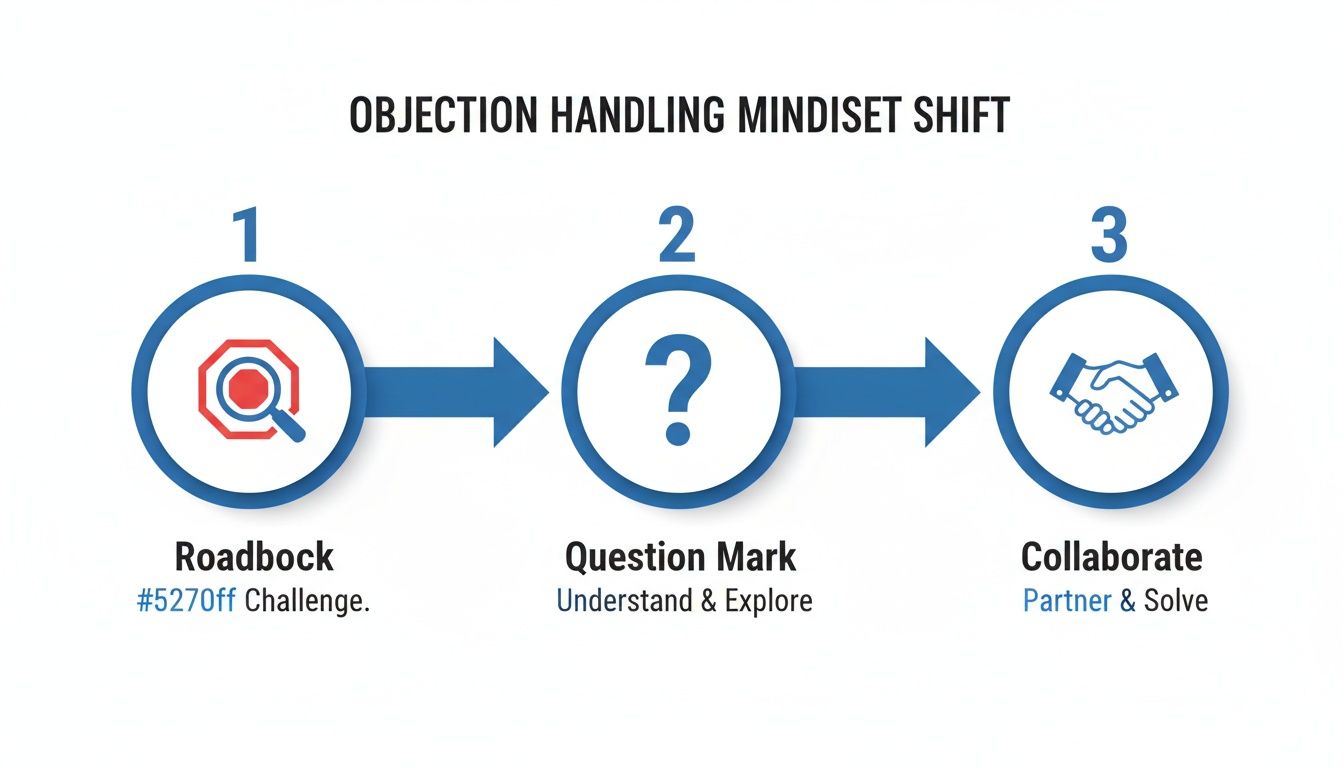
A good response always starts with curiosity, not confrontation.
Let’s break down the five practical stages of this framework.
First: Listen Without Interrupting
When a prospect raises an objection, our first instinct is to jump in. This is a major mistake. It signals that you care more about defending your solution than understanding their view.
Your only job is to listen completely. Let them finish their thought. Silence is a powerful tool here. It shows respect and often encourages the prospect to elaborate, giving you more context.
After they finish, pause for a moment. This small pause reinforces that you have heard them and are considering their words.
Second: Clarify The Real Issue
Most objections are just the tip of the iceberg. "It's too expensive" rarely means they have no budget. It usually stands for something deeper, like "I don't see enough value yet" or "This is an unplanned expense."
Your goal is to find the real problem. Use smart, open-ended questions. Avoid questions with 'yes' or 'no' answers. Instead, probe for the story behind their statement. The quality of your questions is critical. To sharpen this skill, you can explore questioning techniques with this guide on mastering the SPIN selling method.
Here are a few examples of clarifying questions:
Price Objection: "Your price is too high."
Clarifying Question: "That's a fair point. To make sure I understand, what are you comparing our solution against?"
Timing Objection: "Now isn't a good time."
Clarifying Question: "I understand. Could you help me understand what is driving that timing on your end?"
Need Objection: "We're happy with what we have."
Clarifying Question: "That's great to hear. What aspects of your current setup are working particularly well for you?"
These questions explore the objection instead of challenging it.
Third: Validate Their Concern
Before offering a solution, validate their concern. This does not mean you agree with them. It means you acknowledge their perspective is reasonable. Validation is the fastest way to disarm a tense situation and build rapport.
When you validate, you tell the prospect, "I hear you, and it makes sense why you'd see it that way." This lowers their guard and makes them more receptive. It shifts the dynamic from you-vs-them to us-vs-the-problem.
A quick tip: Never start a response with "But..." It negates any validation you just offered. Use bridging phrases like, "I understand, and..." or "That makes sense. What many of our customers in your position find is..."
Here are some simple validation phrases:
"I can understand why you'd feel that way."
"That's a completely fair question."
"It makes sense that you'd be looking at it from that angle."
Genuine validation signals that you are on their side, working with them.
Fourth: Respond With Targeted Value
Now it is time to respond. Because you have listened, clarified, and validated, you are not guessing. You can deliver a precise response that connects your value directly to the root cause you uncovered.
For example, if they said your price was high because they were comparing you to a competitor with fewer features, your response is not about defending your price. It is about showing the value of the features your solution has that the other does not.
A powerful response follows this structure:
Acknowledge the root cause: "It sounds like the key difference you're weighing is our advanced analytics module."
Connect to specific value: "Our clients using that module report a 15% reduction in customer churn because they can spot at-risk accounts sooner."
Frame it as a business outcome: "For a business your size, that could translate to over R$200.000 in retained revenue annually."
Your response should always link back to solving their business problem and delivering a measurable result.
Fifth: Confirm You’ve Resolved It
Do not assume your response landed perfectly. Close the loop by confirming you have addressed their concern. Many reps skip this step, leaving doubt that can reappear later.
A simple confirmation question re-engages the prospect. It gives them a chance to agree or raise lingering doubts. It ensures you are both aligned before moving on.
Here are some ways to check in:
"Does that help clarify things for you?"
"How does that sound?"
"Given that context, do you see how our approach might be a better long-term fit?"
If they agree, you have navigated the objection. If they hesitate, loop back to the clarification phase. This is part of the process and ensures no concern is left unaddressed.
Handling Objections Across Different Sales Stages
Objections are not all the same. A quick brush-off on a discovery call differs from a procurement team's contract review. Treating them the same will stall your deals.
Adapt your approach based on the sales cycle stage. This helps you anticipate and prepare for pushback specific to each phase. It keeps deals moving forward.
Early-Stage Discovery and Qualification Objections
Early-stage objections are often knee-jerk reactions. Prospects do not know you. Their main goal is to protect their time. Your mission is not to close the deal, but to earn the next five minutes of their attention.
You will hear common lines:
"We're happy with who we use now."
"Just send me an email."
"We don't have the budget for this right now."
These are smokescreens, not real objections. "We're happy" is rarely about their current vendor. It is about their lack of interest in talking to you. Get curious instead of defensive.
Try this: "That's great to hear. For my own learning, what parts of your current setup work especially well for you?" This disarms them. It can open a small door for you to find a frustration to explore.
In competitive B2B markets like Brazil, many deals die here. Recent findings on Brazilian sales benchmarks showed that 68% of SaaS deals stalled due to unresolved buyer objections in early calls. Getting past these initial hurdles is crucial.
Mid-Stage Demo and Solutioning Objections
Once you secure a demo, the objections become more specific. The buyer is now seriously evaluating your solution. They will ask about features, integrations, and ease of use.
Expect to hear:
"Your solution is missing [specific feature]."
"This seems too complicated for my team to adopt."
"How does this integrate with our existing tech stack?"
When a prospect points out a missing feature, do not jump to your product roadmap. First, understand the "why" behind their question. Ask, "That's a helpful point. Could you walk me through the workflow where that feature would be most critical?"
Often, you will find your solution already solves their core problem in a different way. If it is a real gap, be honest. Honesty builds more trust than a vague promise about a future update.
Don't sell a feature; sell the outcome. If a prospect is focused on a missing capability, pivot the conversation back to the core business problem. Show them how your existing functionality delivers the result they need.
Late-Stage Pricing and Negotiation Objections
This is the final stretch. Budget and competitor objections appear here. The buyer is interested but now focuses on justifying the cost and reducing risk. You will hear familiar lines: "It's too expensive," or "Your competitor is cheaper."
Remember, it is rarely just about the price. It is about value. It means the buyer has not fully connected your solution's cost to the pain it solves for their business.
Tackling "It's Not in the Budget"
A budget objection often means it was an unplanned expense. Your job is to make it a priority. Frame the cost of your solution against the cost of doing nothing.
For example: "I understand this wasn't a planned expense. You mentioned that manual data entry is costing your team about 20 hours per week. Our solution could reclaim that time, which translates to roughly R$XX,XXX in productive hours each month."
Handling "Your Competitor is Cheaper"
Never badmouth the competition. It makes you look unprofessional. Instead, use this as an opportunity to reinforce your unique value.
A solid response is: "They are a good company. When our customers choose us, it's typically because they need our advanced analytics for churn prediction, which isn't something [Competitor] focuses on. Is that an area of priority for you as well?"
Final-Stage Procurement and Legal Hurdles
You have won over your champion and the economic buyer. Now you face procurement and legal. Their job is to minimize risk and secure the best terms. Objections here are about security, liability, and contract clauses.
Common hurdles include:
Lengthy security reviews.
Requests for changes to your Master Service Agreement (MSA).
Pushback on payment terms or renewal clauses.
The key is preparation and partnership with your champion. Before legal review, ask your champion, "What does your typical procurement process look like? Are there any standard issues we should prepare for?"
A strong internal champion is essential at this stage. A structured qualification methodology can help you build this partnership. The MEDDPICC framework helps build stronger champions and is a great way to prepare for these final stages. Anticipating these late-stage objections helps you address them proactively and prevent them from killing your deal.
How Sales Managers Can Coach for Elite Objection Handling
Great objection handling is not learned in a one-day workshop. It is developed through consistent coaching based on what is actually happening on calls.
Effective coaching uses real-world sales conversations to pinpoint where things go wrong. This data-first approach builds a resilient team that sees objections as opportunities.
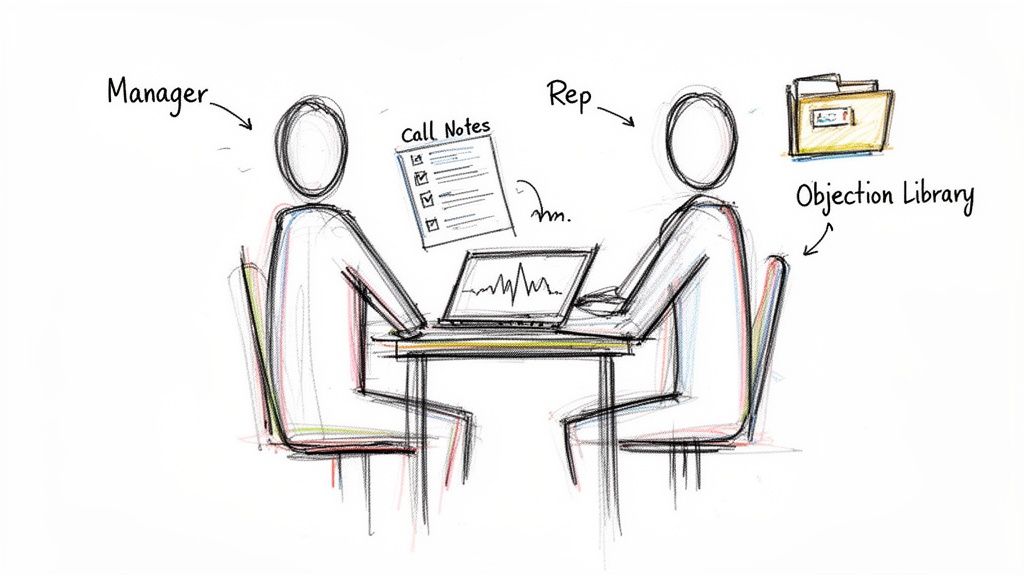
This method moves coaching from subjective opinions to an objective review of what works.
Use Call Recordings as Your Coaching Arena
Recorded sales calls are a goldmine for coaching. They provide a direct way to analyze how a rep handles pressure. This eliminates guesswork.
Instead of saying, “You need to improve at handling price objections,” you can point to a specific moment. “Let's go to the 12:45 mark, when the prospect mentioned budget. What do you think the real reason for that pushback was?” This starts a discussion, not a lecture.
The best managers integrate sales training programs that focus on specific objection handling techniques identified from these calls.
Build a Shared Objection Library
An objection library is a central resource for tracking common objections and sharing effective responses. It should be a living document that evolves with your market.
When a rep successfully handles a new objection, document it. Add the context, the exact phrasing used, and the outcome. This builds a shared knowledge base.
Track the Objection Type: Categorize it as Price, Competitor, or Timing.
Document the Winning Response: Capture what the rep said and why it worked.
Analyze the Outcome: Did the response resolve the concern and move the deal forward?
An objection library turns individual knowledge into a scalable team asset. When one person finds a winning response, the whole team benefits.
This workflow stops reps from reinventing the wheel on every call.
Run Role-Plays That Feel Real
Most sales role-plays are ineffective because they feel fake. To make them practical, ground them in actual deal scenarios from your CRM or call recordings.
Forget generic scenarios. Try this: "Sarah, you're calling a prospect who is worried about a complex implementation. Here's the snippet from their last call. How do you open this new conversation and address that concern directly?"
This level of specificity makes the exercise practical. It forces the rep to think critically about a real situation, not recite a canned response.
Spot Trends Before They Hurt Your Pipeline
Individual coaching is important, but spotting team-wide trends gives you a strategic edge. Are you hearing a new competitor's name more often? Is a specific feature gap mentioned in multiple demos? This is valuable market intelligence.
Recent consulting data on win-loss analysis in Brazil showed that poor objection handling contributed to 47% of lost deals for B2B SaaS companies. One São Paulo team's close rates jumped 18% after tracking objections. They found 35% of objections were about 'complex implementation' and 28% about 'insufficient local support'.
By systematically tracking objections, you can catch these patterns early. This data helps you adjust training, refine messaging, or give feedback to your product team. It shifts you from reactive coaching to proactive sales strategy.
Automating Objection Tracking to Improve Your Workflow
Manually logging every sales objection is unrealistic. Reps are told to do it, but it rarely happens consistently. It is a time-consuming task.
The result is lost context and a missed opportunity for deal intelligence. Smart sales teams are gaining an edge by turning their conversational data into a strategic advantage.
Automating this process removes an administrative burden. It builds a reliable system for capturing what buyers really think. It moves your team from a reactive mode to a proactive, data-driven one.
From Scattered Notes to Actionable Intelligence
Imagine a sales assistant tool automatically joining your calls on Zoom, Google Meet, or Microsoft Teams. It transcribes and analyzes the conversation in real-time.
When a prospect pushes back, the system instantly identifies and categorizes the objection. No manual entry is needed. This frees reps to focus on the conversation. It also ensures no critical feedback is lost.
This turns unstructured conversations into structured data. This data becomes the foundation for smarter coaching and more accurate forecasting.
This means you stop relying on a rep's memory and start working with hard evidence. It removes guesswork from deal reviews and coaching, letting you focus on what truly matters.
A Real-World Scenario: Price Objections
Consider a typical situation. A rep gives a great demo, and the prospect says, “This looks great, but your price is much higher than we expected.”
Manually, the rep might note "price objection." Later, recalling specifics is difficult. They might have to scrub through a long recording to find that one moment.
With an automated system like Samskit, the workflow is transformed:
The tool detects the phrase "price is much higher" and identifies it as a price objection. It can then flag the deal in your CRM and create a deal risk.
The exact transcript snippet, with a link to that moment in the recording, is attached to the opportunity. The full context is captured and available.
Here is what that looks like. Samskit can surface these key moments automatically, giving you a dashboard view of what is happening.
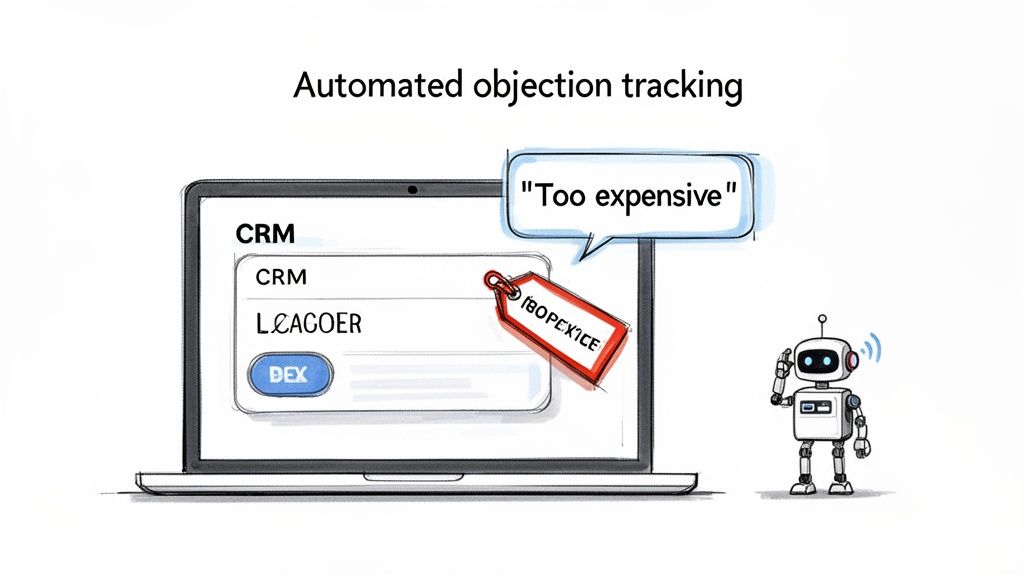
This gives managers instant visibility into objection trends across the team without listening to full recordings.
The Payoff of an Automated Workflow
This is not just about saving time on admin. An automated approach delivers tangible results.
For Your Sales Reps:
More Focus on Selling: Reps spend less time on CRM updates and more time engaging with buyers.
Cleaner Handoffs: All context, including objections, is in the CRM when a deal closes. This ensures a smooth handover to Customer Success.
Targeted Self-Coaching: Reps can quickly find and review moments where objections occurred to improve their performance.
For You, the Sales Manager:
Precision Coaching: You can jump directly to moments where reps struggled and provide specific, actionable advice.
Smarter Forecasting: A sudden spike in late-stage budget objections across deals is an early warning for your forecast.
Real-Time Strategic Insight: You can spot competitive trends as they happen and adjust your team's strategy immediately.
Automating objection tracking turns scattered conversations into a central intelligence source. It provides the clear data you need to master objection handling and drive predictable growth.
Tackling the Tough Questions in Objection Handling
Even with a good framework, you will face tricky situations. Let's cover a few common ones.
What’s the Real Difference Between an Objection and a Brush-Off?
An objection is a sign of engagement. When a buyer says, "Your reporting features don't seem as robust," they are inviting a conversation. They are considering your solution and see a potential issue.
A brush-off is deflection. It is an attempt to end the conversation. Lines like "Just send me an email" or "Call me next quarter" are brush-offs. They signal low interest, not a specific concern. Gently probe a brush-off to see if a real objection is hidden, but also know when to back off.
How Should I Respond When I Don’t Know the Answer?
Never guess. Your credibility is your most important asset. Being honest and turning it into a positive is the best move.
Say, "That's an excellent question, and I want to get you a precise answer. Let me confirm with our technical team and I'll get back to you with the details by the end of the day."
This approach shows you take their concern seriously. It reinforces your commitment to accuracy. It also creates a natural reason for a follow-up, which builds trust.
When Is It Okay to Walk Away from a Deal?
Knowing when to stop pursuing a deal is a strategic skill. Your time is valuable. Chasing a deal that is going nowhere hurts your pipeline. It might be time to walk away when:
You can’t reach the decision-maker. If your champion repeatedly fails to introduce you to the person with budget authority, the deal is likely stalled.
The prospect’s demands are unreasonable. If they ask for custom features not on your roadmap or a price that devalues your solution, it is not a good partnership.
They go silent. If multiple professional follow-ups receive no response, it is time to focus on engaged opportunities.
Mastering objection handling is not about winning arguments. It is about leading conversations with confidence, curiosity, and a clear purpose.
Ready to stop guessing what happened on sales calls and start coaching with evidence? See how Samskit automatically tracks objections, surfaces deal risks, and updates your CRM, giving you and your team more time to focus on what matters most: selling. Learn more about how Samskit can help your team.