MEDDPICC is a sales qualification framework. Think of it as a checklist for complex B2B deals. It helps your sales team check every box before investing time and resources into an opportunity. The framework gives your revenue team a common language to discuss deals, forecast accurately, and focus on winnable opportunities.
Understanding The MEDDPICC Framework
A pilot uses a pre-flight checklist. MEDDPICC is that checklist for your sales opportunities. Before you commit to a long sales cycle, this framework ensures you have checked all systems. It pulls your team away from wishful thinking and grounds them in an evidence-based approach to selling.
The point of MEDDPICC is to bring discipline to the sales process. By gathering information for each of its eight components, you build a complete picture of the deal. This clarity helps you spot risks early, understand the buyer's world, and build a business case tied to their measurable goals.
Why It Matters For Modern Sales Teams
In complex B2B sales, selling without a structured process leads to wasted effort on deals that were never going to close. Teams without a common methodology have inconsistent deal reviews, inaccurate forecasts, and long sales cycles. MEDDPICC is the solution.
A structured sales framework like MEDDPICC creates a unified language across the revenue team. It shifts conversations from feelings about a deal to objective evidence. This makes coaching and forecasting more effective.
For example, Brazil's B2B sales environment is adopting structured methodologies. Brazilian B2B teams using MEDDPICC-inspired processes report a 28% improvement in deal closure rates. This is because the framework forces them to pinpoint the customer's Metrics, engage the Economic Buyer, and define the Decision Criteria early. You can find out more about the growth of Brazil's digital transformation market.
A Quick Look at the Components
Each letter in MEDDPICC stands for a critical piece of information you need to qualify an opportunity. It is not just a list to check off; it is a guide for your discovery calls and deal strategy. Understanding each letter is the first step toward building a reliable pipeline.
Here is a quick look at the eight components and the key questions they help you answer.
The MEDDPICC Framework at a Glance
This table breaks down each component of the MEDDPICC acronym. It provides a summary of what it stands for and the core question it answers for any deal.
Component | What It Stands For | Core Question It Answers |
|---|---|---|
Metrics | Quantifiable Business Outcomes | What measurable results does the customer expect? |
Economic Buyer | The Person with Veto Power | Who has the ultimate authority and budget to approve this purchase? |
Decision Criteria | The "How" of Their Choice | What specific requirements will they use to choose a vendor? |
Decision Process | The Path to a "Yes" | What are the exact stages and approvals to make a final decision? |
Paper Process | Legal and Procurement Hurdles | What is the step-by-step process to get a contract signed? |
Identify Pain | The Compelling Reason to Act | What is the critical business problem that makes a solution urgent? |
Champion | Your Internal Advocate | Who has the influence and personal motivation to sell for us internally? |
Competition | The Known and Unknown Rivals | Who else are they considering, and what are their strengths and weaknesses? |
Use this table as a reference. As you work on a deal, these core questions will keep you focused on what you need to do to close it.
Breaking Down Each MEDDPICC Component
To use MEDDPICC effectively, you must understand what each part means in a real deal. It is about asking the right questions to get the full story.
This section will guide you through all eight elements. We will turn the theory into practical information you can use on your next sales call.
This diagram shows how three key elements are connected: the business pain, the metrics it affects, and the economic buyer who cares about those metrics.
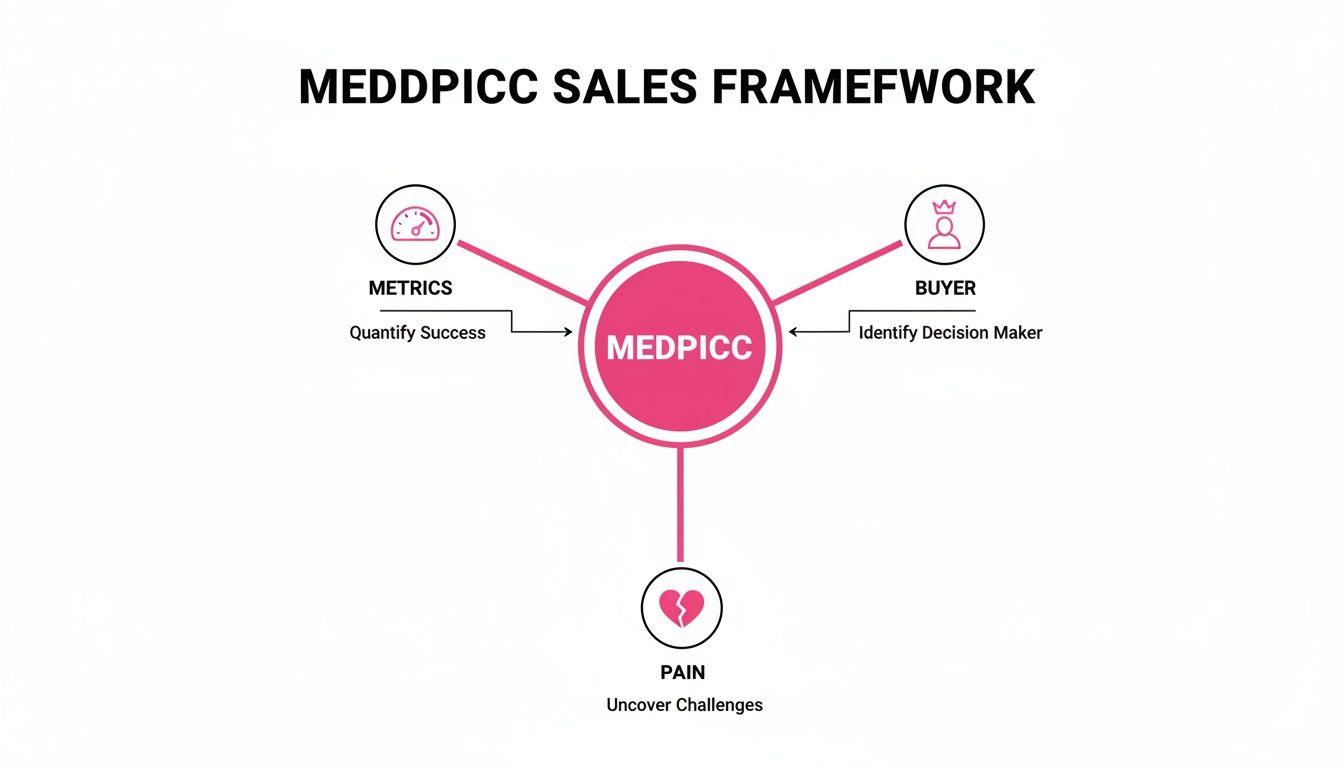
A solid deal is built on a clear line from a critical pain point to a number that matters, which gets the attention of the person with the budget.
M is for Metrics
Metrics are the measurable business results your prospect needs. This is where you shift the conversation from your product’s features to its value. Without metrics, your solution is a “nice-to-have.”
Numbers build the business case. The economic buyer approves investments that deliver a clear return. Define these numbers early to arm your champion with the language they need to justify the purchase.
Actionable Checklist:
Ask which KPIs they need to improve this quarter.
Ask for the tangible impact on revenue, costs, or risk if you solve their problem.
Ask how they measure success today and what they want that number to be in six months.
E is for Economic Buyer
The Economic Buyer is the one person with the final say on spending money. They can approve a project or kill a deal. They control the budget.
Finding and meeting this person is essential. Many deals stall because salespeople only talk to end-users who lack budget authority. You must understand what the Economic Buyer cares about and position your solution as the answer.
Do not assume your main contact is the Economic Buyer. Find out who has Profit & Loss (P&L) responsibility for the area you impact. Who can create a budget or release funds?
Actionable Checklist:
Ask who owns the budget for this type of initiative.
Ask whose sign-off is needed for a purchase of this size.
Ask about the top business priorities for their department this year.
D is for Decision Criteria
Decision Criteria are the specific standards your prospect uses to judge options. This is their vendor selection checklist. Criteria can be technical (must integrate with X), commercial (must be under Y budget), or service-related (must provide 24/7 support).
If you understand these criteria, you can shape the conversation. If you do not know how they score you, you are selling blind. Top sales reps influence the criteria to favor their strengths. For example, if your platform has strong security, make sure "data security standards" is a high-priority item on their list.
Actionable Checklist:
Ask how the team will compare different options.
Ask for the top three "must-have" capabilities in a solution.
Ask what criteria were most important in past purchases.
D is for Decision Process
The Decision Criteria are what they use to choose. The Decision Process is how they will choose. It is the step-by-step path a deal follows inside their organization—from technical validation to final sign-off.
Mapping this process helps you avoid surprises and forecast accurately. It tells you who gets involved, when they get involved, and what milestones to hit. A vague understanding of the process is a red flag. A detailed, confirmed plan indicates a qualified deal.
Actionable Checklist:
Ask them to walk you through the typical steps from today to a signed contract.
Ask who needs to be involved in the technical validation and final business review.
Ask for a realistic timeline for a project of this size to get approved.
P is for Paper Process
The Paper Process covers the procurement and legal steps to get a contract signed. This is where many deals stall. Delays from legal redlines and vendor onboarding can kill momentum.
Ask about this process early. Give your legal and finance teams a heads-up. Start gathering the necessary documents before they are requested. Never underestimate how long paperwork can take.
Actionable Checklist:
Ask what the contracting process looks like after a verbal "yes."
Ask which legal or procurement team members you will work with.
Ask about any standard security or vendor forms to start on.
I is for Identify Pain
Pain drives every deal. It is the business driver that forces the customer to act now. Without significant pain, there is no urgency. Without urgency, there is no deal. The problem must be critical and actively damaging their metrics.
Your job is to find the pain and quantify it. Understand its impact and the consequences of inaction. If the customer does not feel enough pain, your solution will always be a low priority. You can learn more about a similar concept in the MEDDIC sales framework.
Actionable Checklist:
Ask about the single biggest challenge their team faces.
Ask what happens if they do not solve this in the next six months.
Ask how this problem affects their team day-to-day.
C is for Champion
A Champion is your internal advocate. They are someone with influence who sells on your behalf when you are not there. They have a personal interest in your success because your solution helps them solve their own problem.
A true Champion gets you access to key people, feeds you insider information, and defends you against competitors. A critical step in MEDDPICC is to confirm if you have a real Champion or just a friendly contact.
Actionable Checklist:
Ask how this problem personally affects them and their role.
Ask who else in the organization feels the impact of this challenge.
Ask if they will help you prepare for the meeting with the Economic Buyer.
C is for Competition
Competition includes other vendors and any alternative your prospect considers. This includes the most dangerous competitor: doing nothing. Building a solution in-house is another. Do not assume you are their only option.
A disciplined sales process requires you to identify rivals, understand their strengths and weaknesses from the customer's view, and build a strategy to win. This means knowing their story, who their champion is, and how you compare based on the customer’s Decision Criteria. Ignoring the competition is the fastest way to lose a deal.
Actionable Checklist:
Ask what other options they are exploring to solve this problem.
Ask for the pros and cons of a competitor's approach from their perspective.
Ask how they weigh buying a solution versus sticking with their current process.
How to Score Deals with a MEDDPICC Template
Knowing the MEDDPICC framework is one step. Using it to win deals is another. A scoring template helps you move past gut feelings and turn pipeline reviews into an objective exercise.
Think of it as a health check for your opportunities. By rating your confidence in each MEDDPICC element, you get a clear score that shows where to focus. Spend time on deals you can actually win.
This type of qualification is crucial in dynamic markets. In Brazil, revenue operations teams use MEDDPICC to navigate rapid growth. In this market, poor qualification is costly, with 35% of deals lost to unidentified risks. By focusing on Metrics and the Decision Process, they can prove ROI, which is essential in a region where 87% of leaders are increasing AI spending. Find more on AI trends in Brazil on Chambers.com.
A Simple Scoring Model
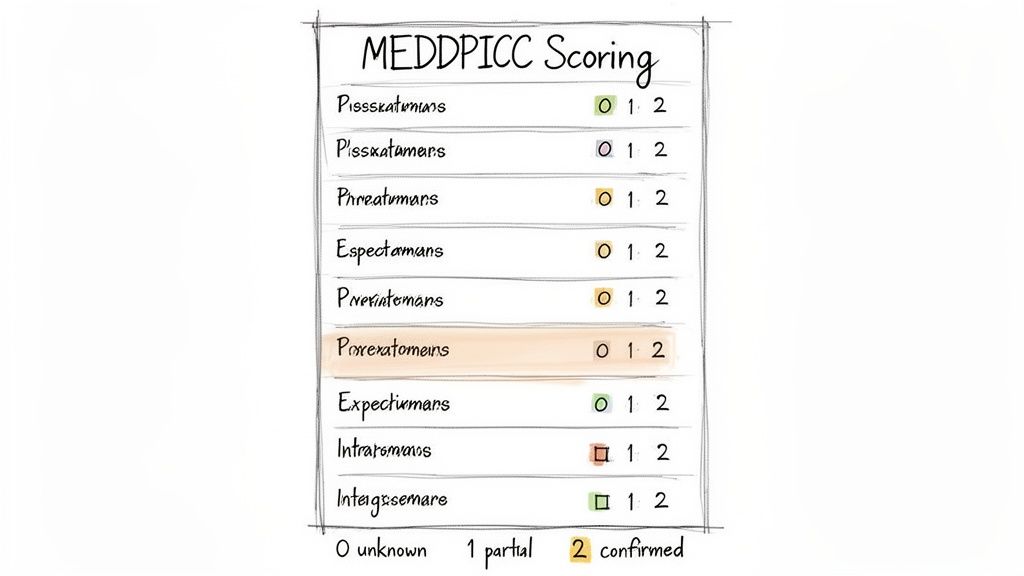
You can use a basic 0-2 scoring system for each of the eight components. Be honest with your scores. Base them on evidence from calls and emails, not assumptions.
Here’s a simple scoring key:
0 = Unknown: You have no verified information on this component.
1 = Partially Confirmed: You have some information, but it is vague or unverified.
2 = Fully Validated: The information is specific, clear, and confirmed by multiple sources.
This method adds structure to your qualification process. It is a first step toward building a predictable pipeline. To learn more, read our complete guide on what lead qualification is.
Putting the Scorecard into Action
Let’s see how this works with a real deal. Imagine you are selling a new software platform. You have had a few calls and need to assess the opportunity.
Here is an example MEDDPICC Deal Qualification Scorecard.
MEDDPICC Deal Qualification Scorecard
MEDDPICC Component | Score (0-2) | Notes and Evidence |
|---|---|---|
Metrics | 2 | Confirmed they need to reduce processing time by 15% by Q3. EB confirmed this target. |
Economic Buyer | 1 | Met with the VP of Operations, but not sure if she has final budget authority. |
Decision Criteria | 2 | They provided a formal checklist. Top criteria are security compliance and CRM integration. |
Decision Process | 1 | They mentioned a technical review and a final presentation, but the timeline is unclear. |
Paper Process | 0 | Have not discussed the legal or procurement steps at all. This is a major gap. |
Identify Pain | 2 | Current manual process causes 40+ hours of wasted work per week and high error rates. |
Champion | 1 | The manager is helpful but has not introduced us to anyone else. May not have enough influence. |
Competition | 2 | Confirmed they are evaluating Competitor X and also the option to do nothing. |
This scorecard provides a clear picture of your risks and next steps.
With a total score of 11 out of 16, this deal is promising but has risks. The score of zero for Paper Process and the uncertainty around the Economic Buyer are major red flags.
Your next steps are clear. Create an action plan: clarify the Economic Buyer's authority and ask about their procurement and legal process. If you do not address these gaps, the deal is at risk.
Weaving MEDDPICC Into Your Daily Sales Workflow
A framework is only useful if you apply it. The goal is to make MEDDPICC a daily habit for your sales team. It should become the way your team thinks about deals, not just another box to check.
This is not about more admin work. It is about working smarter. This separates teams that know about MEDDPICC from teams that win with it.
Map MEDDPICC to Your CRM Stages
Your CRM is the center of your sales operation. Use it to implement MEDDPICC. Tie the framework's components to your deal stages to create a clear, evidence-based path for opportunities. Your CRM becomes a qualification engine, not just a record-keeping system.
This approach adds structure. A deal cannot advance to the next stage based on a rep’s feeling. Progress requires proof that specific MEDDPICC criteria have been met.
Set clear exit criteria for each sales stage.
Discovery Stage Exit: Must have Identified Pain and initial Metrics. Without a clear problem and its business impact, the deal does not advance.
Qualification Stage Exit: Requires confirmation of the Economic Buyer and a map of the Decision Process. This shows you are talking to the right people and know the steps to get a signature.
Proposal Stage Exit: Requires a validated list of Decision Criteria and details on the Paper Process. You must know how your proposal will be judged and what procurement steps are involved.
Make MEDDPICC fields mandatory in your CRM. For example, an opportunity cannot move to 'Proposal' until the 'Economic Buyer Confirmed' checkbox is ticked.
Sharpen Your Sales Conversations
The best way to gather MEDDPICC information is to build questions into your call scripts and discovery templates. This provides a consistent guide for your reps.
Start by updating your standard discovery questionnaire. Reframe the MEDDPICC letters as open-ended questions that get detailed answers.
Example Discovery Questions Template:
Identify Pain: "What business challenge started this evaluation, and what is the risk if you don’t solve it in the next six months?"
Metrics: "How do you measure success now? What specific improvement would make this project a win for the business?"
Economic Buyer: "Who holds the budget for a project like this, and what are their biggest priorities this year?"
This structured approach ensures every rep gathers the information needed to qualify a deal.
Transform Your Deal Reviews and Coaching
Change the conversation in your internal meetings. Deal reviews are where MEDDPICC adoption succeeds or fails. Shift the focus from subjective feelings to objective facts.
Stop asking, "How do you feel about this deal?" Start asking questions based on the framework. This builds accountability and a culture of rigorous qualification.
Evidence-Based Review Questions Checklist:
"Show me the email where the Economic Buyer confirmed the budget."
"What proof do we have that our Champion is selling for us internally?"
"Walk me through the validated Paper Process. Who signs the contract, and in what order?"
This change turns pipeline reviews into factual assessments of deal health. It helps managers provide effective coaching and improves forecast accuracy.
Using Automation to Make MEDDPICC Stick
Sales methodologies often fail because reps are busy. They forget to log details in the CRM or take incomplete notes. This creates gaps in your MEDDPICC intelligence and makes forecasting a guess. Asking reps to manually update eight fields for every opportunity leads to inconsistent data.
Automating data capture is a practical solution. Instead of relying on reps to type out details, AI sales assistants can do the work. This ensures your MEDDPICC framework is built on evidence from every customer conversation.
From Manual Data Entry to Automated Insight
A tool can join your sales calls, transcribe the conversation, and automatically extract key MEDDPICC details. This is how top sales teams operate. A platform like Samskit can analyze call transcripts and identify crucial information automatically.
This workflow captures MEDDPICC elements directly from the customer.
Identified Pain: The tool flags when the prospect discusses their challenges.
Metrics: It extracts specific numbers and KPIs the customer wants to improve.
Decision Criteria: It highlights the "must-haves" and evaluation points.
Competition: It logs every mention of other vendors or solutions.
This screenshot shows how a tool can summarize a call and organize key takeaways for a quick CRM update.

The system surfaces important deal information, turning a long conversation into actionable intelligence and a pre-filled CRM entry.
A Better Way to Manage Deals with Real Evidence
This automated workflow links the sales call directly to the CRM. The AI assistant drafts a summary with MEDDPICC details. The rep can review and approve it in seconds. The result is a CRM that is always accurate.
For sales managers, this provides a real-time, evidence-based view of deal health. You no longer depend on a rep's memory. You can see the facts, spot risks early, and coach your team based on what was actually said.
For instance, as Brazil's data center market expands, B2B teams use MEDDPICC to improve expansion plays. The data shows a 29% higher upsell success rate when reps qualify the Paper Process and pain points early. Samskit's analytics show managers how well reps do this by pulling details from calls for CRM updates. This has also helped cut customer success onboarding time by 40%. You can discover more insights on Brazil's digital maturity in the workplace.
Automation reduces manual data entry and improves data quality. It gives reps more time to sell. This drives higher adoption of your sales methodology and leads to more predictable revenue.
Got Questions About MEDDPICC? We've Got Answers.
When you introduce a new framework, questions will arise. Let’s address some common ones from teams starting with MEDDPICC.
What's the Real Difference Between MEDDIC and MEDDPICC?
MEDDPICC is an evolution of MEDDIC, updated for today's sales cycles. It adds two letters: Paper Process and Competition.
The ‘P’ for Paper Process addresses legal and procurement hurdles that can kill deals late in the process. It forces you to ask about the exact steps to get a contract signed. The second ‘C’ for Competition is a reminder to consider all alternatives. You compete against other vendors and the option of doing nothing. These additions provide a clearer picture of your deal.
Is MEDDPICC Overkill for Anything but Huge Enterprise Deals?
No. MEDDPICC was developed for complex enterprise sales, but its principles are flexible. The key is to scale the framework to fit the deal's size and complexity.
For smaller sales, you can use a "MEDDPICC-lite" version. Focus on the essentials:
Identifying Pain
Understanding Metrics
Confirming the Economic Buyer
Knowing their Decision Criteria
The discipline of qualifying deals based on evidence is valuable for any contract size. Tailor your investigation to match the opportunity.
How Long Will It Actually Take to Get My Team Using MEDDPICC?
Initial training can be done in a few weeks. Making MEDDPICC a habit across the organization usually takes one to two quarters. The real work starts after the kickoff.
True adoption is not a one-time training. It requires weaving MEDDPICC into your sales culture—your CRM stages, pipeline reviews, and coaching conversations.
Leadership commitment is the most important factor for success. Automation also helps. Tools that capture information without adding administrative work can speed up how quickly your team masters the framework.
Samskit turns customer meetings into reliable CRM updates and clear next steps, automatically capturing MEDDPICC intelligence from your sales calls. Eliminate manual data entry and get an evidence-based view of your pipeline at https://samskit.com.