
Is an MBA the right move for a career in customer success? The answer depends on your goals. For leadership roles, it can be a powerful accelerator.
You do not need an MBA to start in customer success. However, a business education can change how you approach the job. It helps you shift from solving immediate problems to building long-term client value. This focus on strategy can lead to a higher salary and faster career progression.
Is an MBA Worth It for a Customer Success Career?
An MBA is not a mandatory ticket for a career in customer success. Many successful Customer Success Managers (CSMs) build their careers on experience and certifications. But if you aim for senior roles like Director, VP, or Chief Customer Officer, an MBA provides a significant strategic advantage.
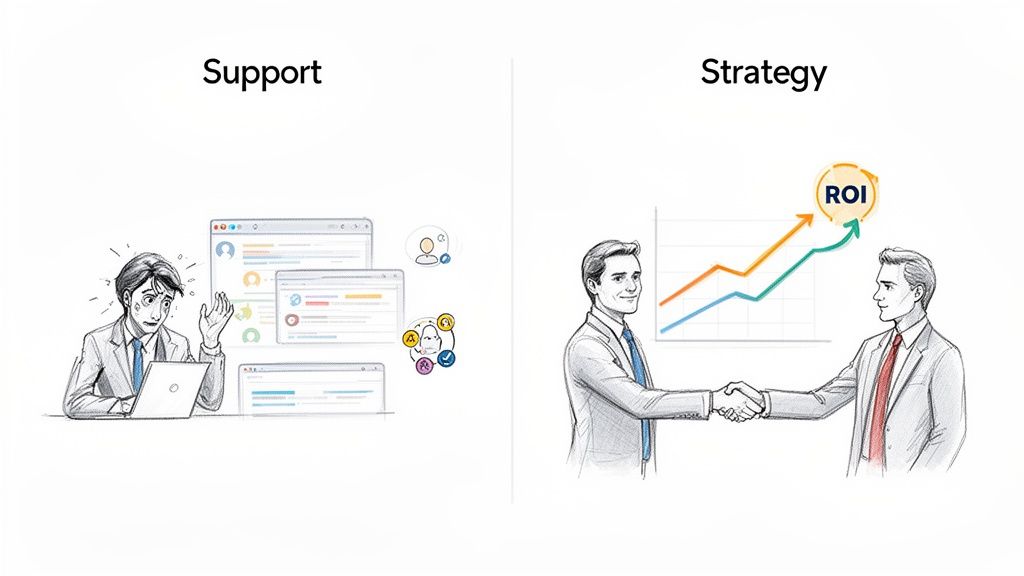
The primary value of an MBA is the change in perspective it offers. You learn to see customer success through the lens of business strategy, not just product support. You begin to speak the language of the C-suite. The conversation shifts from user satisfaction to business outcomes and return on investment.
The Shift from Support to Strategic Partner
Without formal business training, a CSM's work often centers on operational metrics. You track health scores, ticket resolution times, and product usage. These metrics are important, but they are only part of the picture.
An MBA provides the tools to understand a client's entire business.
Here are some practical skills you gain:
Financial Acumen: You learn to read financial statements and identify a client's key performance indicators (KPIs). This lets you build a success plan that directly supports their financial goals.
Operational Insight: You understand how a client's business runs. You can then position your product as a tool that drives efficiency, not just another piece of software to manage.
Marketing and Strategy: You learn to analyze market trends and competitive pressures. This helps you see exactly how your product fits into a client’s go-to-market strategy.
This knowledge transforms you from a product expert into a business advisor. You start to identify growth opportunities for your clients proactively. You become a more valuable partner.
Your ability to problem-solve is a human skill. AI will not replace it. The more you demonstrate this skill, the more you will stand out.
This shift distinguishes a tactical CSM from a strategic leader. It is the difference between asking, "Is my customer happy?" and "Is my customer getting a measurable return on their investment?" The second question is what secures a seat in senior leadership, where demonstrating financial impact is essential.
How an MBA Forges Essential Customer Success Skills
An MBA provides the business framework to become a strategic partner to your clients. It bridges the gap between knowing your product and understanding their business. This shift is critical for anyone pursuing a leadership role. The theory from the classroom becomes a practical tool on the job.
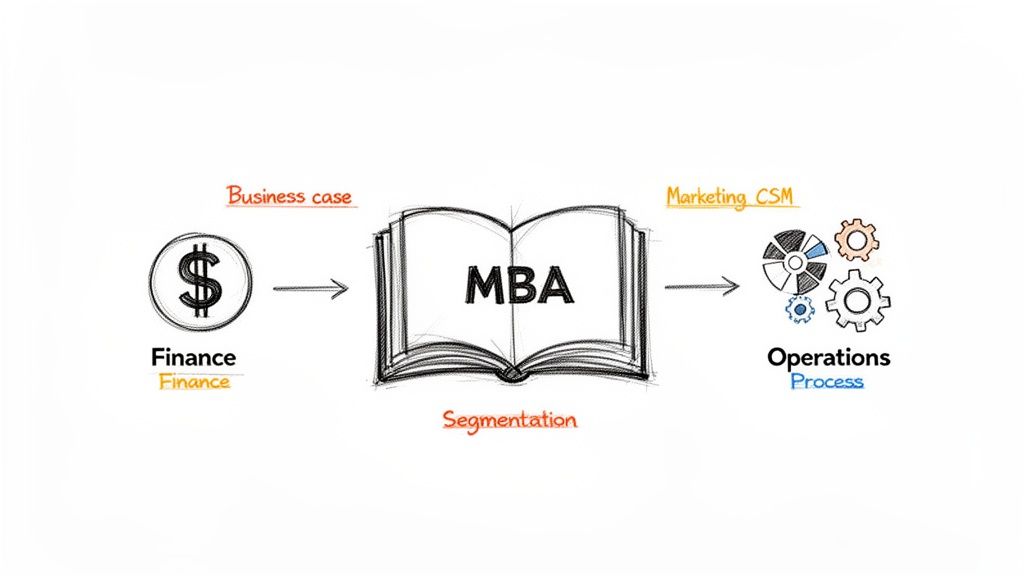
Think of it as learning the language of finance, operations, and market strategy. You can then analyze a client’s challenges with the same analytical view as their own leadership team.
From Theory to Tangible Client Value
A good MBA program offers a comprehensive view of a business. Core courses map directly to the skills needed to deliver measurable results for customers. You learn to prove a clear return on investment.
Here is how MBA subjects become practical tools in your mba customer success toolkit:
Corporate Finance: You learn to build a solid business case. For example, you can use a discounted cash flow (DCF) model to show a client the long-term financial benefit of upgrading. You frame conversations around net present value, not just cost.
Marketing Strategy: You learn to segment your customer base with precision. Instead of a generic approach, you create tailored engagement plans based on company size, usage data, and strategic goals. This results in more effective outreach.
Operations Management: You understand process optimization. This allows you to identify where your solution can create efficiency in a client’s workflow. You can then discuss value in concrete terms, like reduced operational costs or increased team productivity.
This business knowledge elevates a standard check-in meeting to a high-impact strategy session. It is the foundation for strategic conversations during a Quarterly Business Review.
Speaking the Language of the C-Suite
Your job is to translate your daily actions into results that executives notice. An MBA trains you to focus on what they value: revenue growth, cost savings, and risk mitigation.
This strategic mindset is why an MBA often accelerates a career. It prepares you to own the commercial relationship and influence key business decisions.
This shift is increasingly important. The customer experience management market in Brazil, for example, is projected to grow from USD 479.2 million in 2025 to USD 1,434.4 million by 2033. This growth occurs because companies recognize that satisfied customers generate 2.2 times more revenue. Strategic customer management is now a core business function.
An MBA provides the structured thinking to connect daily CS activities—onboarding, training, support—to high-level business objectives. The ability to quantify your impact is what separates a good CSM from a future Chief Customer Officer.
What Does the Career Path and Salary Look Like?
An MBA can change your career trajectory in customer success. It provides the business credibility to move from a frontline role to a strategic leadership position. You shift from managing accounts to shaping the company's retention and expansion strategy.
Your progression becomes about being a business leader who owns a significant portion of the company's revenue. This requires a blend of customer empathy and a commercial mindset.
Climbing the Customer Success Ladder
While titles vary, the career path for a customer success professional with an MBA generally moves from hands-on work to strategic planning. Each step brings more responsibility for financial results and team leadership.
Here is a typical career ladder:
Senior Customer Success Manager: You manage the company's most important accounts. You also mentor other CSMs and contribute to team strategy.
Team Lead or Manager: You take your first step into leadership. You are responsible for your team's results, coaching them to achieve metrics like Net Revenue Retention (NRR) and low churn.
Director of Customer Success: You oversee multiple teams or a large part of the customer base. Your work focuses on process efficiency, scaling the organization, and long-term customer strategy.
VP of Customer Success: You are part of the executive team. You own the post-sale customer journey and are responsible for the customer base's profit and loss (P&L). You collaborate with other C-level leaders on company-wide goals.
Chief Customer Officer (CCO): You are the ultimate advocate for the customer in the boardroom. You ensure all departments align to deliver an excellent customer experience and drive long-term value. The scope of this role has parallels to what an inside sales representative does.
Unpacking Your Salary Potential
In customer success, your earnings are tied to your impact. An MBA graduate often follows an accelerated path to leadership, where the salary difference becomes most apparent.
The salary increase from an MBA is not just for the degree. It reflects an expectation that you will deliver financial outcomes, like reducing churn by 15% or increasing expansion revenue by 20%.
Salaries depend on location, company size, and industry. However, a noticeable gap often exists between professionals with and without an MBA, especially in leadership. The MBA justifies higher pay because you are expected to think and act like a business strategist.
Here is a breakdown of potential salary ranges.
Typical Salary Ranges in Customer Success (With and Without MBA)
This table provides a general idea of annual salary bands and shows the potential financial upside of an MBA.
Role | Salary Range (No MBA) | Salary Range (With MBA) |
|---|---|---|
Senior Customer Success Manager | £55,000 – £80,000 | £70,000 – £95,000 |
Manager, Customer Success | £70,000 – £95,000 | £85,000 – £120,000 |
Director, Customer Success | £90,000 – £130,000 | £110,000 – £160,000 |
VP, Customer Success | £120,000 – £180,000+ | £150,000 – £220,000+ |
The MBA premium increases with strategic responsibility. It reflects the expectation that you will drive business growth, not just manage renewals.
Calculating the ROI of an MBA for Customer Success
Deciding if an MBA is worth it involves more than comparing tuition to salary. It is a strategic investment in your career. You must weigh the financial costs, the opportunity cost of not working, and the long-term benefits.
Start with a realistic budget. It should cover tuition and all associated costs, including the salary you give up while studying.
Assessing the Complete Financial Picture
A proper ROI calculation begins with a clear view of all costs. This is not just about tuition; it is the full financial commitment.
Use this checklist to calculate your total investment:
Total Program Costs: Include tuition, fees, books, and required technology.
Lost Income: Calculate the salary and bonuses you will forgo to study full-time.
Living Expenses: Factor in rent, food, and transport, especially if you need to relocate.
Financing Costs: Account for the interest on any student loans.
Once you have this total investment figure, you can project the potential returns.
Projecting Your Financial and Career Returns
The return is more than a bigger paycheck. It includes faster career progression, higher lifetime earning potential, and access to new opportunities. The goal is to determine how quickly you can earn back your investment and what your long-term career could look like.
This infographic shows the salary jump an MBA can provide at different career stages.
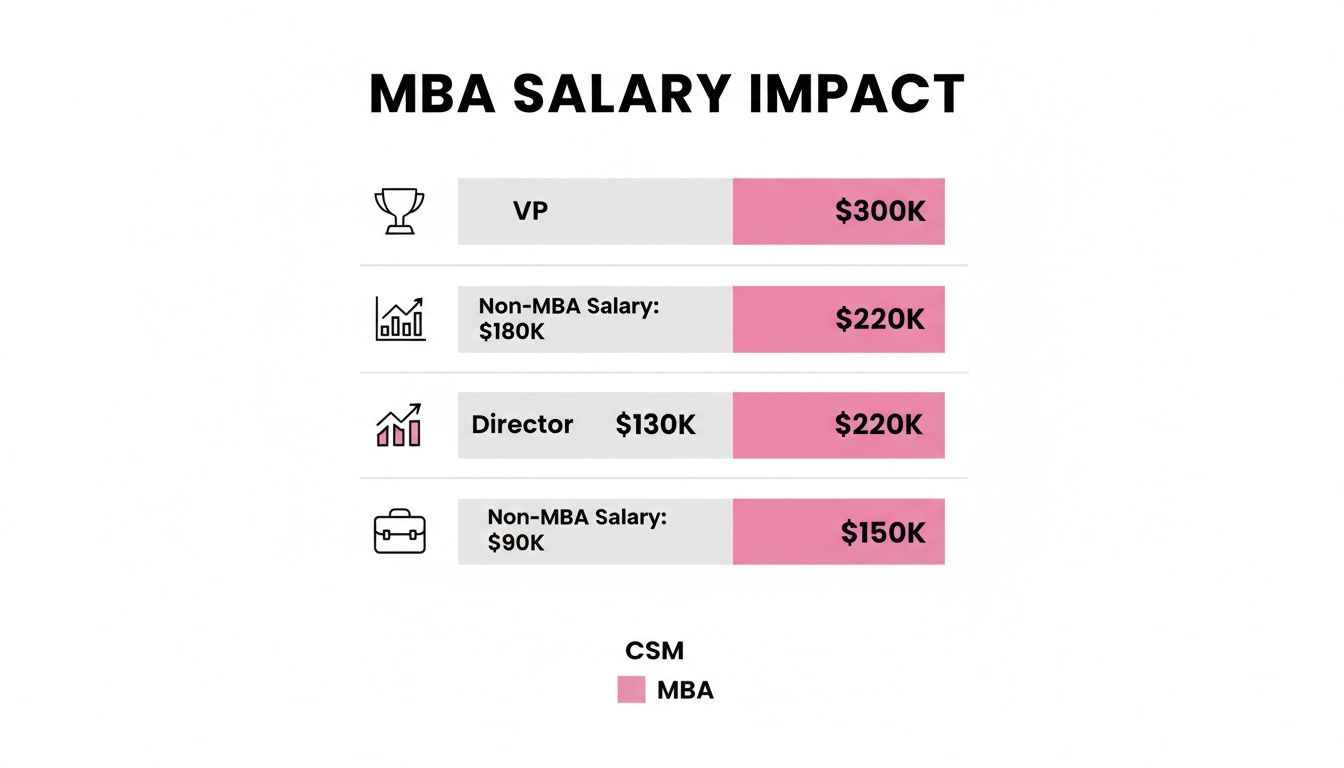
The salary gap widens significantly at senior leadership levels. Many companies view an MBA as a key qualifier for roles with strategic and financial responsibility. This increased earning power is a major part of your mba customer success ROI.
An MBA's value lies in both the salary it commands and the career mobility it provides. Access to an alumni network and enhanced strategic skills can open doors that were previously out of reach.
The market shows a growing demand for skilled leaders. Investment in customer success tools is increasing. Brazil's customer success platforms market is expected to grow from USD 51.5 million in 2024 to USD 178.1 million by 2030. You can see more market growth trends on grandviewresearch.com. This growth creates demand for leaders who can manage complex customer relationships and drive key metrics like Net Dollar Retention.
Putting Your MBA to Work: A Practical Plan
An MBA provides a strategic toolkit. The next step is to use that knowledge to produce business results. Whether job hunting or seeking promotion, you must show how your MBA skills create value.
This means connecting your strategic thinking to the metrics that company leaders care about.
Reframing Your CV for Strategic Roles
Your CV should communicate business outcomes, not just list academic courses. Hiring managers want people who can solve their problems.
For example, instead of listing "Corporate Finance," demonstrate its application.
Before: Completed coursework in Corporate Finance.
After: Developed a discounted cash flow (DCF) model to evaluate a product expansion, projecting a 15% increase in customer lifetime value (CLV).
This change shifts the focus from what you learned to what you can do. It proves you can apply financial models to business challenges, a core expectation for an mba customer success leader.
Present yourself as a strategic thinker who delivers measurable results. Each bullet point on your CV should answer the question, "How did this create value?"
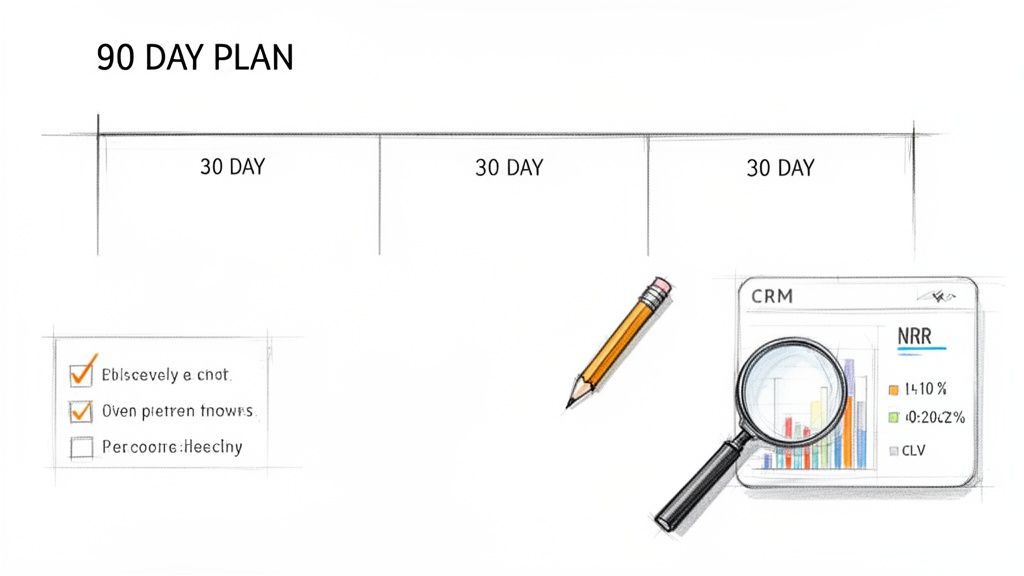
A 90-Day Plan for New Customer Success Leaders
A structured 90-day plan is an effective way to showcase your MBA-level thinking in a new role. This plan is a roadmap for making an immediate, data-backed impact.
First 30 Days: Listen, Learn, and Analyze
Your first month is about gathering information.
Customer Base Analysis: Use CRM data to segment customers by revenue, product usage, and health score. Identify your top 10% of accounts and your bottom 10% at risk of churn.
Internal Stakeholder Interviews: Meet with leaders from Sales, Product, and Marketing to understand their goals and how customer success supports them.
Team Assessment: Hold one-on-one meetings with your team members. Understand their challenges, strengths, and ideas for improvement.
Days 31-60: Formulate a Data-Backed Strategy
Now, use your analysis to build a plan.
Identify Churn Drivers: Analyze historical data for churned accounts to find patterns. Identify the top three reasons customers leave and form hypotheses to address them.
Map Expansion Opportunities: Work with top accounts to find upsell or cross-sell opportunities. Build a business case for at least one strategic expansion.
Develop a Pilot Program: Create a small-scale initiative to test one of your churn-reduction hypotheses. Define clear success metrics before you begin.
Days 61-90: Execute, Measure, and Report
This phase focuses on execution and proving the value of your strategy.
Launch Your Pilot: Roll out the churn-reduction program with a specific customer segment.
Track Key Metrics: Use CRM and BI tools to monitor progress. Watch leading indicators like engagement and health scores, as well as Net Revenue Retention (NRR).
Present Your Findings: Create a concise report for leadership. Show your initial results, lessons learned, and a proposal for a broader rollout.
This structured approach demonstrates your ability to move from analysis to action. This skill is critical as the global customer success management market is projected to grow from USD 2.827 billion in 2025 to USD 16.564 billion by 2033. You can read the full customer success management market report on mordorintelligence.com for more details. Proving your strategic value is how you secure your place in this expanding field.
Common Questions About an MBA for Customer Success
Pursuing an MBA for a customer success career raises many practical questions. Getting clear answers helps turn a general idea into a realistic plan.
Let's address some common questions about the mba customer success path.
Should I Do a Part-Time or Executive MBA?
For professionals already in a customer success role, a full-time program can be a major disruption. Part-time and Executive MBA (EMBA) programs are practical alternatives that allow you to continue working.
Part-Time MBA: This is the most flexible option. Classes are typically held on evenings or weekends. This format allows you to apply what you learn immediately at work. It is ideal for CSMs or managers who want to advance without pausing their careers.
Executive MBA (EMBA): This program is designed for experienced leaders, usually with 10+ years of experience. The curriculum focuses on high-level leadership and strategy. An EMBA is a good fit if you are a director or senior leader aiming for a VP or C-suite role.
The right choice depends on your career stage and personal commitments.
What MBA Specializations Give an Edge?
A general management MBA provides a strong foundation. However, a specialization can sharpen your skills for specific customer success challenges.
An MBA specialization focuses broad business principles on the critical challenges of customer retention and value creation.
Here are a few specializations that are particularly valuable:
Strategy: This specialization provides frameworks to analyze markets, understand competitive positioning, and link customer success work to business objectives.
Business Analytics: Customer success is increasingly data-driven. The ability to analyze data to predict churn, identify upsell opportunities, and prove ROI is essential. This specialization provides the skills to support your strategic decisions with data.
Marketing: A deep understanding of marketing teaches customer segmentation, value proposition development, and effective communication. These skills are fundamental for driving product adoption and turning customers into advocates.
How Can I Build Relevant Experience During My MBA?
An MBA offers opportunities to gain practical experience beyond the classroom. Actively seek out projects that will enhance your CV.
Experiential learning projects, often called practicums or consulting projects, are a great way to do this. You might work with a tech startup to build their first customer success maturity model. These projects provide tangible results to discuss in interviews, proving you can apply academic theory to solve real business problems.
At Samskit, we know that a clean handoff from sales is the first step in preventing churn. Our sales assistant makes sure every promise and key detail from sales calls gets captured and logged in your CRM, so your customer success team has the full story from day one. Learn how Samskit helps you protect and grow revenue.