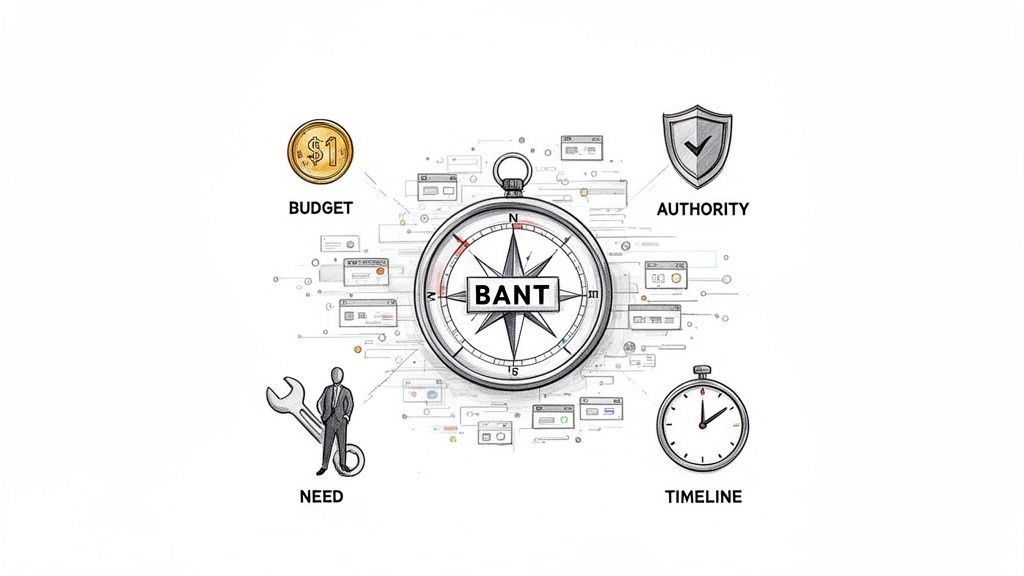
The BANT framework helps sales teams qualify leads. It stands for Budget, Authority, Need, and Timeline. Using BANT means asking four core questions to decide if a prospect is a good fit. Do they have funds? Is this person a decision-maker? Is their problem urgent? Do they have a firm deadline? This guide explains how to apply BANT in a practical, modern way.
Why the BANT Framework Still Works for Sales
Today, many buyers research products on their own. They read reviews and compare competitors before speaking to a salesperson. This makes your job harder. You have less time to make an impact. A structured method like BANT helps you quickly identify serious buyers.
This buyer behavior is part of a larger digital shift. For example, projections show that by 2025, 80% of B2B sales interactions in Brazil will happen online. Buyers want to control the process. When digital leads increase, you need a solid qualification method to manage them effectively. You can read more about B2B sales benchmarks to understand these trends.
BANT is not a rigid script. It is a compass for your discovery calls. Use it to guide the conversation and get the information you need to qualify or disqualify a lead.
Adapting BANT for Modern Sales
To make BANT work today, be flexible. Think of it as a guide for conversation, not an interrogation.
Here is how BANT helps your sales process:
Creates focus: It helps reps check if a deal is viable early on. This stops them from wasting time on leads with no budget or authority.
Improves forecasting: Qualifying leads with the same criteria makes revenue forecasts more reliable.
Aligns teams: When sales and marketing agree on what a "BANT-qualified" lead is, handoffs become smoother and lead quality improves.
This guide provides steps and examples to help your team use BANT without sounding robotic.
How to Navigate Each Part of BANT
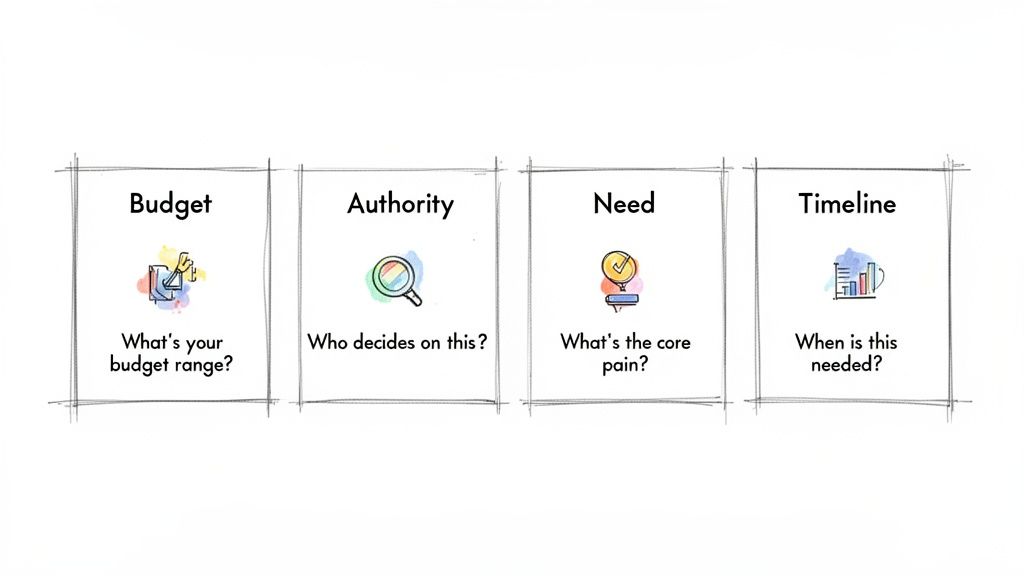
Applying the BANT framework is like having a good conversation. The goal is to steer the discussion to uncover a prospect's situation. Let's break down each element with practical questions and examples.
Budget: How to Discuss Money
Talking about money can be awkward. Many sales reps avoid it. The key is to connect the cost to the value your product provides. Asking, "What's your budget?" is often too direct. Instead, ask about the financial impact of their problem.
If a prospect has no budget, it is not a dead end. It often means they are early in the buying process. Your job is to help them build a business case.
Questions to Qualify Budget:
"What is this problem costing your team in lost productivity or missed targets?"
"Have you bought similar tools before? What was the typical investment?"
"Based on the value we discussed, what ROI would make this a clear win for you?"
A weak signal is vague: "We don't really have a budget for this right now." A strong signal is specific: "We haven't allocated funds, but if we can prove a 20% efficiency gain, my director will find the money."
Authority: Who Makes the Decision?
In B2B sales, a committee often makes decisions. This group includes users, influencers, and the economic buyer who controls the funds. Asking, "Are you the decision-maker?" can sound confrontational. The answer may also be misleading.
Your goal is to map the organization's decision-making process. Identify who has a say and what matters to them.
A common mistake is assuming your first contact is the only decision-maker. Proper qualification means identifying the entire buying committee. This includes people who can say "no" even if they can't give a final "yes."
Questions to Uncover Authority:
"Besides yourself, who else would be involved in evaluating a solution like this?"
"What does your company’s purchasing process look like for new software?"
"Which department usually controls the budget for this type of project?"
Need: Why Does This Matter?
A prospect's need drives the deal. If they lack a significant pain point, they have no reason to buy. Good salespeople help prospects understand the full weight of their problem by connecting it to business outcomes.
You must dig deeper than surface-level issues. If a prospect says, "Our current process is slow," find out the real impact. A slow process might cause missed deadlines or lost revenue. This is a vital part of lead qualification that gives a deal momentum.
For example, a weak need is, "It would be nice to have a better system." A strong need is, "Our manual reporting takes 30 hours a month, which delays our financial close and causes errors our CFO is concerned about."
Timeline: How Urgent Is This?
The timeline shows a project's priority. A vague timeline suggests a lack of urgency. A hard deadline is a strong signal of a real opportunity. Timelines are often tied to specific business events or "trigger events" that create urgency.
Checklist for Gauging Timeline Urgency:
Identify Trigger Events: Is a contract expiring? Is there a new executive? Is a product launch or regulatory deadline approaching?
Clarify Next Steps: Ask, "What needs to happen for your team to decide by the end of this quarter?"
Understand Consequences: Explore what happens if they do nothing. "What is the impact if you don't solve this in the next six months?"
An unqualified timeline is, "We're just exploring our options." A qualified one is, "We need a solution implemented and our team trained before our new fiscal year on July 1st." This specificity separates a real opportunity from a lead that clogs your pipeline.
Putting BANT Into Practice with Real Scenarios
Knowing what BANT stands for is one thing. Using it in a conversation without reading from a checklist is another skill. The best salespeople weave these qualifying questions into a natural dialogue. They let the conversation flow while guiding it to get the answers they need. Let's look at two common sales situations.
Scenario 1: The Experienced Account Executive
An Account Executive (AE) leads a discovery call for a B2B SaaS product. They do not follow BANT in a rigid order. Instead, the customer's story guides the qualification process.
Start with Need: The AE asks open-ended questions about the prospect's challenges. When the prospect mentions drowning in manual work, the AE has an opening.
Transition to Authority: The AE says, "That sounds like a drain on resources. Who else is most affected by this and would be part of a discussion to fix it?"
Address the Budget: Instead of asking for a number, the AE frames it around value. "To build a business case, what do you think a solution that gives your team 10 hours back each week would be worth?" This shifts the talk from cost to investment.
Confirm the Timeline: The AE connects the timeline to the pain point. "Given the impact this has, how quickly are you hoping to have a new process in place?"
This approach builds trust while gathering critical information.
Scenario 2: The High-Volume SDR
A Sales Development Representative (SDR) handles many inbound leads. They must quickly sort leads to find those worth an AE's time. An SDR uses a faster version of BANT.
Need: "What made you look into a solution for [problem] today?"
Authority: "To make sure I connect you with the right person, what is your role in this evaluation?"
Timeline: "Are you hoping to have something in place in the next few months, or are you in the early research stage?"
SDRs often skip a detailed Budget discussion at this stage. The main goal is to confirm a real problem and some urgency. The AE can explore financial details on a later discovery call.
The goal of BANT is to prioritise leads, not disqualify them. A lead with no immediate budget but a severe need is a valuable nurturing opportunity, not a dead end.
This flexible mindset is vital. For example, B2B commerce in Brazil is growing rapidly. It is expected that over 50% of revenue will come from digital channels by 2025. Sales teams there manage about 10 channels. An adaptable framework like BANT allows reps to qualify opportunities across all touchpoints. You can explore more about these B2B commerce trends on Salesforce.com.
Choosing the Right Sales Qualification Framework
While BANT is a straightforward framework, it is not perfect for every situation. Its simplicity is a strength, but it can also be a weakness. Knowing when to use it is key.
BANT works well in high-volume environments. It is a good tool for quickly sifting through many inbound leads. Its four-point structure gives reps a clear, repeatable process for initial qualification. It is efficient and easy to learn.
However, its structure can feel rigid. Jumping straight into budget talks can seem pushy. This may shut down a conversation before it starts. Most buyers do not have a set budget until they understand their problem and see the value you offer.
BANT fails when treated as a rigid checklist. The best teams use it as a conversational guide, not an interrogation script.
When to Look Beyond BANT
For complex, high-value deals with long sales cycles, BANT might be too basic. These sales involve many people and an intricate buying process. Other frameworks can provide a more detailed roadmap.
Here are a few alternatives:
MEDDIC (or MEDDPICC): This framework is for large enterprise sales. It focuses on Metrics, Economic Buyer, Decision Criteria, Decision Process, Identifying Pain, and finding a Champion. It is more comprehensive than BANT. If you sell complex solutions to large companies, learn more about the MEDDIC sales methodology.
CHAMP: This stands for Challenges, Authority, Money, and Prioritisation. It is similar to BANT but leads with "Challenges." Starting with the prospect’s pain points makes the conversation feel more natural and buyer-friendly.
GPCTBA/C&I: This framework (Goals, Plans, Challenges, Timeline, Budget, Authority, Negative Consequences, and Positive Implications) is for consultative selling. The salesperson acts as an advisor, helping the prospect clarify goals and create a plan.
The best framework is the one your team will use consistently. BANT provides a solid foundation, especially when used flexibly. If your sales process is more complex, alternatives like MEDDIC or CHAMP could provide the detail your team needs.
Putting BANT to Work in Your Daily Sales Grind
To make BANT a practical tool, integrate it into your team's daily workflow. Add it to the tools they use, the notes they take, and the conversations they have. This turns BANT into actionable data that strengthens your pipeline.
The first step is to set up BANT inside your CRM. Whether you use Salesforce or HubSpot, create custom fields that prompt reps to capture this information. This standardizes your qualification process and makes your pipeline data more reliable.
Setting Up Your CRM for BANT Success
Add specific fields to your contact, company, and deal records. This creates a consistent blueprint for every opportunity.
Here is a practical template for CRM fields:
Budget Status (Dropdown):
Approved,To Be Sourced,Building Business Case,No Budget Identified.Authority Level (Multi-select):
Economic Buyer,Champion,Influencer,End-User,Blocker.Need Score (1-5 Scale): A simple rating to score the prospect's pain.
Timeline Driver (Text Field): Note the specific event creating urgency, like
Contract RenewalorEnd of Fiscal Year.
This structure helps you see how BANT compares to other sales methodologies.
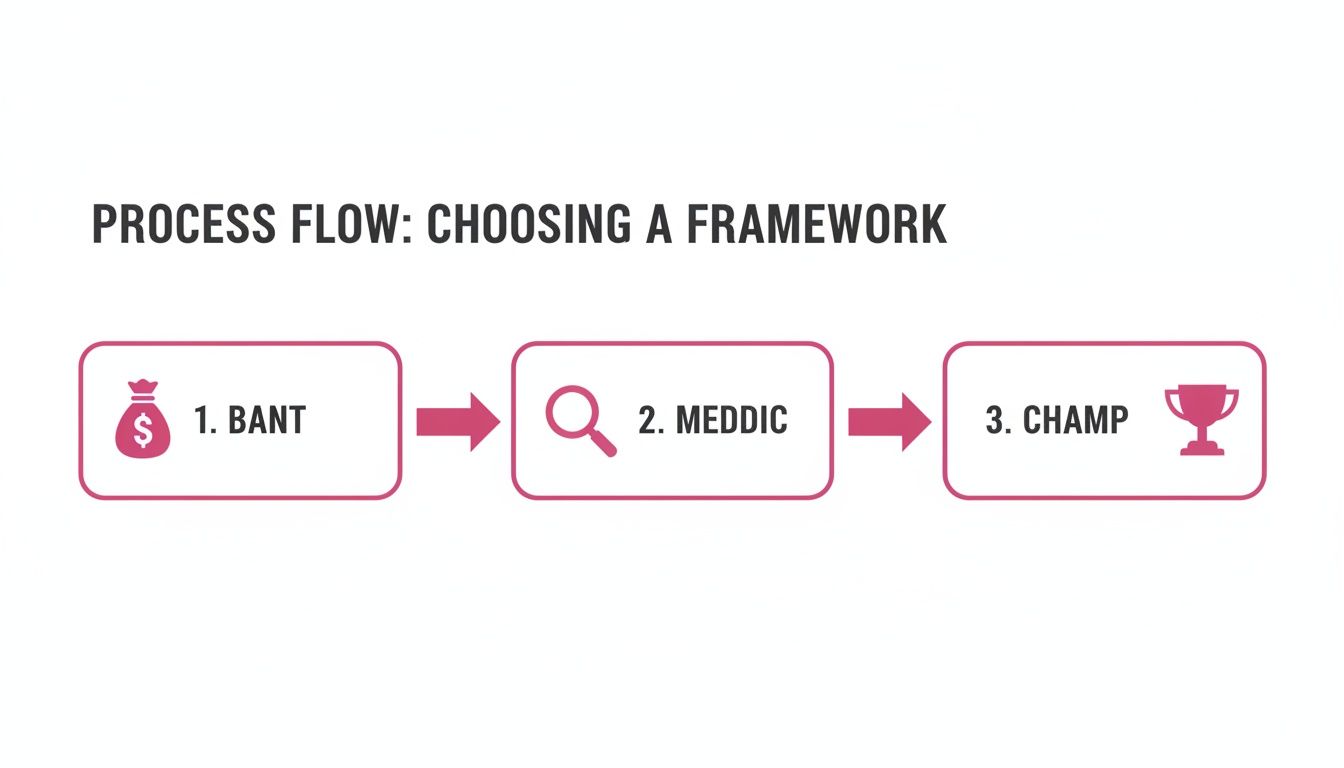
While frameworks like MEDDIC are for deep analysis, BANT is effective for fast, high-level qualification.
BANT vs Alternatives: A Quick Comparison
This table helps you decide which framework best fits your sales cycle and team.
Framework | Best For | Primary Focus |
|---|---|---|
BANT | High-volume, transactional sales; initial qualification | The buyer's readiness and resources to make a purchase. |
MEDDIC | Complex, enterprise-level sales with long cycles | Deeply understanding the customer's metrics and process. |
CHAMP | Sales environments needing a buyer-centric approach | The buyer's challenges and finding a champion internally. |
The "best" framework depends on your product and your customers. For many teams, BANT is a good starting point due to its simplicity.
Standardising Your Call Notes and Summaries
Next, create templates for call notes. A good template prompts reps to think critically about the opportunity.
A well-designed template is like a mini-coaching session. It forces reps to reflect on what they know and what they still need to find out.
Add a "BANT Snapshot" section to your meeting summary template in your CRM or a tool like Samskit.
Example BANT Snapshot Template:
Budget: What is the budget status? Do we need to help build a business case? What is the estimated cost of inaction?
Authority: Who did we talk to? Who else is involved? Have we confirmed the decision-making process?
Need: What is the core business problem we can solve? What are the consequences if they do nothing? How does this pain connect to company goals?
Timeline: Is there a hard deadline or a trigger event? What are the next steps, and who owns them?
Finally, make coaching a continuous habit. Use call recordings to review how reps apply the BANT framework. Check how they navigate the discussion to uncover answers naturally. This turns BANT from a checklist into a repeatable process that improves qualification and forecasting.
How to Automate BANT for Smarter Qualification
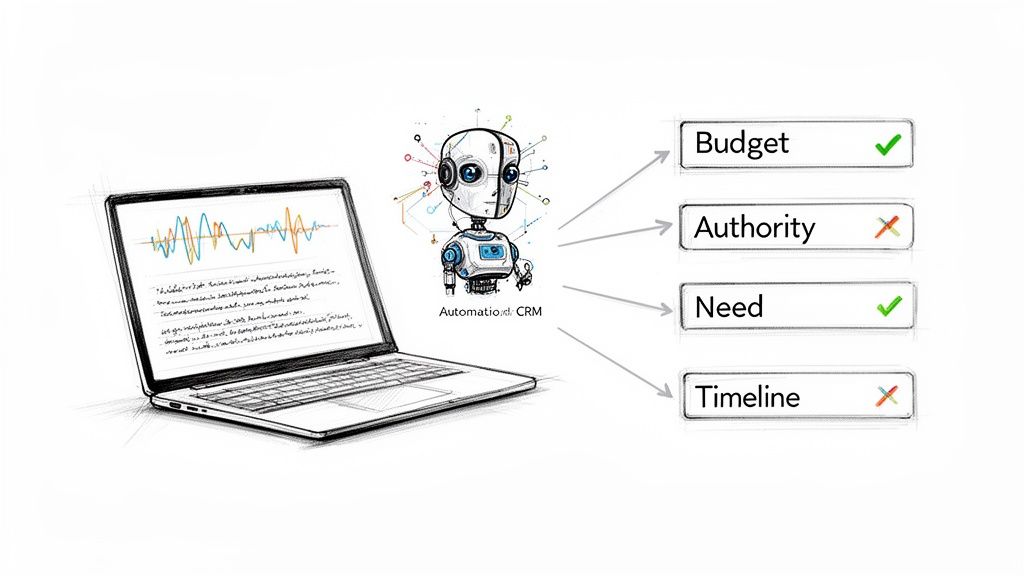
Manually tracking BANT criteria during sales calls is difficult. Reps focus on taking notes instead of engaging with the prospect. Modern sales tools can automate this workflow and help your team qualify leads with more precision.
AI-powered tools can automatically record and transcribe your calls on platforms like Zoom or Microsoft Teams. This frees up reps to build rapport with prospects.
Pinpoint BANT Signals Automatically
After the call, AI analyzes the transcript to flag key BANT signals. It recognizes specific phrases related to each BANT element.
Budget: It picks up mentions of "funding," "investment," "cost," or "pricing."
Authority: It spots keywords like "my boss," "the board," or "decision-maker."
Need: It identifies descriptions of pain points and business challenges.
Timeline: It catches references to "end of quarter" or project deadlines.
This data is organized into a clear summary. Reps no longer need to re-listen to calls or decipher messy notes.
This level of automation is important in markets like Brazil. With 90% of companies there moving to hybrid sales models, which can boost revenue by 50%, precise deal tracking is critical. According to these regional sales trends from Tendata, tools that analyze calls and reduce CRM data entry are essential.
Keep Your CRM Up to Date
This process integrates smoothly with your CRM. The extracted BANT information, objections, and next steps are automatically formatted into a summary. The data then syncs to the correct fields in your Salesforce or HubSpot account. This eliminates manual data entry. See how Samskit can become a dream team bot for your sales process and handle these tasks.
Automating BANT tracking gives managers an objective view of lead qualification. They can assess deal health based on consistent data, not just a rep's feeling. This makes coaching and deal reviews faster and more effective.
BANT: Your Questions Answered
Here are answers to a few common questions about using the BANT framework.
Is BANT Still Relevant Today?
Yes, but not in a rigid way. Using BANT as a strict interrogation script is outdated and ineffective. Today, the framework works best as a flexible, conversational guide. It provides a mental map to steer discovery calls toward the four key parts of any deal: budget, authority, need, and timeline.
What if a Prospect Has No Defined Budget?
This is common and not a deal-breaker. A lack of budget usually means you are engaging them early in their buying journey. Your role shifts from asking for a number to building a business case with them.
Focus on the cost of their problem. Ask questions like:
"What is the financial impact of this issue each month?"
"What kind of ROI would make this an easy decision for your leadership?"
When you focus on value and return on investment, you help them create a budget instead of just asking for one.
A lead with an urgent need but no formal budget is an opportunity to guide them and build value. Nurture these leads, do not disqualify them.
How Do I Adapt BANT for Different Sales Cycles?
Flexibility is key. BANT is not a one-size-fits-all tool. For fast, transactional sales, a 'BANT-lite' approach works well. You might prioritize Need and Authority to ensure you are talking to the right person about a real problem.
For large, complex enterprise deals, BANT is a starting point. It serves as the first layer of qualification. From there, use a more detailed framework like MEDDIC to explore organizational politics and decision-making processes.
Ready to make every sales conversation count? Samskit turns your meetings into reliable CRM updates, automatically pinpointing BANT signals and other key insights so you can focus on selling, not data entry. Discover how Samskit can help.