
Sales and marketing alignment is a simple concept: get both teams working from the same playbook. When they share goals and data, they drive more revenue. When they don't, they waste time and money.
Sales and marketing alignment means marketing generates leads that sales can actually close. Sales then provides feedback so marketing can refine its campaigns. This creates a feedback loop that improves customer retention and increases revenue.
What Does Alignment Look Like in Practice?

Imagine two people rowing a boat. If they paddle in sync, the boat moves forward. If they paddle out of sync, the boat spins in circles. Effort is wasted, and they go nowhere.
This is what happens when sales and marketing are misaligned. Marketing might generate 1,000 leads, but sales finds 950 of them are unqualified. In response, sales might ignore marketing's leads and focus on cold prospecting. Good opportunities are lost. This is not just an internal issue; it's a direct block to growth.
This checklist shows the difference between a misaligned and an aligned organization.
Misalignment vs. Alignment Checklist
Misaligned Teams | Aligned Teams |
|---|---|
Finger-Pointing: Marketing blames sales for not closing leads. Sales blames marketing for poor lead quality. | Shared Ownership: Both teams own the entire funnel and work together to improve it. |
Wasted Spend: Marketing runs campaigns that generate leads the sales team ignores. | Efficient Investment: Marketing spend is tied to revenue, delivering a clear return on investment. |
Confusing Customer Journey: Prospects receive conflicting messages from marketing content and sales calls. | Consistent Experience: The buyer's journey is seamless, building trust from the first touch to the final sale. |
Unpredictable Revenue: Sales cycles are long, win rates are low, and forecasting is difficult. | Predictable Growth: A steady flow of quality leads makes revenue more forecastable and scalable. |
Misalignment is a financial problem.
B2B companies with poor sales and marketing alignment can lose 10% or more of their annual revenue. This loss comes from inefficiency and missed opportunities.
From Separate Silos to a Single Revenue Team
Fixing misalignment requires operational changes, not just more meetings. Both teams must agree on a shared definition of a qualified lead and a formal Service Level Agreement (SLA) to hold everyone accountable.
A shared CRM is the single source of truth for both teams.
When this system is in place, marketing delivers high-intent leads that sales is ready to work. Sales provides feedback directly in the CRM. This data helps marketing improve its campaigns. This creates a self-improving cycle that turns two departments into one cohesive revenue team.
The Hidden Costs of Team Misalignment
Poor sales and marketing alignment quietly drains resources and slows growth. When teams operate in separate silos, the financial damage is real.
The most obvious cost is wasted marketing spend. Marketing might hit its lead volume targets, but if sales considers the leads worthless, the money spent on those campaigns is lost. This creates a cycle where marketing metrics look good, but the sales pipeline remains empty.
Sales Productivity Declines
Misalignment hurts sales productivity. Reps waste time on prospects who will never buy. Instead of closing high-value deals, their calendars fill with dead-end calls, leading to frustration and burnout.
This wasted effort increases your customer acquisition cost (CAC). You spend more time, money, and energy to close each deal because so much effort is wasted on unqualified leads. Higher CAC directly reduces profits.
When sales and marketing have different goals, the customer experience suffers. A prospect gets one message from marketing and a different one from sales. This inconsistency erodes trust and causes potential buyers to walk away.
The Financial Impact of Misalignment
A misaligned strategy doesn't just waste money—it leaves it on the table. Sales teams often ignore marketing leads if they have lost faith in their quality. These are warm prospects who have shown interest but are never contacted. That is lost revenue.
Consider Brazil's digital advertising market, valued at around USD 14.2 billion. When teams are aligned, every advertising dollar works harder. When they are not, it's common for 30-40% of the ad budget to be wasted on generating poor-quality leads. A simple feedback loop from sales could fix this costly mistake. You can find more data on Brazil's digital advertising market on Ken Research.
The human cost is also significant. Constant finger-pointing creates a toxic "us vs. them" culture. When employees feel their work is unappreciated or undone by another team, morale drops. This can lead to higher employee turnover and increased hiring and training costs.
How Costs Add Up: A Common Workflow
This scenario happens in many businesses:
Marketing launches a campaign with broad personas and generates 500 new leads.
The leads go to sales, who find that only 50 are qualified. The other 450 are a waste of time.
Productivity drops as reps spend hours sorting through unqualified leads instead of pursuing real opportunities.
The blame game begins. Marketing defends its lead numbers, while sales complains about quality. The gap between the teams widens.
Each step in this process is a financial leak. When you connect these operational problems to real numbers, the case for fixing sales and marketing alignment becomes clear.
Your Step-by-Step Alignment Playbook
Moving your teams from separate silos to a unified revenue engine requires a clear plan. Here are the practical steps to take.
Fixing this disconnect stops you from wasting money, hurting productivity, and losing customers.
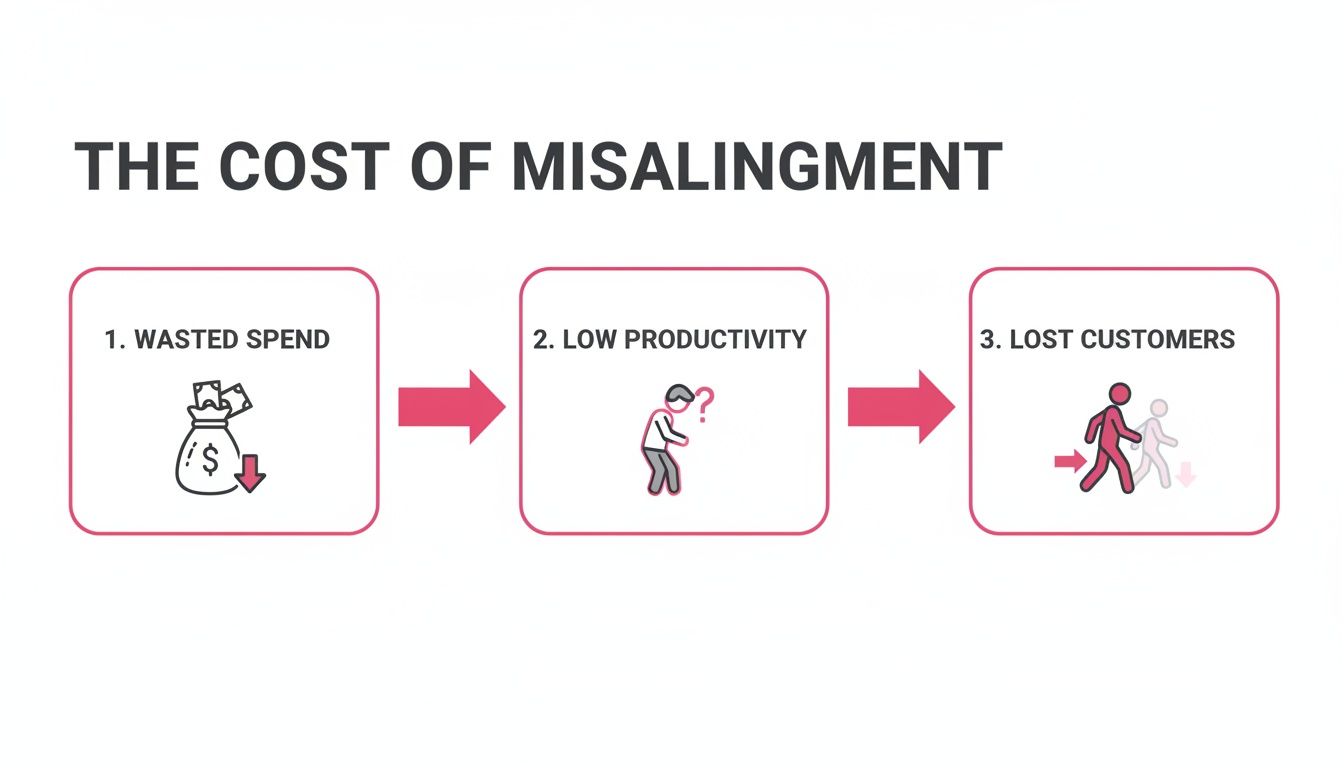
Internal friction directly impacts your bottom line.
Step 1: Create a Shared Funnel Language
The biggest source of friction is often a simple one: sales and marketing do not speak the same language. If marketing’s definition of a "good lead" differs from sales', the system breaks down.
Your first step is to get leaders from both teams to agree on a universal set of definitions for your sales funnel.
Marketing Qualified Lead (MQL): A contact who is more likely to become a customer based on their actions, such as downloading a case study or attending a webinar.
Sales Accepted Lead (SAL): An MQL that the sales team has reviewed and agreed meets the minimum criteria for outreach. This is the official handoff.
Sales Qualified Lead (SQL): An SAL that a sales rep has contacted and confirmed has a real need, budget, and authority to buy. This is a tangible sales opportunity.
With clear definitions, you build a shared framework for success. For more detail, read our guide on how to improve your lead qualification process for B2B teams.
Step 2: Build a Service Level Agreement (SLA)
A Service Level Agreement (SLA) is a formal contract between your teams. It documents who is responsible for what, turning good intentions into measurable goals.
An SLA is a commitment. It sets clear expectations and provides a data-driven way to have productive conversations instead of arguments.
A good SLA is simple and focuses on revenue-driving activities. It specifies what marketing will deliver and what sales will do with those leads.
Here is a basic template to get started.
SLA Template: Sales and Marketing
Commitment | Marketing's Responsibility | Sales's Responsibility |
|---|---|---|
Lead Volume | Deliver 150 MQLs per month that meet agreed criteria. | Review every MQL within 24 hours. |
Lead Quality | Ensure at least 40% of MQLs become Sales Accepted Leads (SALs). | Attempt to contact each SAL a minimum of 5 times over 7 days. |
Data Integrity | Provide complete and accurate contact data for every lead. | Log all activities and feedback for every SAL in the CRM. |
Feedback Loop | Review sales feedback on lead quality weekly to adjust campaigns. | Provide specific reasons when rejecting a lead (e.g., "wrong industry," "no budget"). |
This structure creates mutual accountability. Marketing is responsible for quality, and sales is responsible for follow-up.
Step 3: Establish a "Smarketing" Meeting
With a shared language and an SLA, you need a regular meeting to check progress and solve problems. This is the "Smarketing" meeting. It must be a data-driven, problem-solving session focused on the SLA.
Smarketing Meeting Checklist:
Review SLA Dashboard (15 mins): Look at the numbers. Are we hitting our MQL target? What is the MQL-to-SAL conversion rate?
Sales Feedback on Leads (10 mins): Sales provides direct feedback. Which campaigns are generating good conversations? Which are not?
Marketing Campaign Updates (10 mins): Marketing shares upcoming campaigns so sales can prepare.
Action Items (10 mins): Identify roadblocks and assign clear action items with owners and deadlines.
This regular meeting helps catch small issues before they become big problems, keeping both teams focused on revenue.
Step 4: Implement Closed-Loop Reporting
Closed-loop reporting tracks a lead's entire journey, from their first click on a marketing asset to a closed deal. Your CRM makes this possible.
This system shows marketing which campaigns, channels, and content generate revenue, not just leads. It connects marketing activities directly to sales outcomes.
When a sales rep marks a deal as "Closed-Won" in the CRM, that data should automatically flow back to the marketing platform. Marketers can then see that a new customer who signed a £50,000 contract started by reading a specific blog post six months ago. This insight allows you to invest more in what works and cut what doesn't.
Measuring the Metrics That Truly Matter
To achieve sales and marketing alignment, you must track the right metrics. Forget vanity metrics like website traffic or total lead counts. Success is not about how busy each team is; it's about how well they work together to generate revenue.
Both teams must agree on a set of shared Key Performance Indicators (KPIs). These KPIs serve as a common scoreboard, showing where your combined efforts are succeeding.
Moving Beyond Siloed Metrics
Traditionally, marketing focused on top-of-funnel numbers, while sales focused on closed deals. This created a blind spot in the middle of the customer journey.
An aligned approach focuses on metrics that track a lead's entire journey. These shared KPIs measure the health of your entire revenue process.
The goal is to build a dashboard that reflects the health of the entire funnel, not just individual team performance. When both teams look at the same numbers, they can solve problems together instead of assigning blame.
Essential KPIs for Aligned Teams
Focus on these four critical metrics to measure how well your teams work together. They connect marketing campaigns to sales results.
MQL-to-SQL Conversion Rate: This measures lead quality. It shows the percentage of Marketing Qualified Leads (MQLs) that sales accepts and converts into Sales Qualified Leads (SQLs). A low rate indicates a disconnect.
Sales Cycle Length: This is the time it takes to close a deal, from first contact to signed contract. When teams are aligned, sales cycles shorten because reps work with better-qualified leads.
Lead Velocity Rate (LVR): This tracks the month-over-month growth of qualified leads. A healthy LVR is a strong predictor of future sales growth.
Marketing's Contribution to Revenue: This calculates the percentage of total revenue from marketing-generated leads. It shifts the focus from "how many leads?" to "how much revenue?"
Using Metrics to Improve Workflows
Tracking numbers is not enough. You must understand what they mean. For example, if your MQL-to-SQL rate drops, a recent marketing campaign might be attracting the wrong audience. A conversation with the sales team can help diagnose and fix the problem. You can learn more about using data in our guide to sales forecasting with Power BI.
This data-driven approach is crucial in dynamic markets. In Brazil, e-commerce grew to R$285.2 billion (USD 57 billion) in 2023. This growth is driven by tight sales and marketing execution. For a country with over 108 million online shoppers, a smooth lead-to-sale journey is essential for success. You can find more insights about the Brazilian market on Statista.com.
By focusing on shared KPIs, you create a system of mutual accountability. Marketing is motivated to deliver quality, not just quantity. Sales has a reason to provide feedback to improve the process. The relationship becomes a partnership focused on one goal: predictable revenue growth.
The Technology Stack That Powers Alignment
Effective sales and marketing alignment requires the right technology. Your tech stack is the central system that connects data and team interactions. Without integrated tools, even the best strategy will fail due to manual work and data silos.
The goal is to create a seamless flow of information, from the first marketing touchpoint to a closed deal. Integrated tools reduce friction, automate tasks, and provide a single source of truth. When information flows freely, decisions are smarter and collaboration is easier.
The CRM as Your Single Source of Truth
Your Customer Relationship Management (CRM) system is the foundation of your tech stack. Platforms like Salesforce or HubSpot are essential. Your CRM must be the single source of truth for all customer and prospect data.
When the CRM is the central hub, every interaction is logged in one place. Marketing can see which leads sales is working on. Sales can see a prospect's full history with marketing content. This shared view helps break down the "us vs. them" barrier and enables closed-loop reporting.
Automation for a Frictionless Data Flow
A CRM is only as good as its data. Automation tools are critical for maintaining data quality. Sales reps are busy and often see updating the CRM as a chore, which leads to incomplete data.
Integrating your communication tools directly with your CRM solves this problem. Here is how call-to-CRM automation works.
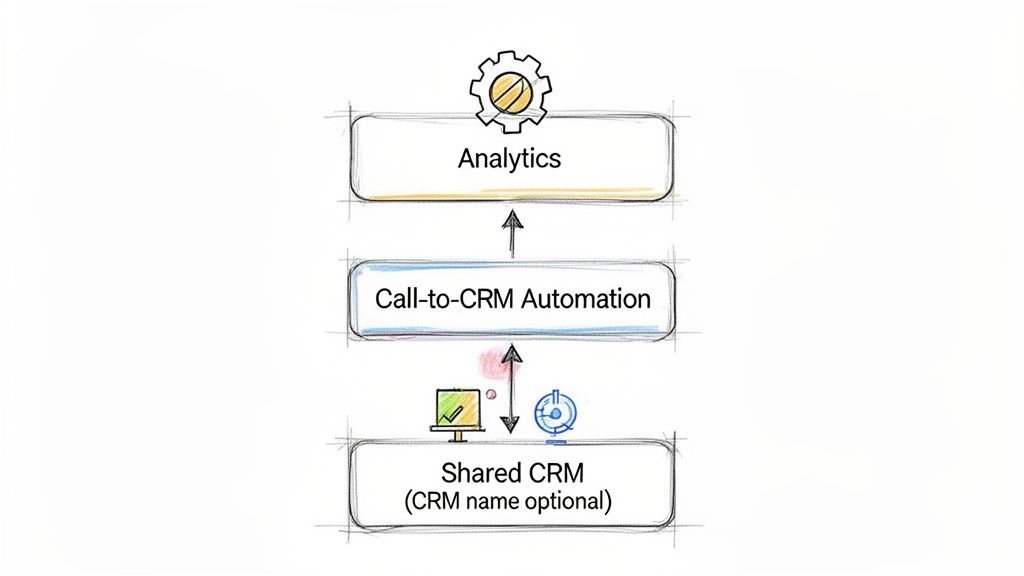
This automated workflow ensures that important data from sales calls is captured in your system.
Tools like Samskit automatically sync key details from sales calls—such as buyer intent, objections, and next steps—directly into your CRM. This reduces administrative work for your reps and ensures that vital data is captured accurately. For a deeper look, check out our guide on using a CRM for inside sales teams.
Automating the flow of conversation intelligence into the CRM creates a rich, reliable dataset. This data becomes a strategic asset that both teams can use to improve performance.
How Automation Fuels Alignment
This automated data flow actively supports alignment in practical ways.
Marketing Gets Better Data: When buyer objections and feature requests from sales calls are automatically logged in the CRM, the marketing team sees what prospects are actually saying. They can use these insights to refine messaging and create more effective campaigns.
Sales Leaders Gain Clear Visibility: Sales managers can see what is happening on the front lines. They can coach reps based on actual conversations, not just brief notes. Forecasts become more accurate because they are based on real data.
Handoffs Become Seamless: A complete conversation history makes handoffs smooth. When a deal closes, the customer success manager can see the promises made during the sales cycle, ensuring a positive onboarding experience.
A well-integrated tech stack does more than connect systems; it connects people. It automates manual work, provides shared data that builds trust, and frees up both teams to focus on driving predictable growth together.
How B2B Companies Achieve Alignment: An Example
Let's look at a practical example of a B2B SaaS company that moved from friction to collaborative growth.
"InnovateTech" had long-standing issues between its sales and marketing teams. Marketing would hit its MQL targets, but sales complained the leads were poor quality. Sales reps missed quotas, morale was low, and revenue was flat.
The Turning Point: A Shared Goal
InnovateTech's leadership realized their biggest growth obstacle was internal conflict. They started with a workshop where both teams openly discussed the problems.
The first step was to create a shared Ideal Customer Profile (ICP) and agree on firm definitions for MQLs and SQLs. For the first time, they were speaking the same language.
Next, they created a simple Service Level Agreement (SLA):
Marketing committed to delivering 75 high-quality MQLs per month.
Sales committed to following up on every MQL within 24 hours.
This created mutual accountability. Marketing had to deliver quality, and sales had to follow up.
The real change occurred when both teams focused on a single shared metric: revenue. This shift forced them to solve problems together.
The Right Technology and the Results
InnovateTech made their CRM the single source of truth. They also implemented a call-to-CRM automation tool like Samskit to eliminate manual data entry. Now, key intelligence from sales calls—like common objections or competitor mentions—was automatically logged for marketing to see.
This created a powerful feedback loop. Marketing used insights from sales calls to improve campaigns, which generated better leads. The results were clear:
The MQL-to-SQL conversion rate increased from 15% to 45% in six months.
The average sales cycle shrank by 22% because reps were talking to the right people.
Revenue growth became predictable, and they exceeded their targets for three consecutive quarters.
This is not an isolated case. In Brazil’s e-commerce market, aligned teams drove 27% year-over-year sales growth. You can read more about Brazil's e-commerce growth on americasmi.com. InnovateTech's story shows that with shared goals, clear commitments, and the right technology, any company can turn internal friction into a growth engine.
Answering Your Top Alignment Questions
Where do you start with sales and marketing alignment? Here are answers to the most common practical questions.
Getting started involves agreeing on a destination, communicating consistently, and using helpful technology.
What is the very first step to take?
Establish one shared revenue target for both sales and marketing. Without a common goal, the teams will continue to work separately.
Next, sit down together to define your Ideal Customer Profile (ICP) and agree on terms like MQL and SQL. This creates a shared language and ensures everyone is on the same page about what a "good lead" is.
How often should sales and marketing meet?
Schedule a recurring "Smarketing" meeting, either weekly or bi-weekly. This must be a data-driven session to review your SLA performance, lead quality, and conversion rates. It is where sales provides direct feedback on marketing campaigns.
A regular, data-focused meeting transforms the relationship into a continuous, collaborative partnership. It drives ongoing improvement and keeps both teams in sync.
What is the most critical piece of technology?
Your CRM. It must be the single source of truth for all customer data.
However, a CRM is only as good as the data inside it. That is why tools that automate data entry into the CRM are vital. They ensure data is accurate and up-to-date without requiring hours of manual work from reps. This clean, automated data flow makes alignment work at scale.
Turn your sales conversations into reliable CRM updates automatically. Samskit captures buyer intent and next steps from every call, so your teams can stop chasing context and start closing deals faster. Learn more about how Samskit works.