
Your forecast is a guess. Your pipeline is full of deals that stall. The MEDDIC sales methodology fixes this. It is not another sales theory. It is a qualification framework that brings discipline to your sales process. It moves your team from hope to evidence.
Think of it as a reality checklist for every opportunity. It gives you a repeatable workflow to diagnose deal health.
Why MEDDIC Works for B2B Sales
Sales leaders know the forecast call routine. A rep sounds optimistic, but the deal feels weak. A week later, that "sure thing" is gone. MEDDIC cuts through this uncertainty. It provides a system to separate real opportunities from time-wasting ones.
It treats sales as a science, not an art. It’s a diagnostic toolkit. It shows you exactly where a deal stands and what to do next. This is not just another acronym. It is a qualification framework built for long, complex B2B sales cycles with multiple stakeholders.
The goal is to qualify opportunities based on facts, not feelings. By gathering specific information across six areas, your team can:
Improve forecast accuracy: Base pipeline projections on verified information, not a rep's optimism.
Increase win rates: Focus resources on deals you can actually win.
Shorten sales cycles: Identify and solve problems before they derail a deal.
This shift is critical in competitive markets. For example, Brazil’s medical devices market is projected to reach USD 12.5 billion by 2025. A study showed that sales teams using MEDDIC increased qualified leads in their pipeline by 35%. The methodology helps them navigate complex procurement by focusing only on high-value, qualified deals. You can find more data on the Brazilian market at imarcgroup.com.
At its core, MEDDIC is about control. It helps your sales team stop reacting to the customer's process and start guiding it with clarity.
This systematic approach is the foundation for predictable revenue. The original MEDDIC framework has six parts. Modern versions like MEDDPICC add more layers for deeper qualification. Learn more in our guide to MEDDPICC.
To start, you need to understand how each piece fits together. The table below outlines the six core elements of MEDDIC and the key question each one answers.
The MEDDIC Framework at a Glance
Component | What It Means | The Core Question to Answer |
|---|---|---|
Metrics | The quantifiable business results the customer expects. | How will they measure success and ROI? |
Economic Buyer | The person with final authority to approve the purchase. | Who has final say and controls the budget? |
Decision Criteria | The specific requirements the customer uses to evaluate options. | What are the must-have criteria for their final decision? |
Decision Process | The step-by-step path the customer follows to a purchase decision. | What are the exact stages, people, and timelines? |
Identify Pain | The business problem driving the need for a solution. | What is the critical business pain, and what if they do nothing? |
Champion | An influential person who advocates for your solution internally. | Who sells for me when I am not in the room? |
With this framework, you stop guessing. You build a case for your solution based on evidence, one piece at a time.
Breaking Down Each Piece of the MEDDIC Puzzle for B2B Sales
The MEDDIC sales methodology works because it forces you to validate, not assume. It provides a structured way to uncover the six critical pieces of information that separate a real deal from a hopeful one. Success is not about ticking a box. It's about weaving this discovery into your sales conversations.
Think of it as building a business case with your customer. Each MEDDIC component is a chapter. If a chapter is missing, the story fails. Your job is to uncover the plot and the motivations, one conversation at a time.
This diagram shows how each element is a crucial checkpoint for a healthy deal.
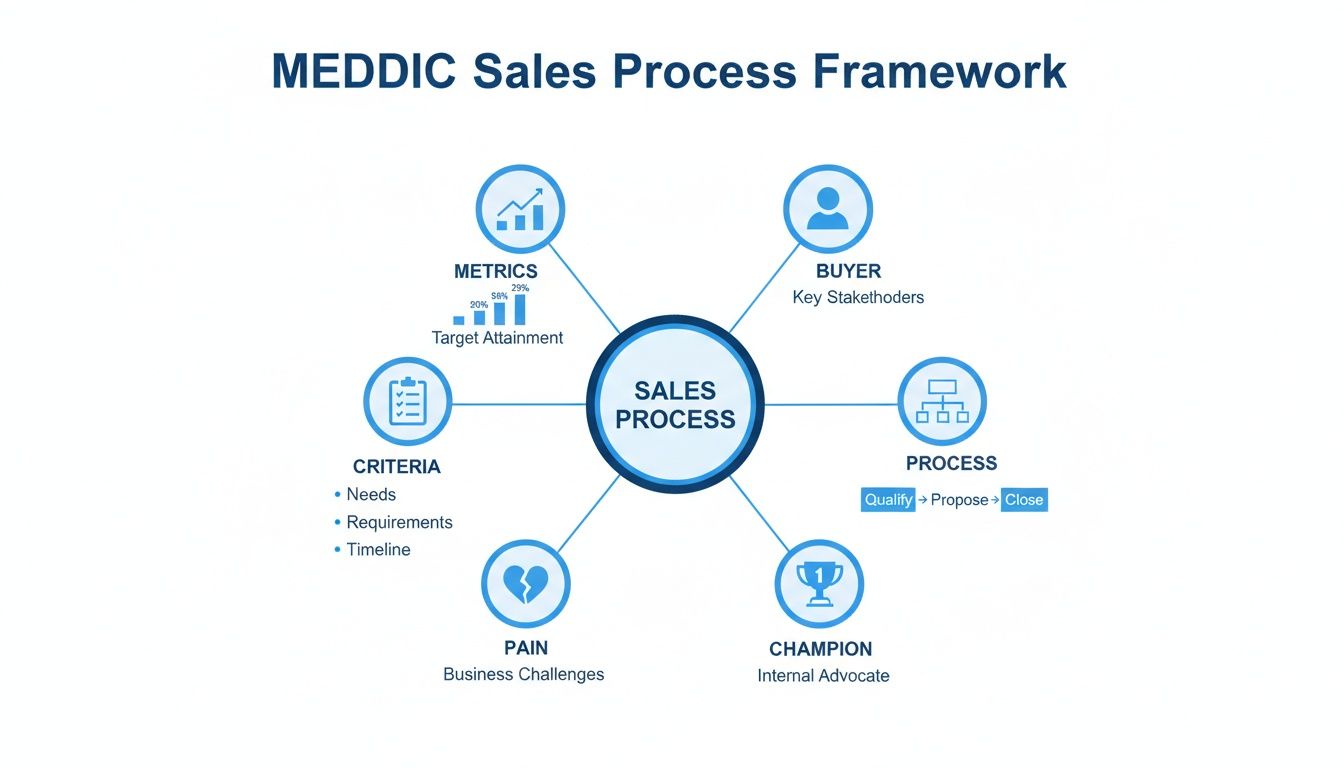
It shows how a strong sales process uses interconnected intelligence from each MEDDIC element to produce a predictable outcome.
Metrics: The Quantifiable Value
Metrics are the "so what?" behind your solution. They translate your customer's pain into numbers. This is not about features. It is about measurable economic impact.
Without metrics, you sell a "nice-to-have." With them, you sell a strategic investment with a clear ROI. The goal is to build these metrics with your prospect.
Ask questions that force them to quantify the problem:
"If we could reduce X by 15%, what would that mean for your annual budget?"
"What is the one KPI you are responsible for improving this year?"
"How do you measure the cost of this problem today?"
This shifts the conversation from vague benefits to concrete business outcomes. That is the language the Economic Buyer speaks.
Economic Buyer: The Person with Veto Power
The Economic Buyer is the single individual with the ultimate authority to say "yes" or "no" to the purchase. They might not be the end-user. They own the budget and can move funds for your specific project.
Identifying this person early is critical. Do not assume a senior title equals Economic Buyer. The real test is their control over funds for this specific purchase. Your Champion can help you identify and meet this person.
The Economic Buyer focuses on strategic impact. Your conversations with them must center on the Metrics you defined, not product features. You have to prove your solution aligns with their business objectives.
Decision Criteria: The Rules of the Game
Every company has rules for choosing a new vendor. These are the Decision Criteria. They are the specific requirements your solution must meet to be considered.
These criteria usually fall into a few categories:
Technical: "It must integrate with our CRM."
Commercial: "The vendor must offer flexible payment terms."
Vendor-related: "They need to have case studies in our industry."
Your job is to uncover this scorecard. If a prospect lacks clear criteria, help them build it. Align it with your solution's strengths. Trying to win a deal without knowing the criteria is like playing a game without knowing how to score.
Decision Process: The Path to a Signature
The Decision Process is the step-by-step roadmap of how the organization buys. It outlines the stages, approvals, and people involved from now until a signed contract. A vague understanding here is a common reason deals slip.
You need to map this out precisely. Ask your contacts to walk you through a similar, recent purchase. Key stages often include technical review, legal review, and final sign-off from the Economic Buyer. Knowing this timeline lets you manage the deal proactively.
The impact is clear. In Brazil's medical technology market, projected to hit R$80 billion in 2025, this is a game-changer. A report showed B2B teams selling diagnostic imaging devices improved forecast accuracy by 42% using MEDDIC. Teams that mapped the Decision Criteria and Process closed 31% larger contracts, averaging R$2.5 million. You can find more findings at peq42.com.
Identify Pain: The Reason to Change
Pain is the compelling business reason that forces an organization to act. It's that simple. No pain, no urgency. No urgency, no deal. The key is to draw a straight line from your solution to solving a critical business problem.
A good sales rep uncovers a technical problem. A great rep links that problem to a business pain with a metric attached. Always ask: what happens if they do nothing? If the answer is "not much," you do not have a real opportunity.
Champion: The Internal Seller
Your Champion is your advocate inside the customer’s organization. This person has a personal interest in your solution's success. They have the influence to sell for you when you are not in the room.
A true Champion is more than a friendly contact. You must test them. Ask for something that requires effort, like setting up a meeting with the Economic Buyer. Their willingness and ability to deliver proves their commitment. Nurturing this relationship is one of the most important actions you can take to de-risk a deal.
Implementing a new sales methodology can feel disruptive. The stakes are high. You do not want to break your team's rhythm or hurt the pipeline. Integrating MEDDIC does not have to be chaotic.
A phased approach helps get everyone on board without stopping work. The key is to position MEDDIC not as more admin, but as a tool reps can use to win bigger deals. Show them how it helps them focus on what matters and increase their commissions.
Start with Practical Training
First, build understanding. Your initial training cannot be a dry lecture on the six letters of MEDDIC. That will make your team tune out.
Instead, run a hands-on workshop. Use real, anonymized deals from your CRM—a mix of wins and losses. Walk through them using the MEDDIC framework. Get the team talking:
"On that deal we lost, who was the real Economic Buyer? Did we ever talk to them?"
"Remember that big win? What were the Metrics that made our solution a must-have?"
"Was Sarah a true Champion on that stalled deal, or just a friendly contact?"
This exercise makes the framework tangible. It connects MEDDIC to their daily work. It shows them how it could have helped spot a bad deal early or win a good one faster.
A successful MEDDIC implementation is not about giving reps more work. It is about making their existing work more impactful. Frame it as a system for focusing their energy on deals with the highest probability of closing.
Getting this framing right is essential to win over veteran reps who are skeptical of new processes.
Build MEDDIC into Your CRM
For a new methodology to stick, it must live where your team works: the CRM. If you expect reps to track MEDDIC in spreadsheets, the initiative will fail. Your RevOps or Sales Ops team is your key partner here.
Their job is to build the MEDDIC framework into your opportunity records in platforms like Salesforce or HubSpot. This means creating custom fields for each of the six components. Think dedicated text boxes for "Economic Buyer," "Decision Criteria," and "Champion Test."
Once the fields exist, make the information visual and actionable. This leads to the MEDDIC scorecard. It gives an at-a-glance, quantifiable view of deal health. It shifts your pipeline reviews from gut feelings to data-backed analysis.
Here is a simple scorecard template you can build into your CRM. Reps score each component from 0 (know nothing) to 2 (validated and confirmed). This gives them a clear map of where the gaps are.
MEDDIC Opportunity Scorecard Template
MEDDIC Component | Score (0-2) | Evidence/Notes |
|---|---|---|
Metrics | 1 | They mentioned "improving team output," but I lack hard numbers. Next step: quantify the cost of their current workflow on our next call. |
Economic Buyer | 0 | I do not know who controls the budget. My contact is the Director of Marketing. I need to ask her for an intro to the CMO. |
Decision Criteria | 2 | They confirmed they need a solution that integrates with their tech stack, offers 24/7 support, and is SOC 2 compliant. We meet all three. |
Decision Process | 1 | I know a "technical review" and "legal sign-off" are involved, but the timeline and players are fuzzy. I need to map this out with my Champion. |
Identify Pain | 2 | Their current process wastes 40 hours of manual work per week, causing reporting delays that lost a client last quarter. The pain is real. |
Champion | 1 | The Marketing Director likes our solution and gives me info, but I haven't tested if she can get me a meeting with the CMO. The test is asking for that meeting. |
Total Score | 7/12 | This deal has strong pain and clear criteria, but we're blind on the Economic Buyer and Decision Process. Those are my focus areas for next week. |
A scorecard like this changes the conversation in pipeline meetings. Instead of a manager asking, "How do you feel about this one?" they can ask, "Why is the Economic Buyer a zero? What is our plan to get that to a two by Friday?" It makes coaching specific, actionable, and data-driven. It builds a culture of rigorous qualification.
Real-World MEDDIC Playbooks for SaaS Sales
Theory is one thing; execution closes deals. The MEDDIC sales methodology is a practical playbook that works best in your daily sales conversations. It provides a reliable framework for digging up the information you need to qualify and win deals.
Let's walk through two common B2B SaaS scenarios: a high-velocity sale and a complex enterprise deal. These playbooks show how an Account Executive uses MEDDIC to guide actions, ask the right questions, and build a case for their solution.
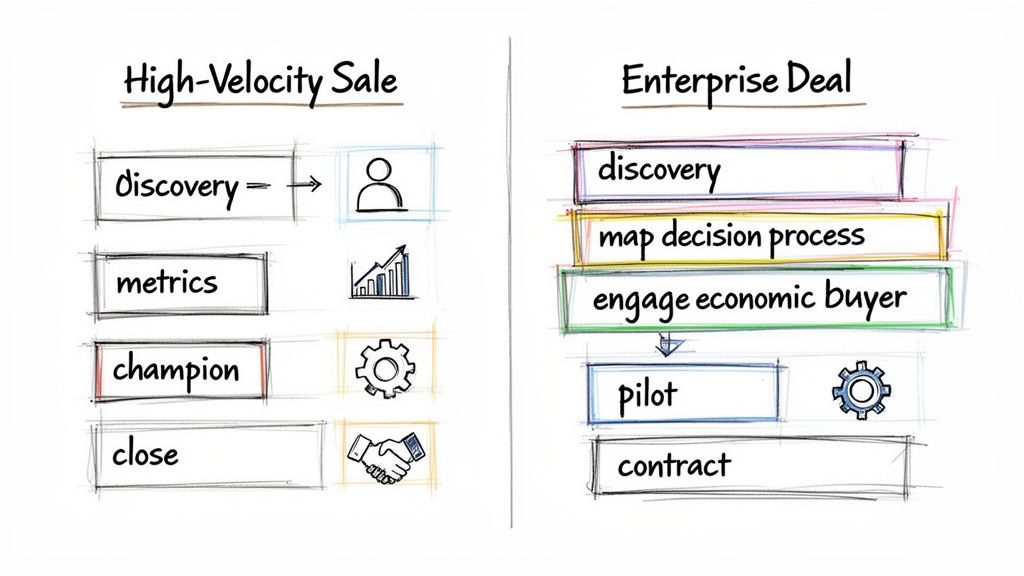
The game changes based on deal size. The core MEDDIC principles apply, but your focus and depth shift based on the complexity.
Playbook 1: The High-Velocity SaaS Sale
You sell a project management tool for R$25,000 per year. The sales cycle is under 45 days. Your job is to qualify efficiently and stop wasting time on prospects who will not buy.
In this sale, focus on Pain, Metrics, and the Economic Buyer. The Decision Process is usually simple, so you do not need to spend as much energy mapping every step.
Discovery & Qualification Questions
Identify Pain: "What is the biggest bottleneck in your projects right now? What are the consequences when a deadline slips?"
Metrics: "How many hours a week do your team leads lose to manual updates? If you reclaimed 10 hours for each, what is that worth to the business?"
Economic Buyer: "Who normally signs off on software purchases of this size? Is that you, or does your VP need to approve the budget?"
Your first contact is likely a Project Manager. They feel the Pain daily. Your job is to arm them with a business case built on hard Metrics (like "saving 40 hours a week"). This is the language that gets the Economic Buyer, likely a Director or VP, to pay attention.
The secret to high-velocity sales is speed to qualification. If a prospect cannot explain their problem or quantify its impact, that is a red flag. Disqualify and move on.
Once you have a clear pain point and a compelling metric, test your contact's influence. Can they be your Champion? A simple test: ask them to forward your business case to the decision-maker. How they respond tells you everything about the deal's chances.
Playbook 2: The Complex Enterprise Deal
Now, switch gears. You are working on a large enterprise deal for a data analytics platform costing R$1,000,000 a year. The sales cycle is 9-12 months, with multiple departments and a formal procurement process. Here, every element of the MEDDIC sales methodology is critical.
A methodical approach pays off. Brazil's medical device market is forecast to hit USD 20.8 billion by 2034. A 2025 survey showed sales teams using MEDDIC had a 29% increase in deal velocity. Their reps qualified 52% more opportunities by turning customer pain points into measurable Metrics, like R$500k in annual savings. You can find more market insights on kenresearch.com.
Deep Discovery & Validation Questions
Your discovery will be a series of conversations with different stakeholders. You must go deep and validate every piece of the puzzle.
Decision Process: "Can you walk me through the approval process for a similar purchase your company made last year? Who was involved in technical validation, security review, and legal sign-off?"
Decision Criteria: "As your team evaluates platforms, what are the top three 'must-have' capabilities you will look for? How will you score vendors against that list?"
Economic Buyer: "Who owns the P&L for the business outcome this project is meant to achieve? Who can approve a seven-figure investment like this?"
Champion: Testing your Champion here requires a bigger ask: "To ensure we are aligned on business value, could you get 30 minutes on the CFO's calendar for us to review the ROI model together?"
Your initial contact might be a Director of Analytics. They are invested, but they are not the Economic Buyer (who is likely a C-level executive). They also may not know the full procurement process. Your Champion becomes your internal guide. They help you map the organization, meet key players, and understand the Decision Criteria.
By methodically uncovering and validating each piece of information, you become a trusted advisor. You are not just selling; you are guiding the customer through their own buying journey. This structured approach makes the MEDDIC sales methodology a powerful tool for winning the strategic accounts that define a company's success.
Let AI Handle the Heavy Lifting in Your MEDDIC Workflows
Let's be direct. Even disciplined sales teams struggle with the manual work of MEDDIC. A rep can have a great call and uncover key information, but much of that detail gets lost before it reaches the CRM. This is the biggest weakness in most MEDDIC implementations.
Modern AI sales tools solve this problem. They are designed to turn unstructured conversations into organized MEDDIC insights. They do it without adding to your team's workload. The result is a sales process built on evidence, not guesswork.
Think of it as giving your reps a dedicated assistant. The AI handles the admin, freeing your sellers to build relationships and close deals.
How Does AI Actually Automate MEDDIC?
The process is simple but powerful. An AI assistant, like Samskit, joins your sales calls on platforms like Zoom or Google Meet. It records, transcribes, and analyzes the entire conversation.
Reps no longer spend hours reviewing recordings or trying to recall details. The AI does it for them. It automatically identifies the moments and phrases that map directly to your MEDDIC sales methodology.
Suddenly, MEDDIC components become concrete data points:
Metrics: The AI hears a prospect say, “We need to boost our production efficiency by 20%,” and flags it as a Metric.
Economic Buyer: A contact mentions, “I’ll need to get the CFO’s final sign-off,” and the AI flags a potential Economic Buyer.
Decision Process: A phrase like, “First, our legal team reviews it, and then it goes to procurement,” is logged as a step in the Decision Process.
All this information is then structured and ready to use.
Closing the Loop: From Conversation to CRM
The real impact comes next. Instead of reps manually typing notes, AI tools can automatically push this structured data into the custom MEDDIC fields in your CRM. You get a single source of truth for every deal, built on what the customer actually said.
This screenshot shows how Samskit organizes these insights, providing a clear dashboard with product features and call highlights.
This clean layout means managers and reps can understand a deal in seconds. Deal reviews become faster and more strategic because you are no longer digging through transcripts.
By capturing the truth from every call, you stop relying on "gut feelings." Pipeline reviews become evidence-based strategy sessions, leading to better forecasts and more impactful coaching.
This automated workflow ensures your MEDDIC framework is used consistently on every deal. It eliminates the data entry that tempts reps to cut corners. For teams looking to maximize efficiency, understanding how a sales assistant can act as a dream team bot is a game-changer.
Ultimately, automation turns the MEDDIC sales methodology from a checklist into a core part of your company’s workflow. It gives your team the real-time data they need to qualify with rigor, forecast with confidence, and spend more time selling.
Common MEDDIC Traps and How to Sidestep Them
Let's be clear. Even the best framework can fail with a poor rollout. I have seen teams get excited about the MEDDIC sales methodology, only to make common mistakes that turn a great tool into another checklist. To make MEDDIC work for you, you need to know these traps.
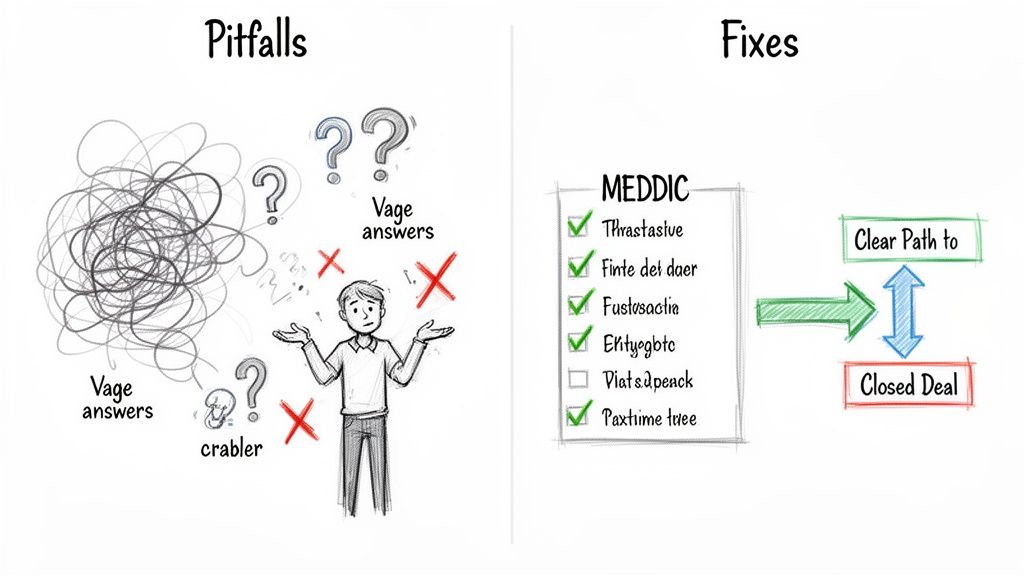
The biggest mistake is turning discovery into an interrogation. A rep, armed with new acronyms, fires off robotic questions to fill boxes in the CRM. This kills rapport and makes the prospect defensive.
Confusing Friendly Contacts with True Champions
This one is critical. It is easy to mistake a friendly contact for a real Champion. Someone liking your product is great, but it does not make them a Champion. Not unless they have influence and are willing to use their political capital for you.
A real Champion has a personal stake in your success and knows how to navigate their company's internal politics.
Before (The Trap): You accept your contact's positive words. You never ask them to do anything that tests their influence.
After (The Right Way): You test them. Gently but firmly. Ask for an introduction to the Economic Buyer. See if they can get you on the agenda for a key meeting. Their ability to deliver is the only proof that matters.
A Champion is rarely found; they are developed and tested. If your contact cannot get you access to power, they are a well-wisher, not an advocate. Knowing the difference changes your forecast accuracy.
Accepting Fuzzy Answers on Process and Metrics
Many deals die slowly because reps accept vague answers. When a prospect says, "We need to improve efficiency," that is not a Metric. It's a wish. When they say, "It just goes through a few approvals," that is not a Decision Process; it is a brush-off.
Digging for specifics is not pushy; it is professional. You cannot build a credible business case or forecast accurately without concrete details.
Decision Process Before: Your contact says, "Legal and security will look at it." You nod and update your CRM with a note like "Legal/Security Review."
Decision Process After: You lean in and ask, "That's helpful. To be prepared, can you walk me through what that looked like for a similar software purchase? Who drives that legal review, and what are their typical concerns?"
See the difference? That conversational pivot turns a vague statement into a tangible roadmap.
By sidestepping these common pitfalls, you can elevate your use of the MEDDIC sales methodology. It stops being a rigid set of rules and becomes what it was meant to be: a flexible, dynamic tool for closing complex deals.
Got Questions About MEDDIC? We've Got Answers.
When sales teams explore MEDDIC, a few common questions always come up. Let's tackle them with direct, practical advice.
How Is MEDDIC Different From BANT or Challenger?
Think of BANT (Budget, Authority, Need, Timing) as a quick, first-pass filter. It is a simple checklist. MEDDIC is a deep-dive diagnostic toolkit for complex B2B sales. It is less about if they can buy and more about how they decide.
Challenger is about how you sell—by teaching, tailoring your message, and taking control. MEDDIC is about what you need to know to win the deal. The two work well together. You can use the Challenger approach to challenge a prospect, which helps you uncover the information needed to fill out your MEDDIC scorecard.
Is MEDDIC Overkill for Smaller, Faster Deals?
No, but you have to be smart. For smaller, transactional sales, you do not need the full, in-depth MEDDIC playbook. A 'MEDDIC-lite' version is effective. You likely do not need to map a ten-step decision process.
But you absolutely still need to confirm the Economic Buyer and what core Pain you're solving (and its Metrics). The key is to apply the framework in proportion to the deal's size and complexity. This keeps your qualification sharp without slowing down a fast-moving sale.
The biggest mistake is treating MEDDIC like a form to fill out on the first call. It is an ongoing discovery process, not a script.
You gather this intelligence over time, across multiple conversations. You don't just find a Champion; you develop and test that relationship. Use MEDDIC as your strategic compass throughout the sales cycle. It guides you to build the trust needed to uncover what is really happening behind the scenes.
Stop chasing context and start closing deals. Samskit turns your sales calls into reliable CRM updates and clear next steps, automating MEDDIC data capture so your team can focus on selling. See how it works at https://samskit.com.